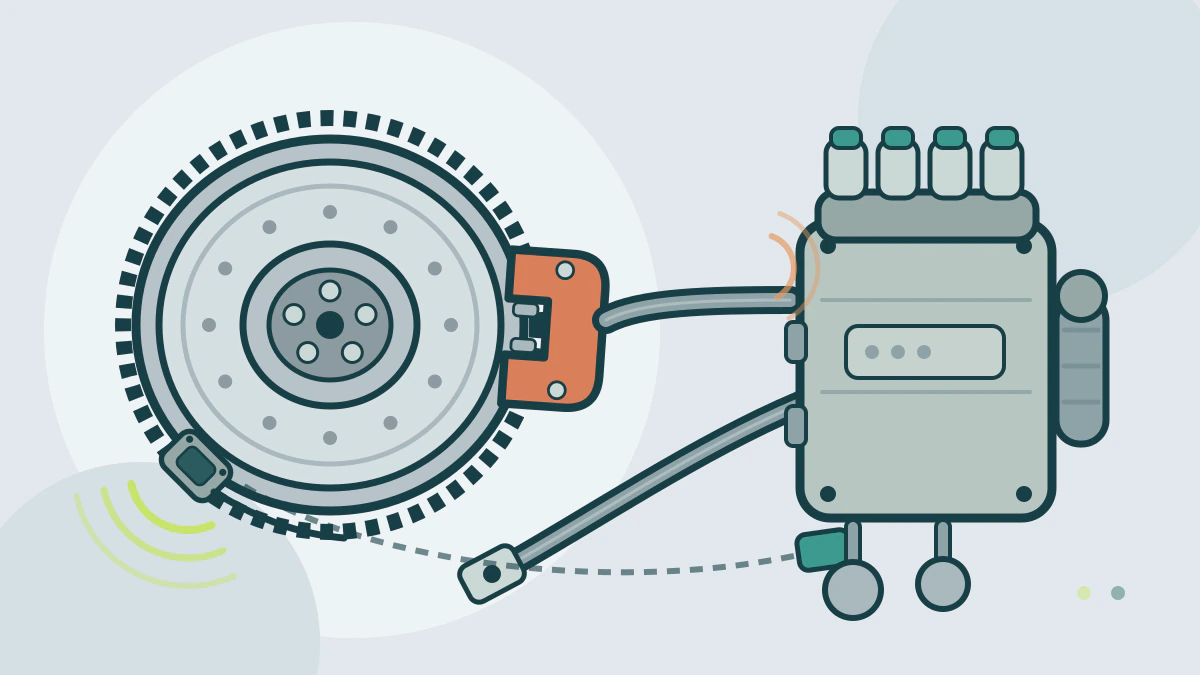
ABS reads wheel speed, compares it with the car's motion and pulses brake pressure at each wheel to keep the tires rolling and steering alive.
What is ABS actually controlling?
ABS controls the amount of slip between each tire and the road during braking, rather than simply sending maximum pressure to the brakes. Federal rule FMVSS 135 defines it as a portion of the service brake system that automatically controls the degree of rotational wheel slip while braking (49 CFR 571.135).
The rule defines wheel lockup as 100 percent wheel slip. A locked tire is sliding, not rolling, and ABS works to stop that or end it quickly.
The ABS glossary entry covers the letters and dashboard lamp; the history of anti-lock brakes covers the engineering timeline.
The parts that make the control loop
A typical light-vehicle system measures wheel speed, decides what is happening and changes hydraulic pressure.
| Part | What it does | What a failure can look like |
|---|---|---|
| Wheel-speed sensor | Measures how fast each wheel turns | Missing or erratic speed signal at one wheel |
| Electronic control unit | Compares wheel speeds and decides when slip is too high | Stored fault code and a lit ABS lamp |
| Hydraulic modulator valves | Hold, release or reapply pressure at a wheel | A wheel that locks or a brake that drags |
| Return pump and accumulator | Moves fluid back so pressure can be reduced and reapplied | Weak or delayed pressure recovery |
Bosch describes the hydraulic unit as the central part of the system. It contains pressure-control valves for each wheel, a return pump and the electronic control unit. Each wheel has a speed sensor that sends its signal to the control unit (Bosch).
Some systems control only the two rear wheels, while others control all four (NHTSA). Four-wheel systems generally provide better stability and control.
From a speed signal to a pressure pulse
The control unit watches each wheel and compares it with the others and with the vehicle’s rate of deceleration. When one wheel slows much faster than the rest, the unit reads that as a sign that the tire is about to lock.
It commands the modulator to reduce pressure at that wheel. If the wheel starts turning again, pressure is reapplied. If it slows again, the cycle repeats.
Bosch says the system can reduce and increase brake pressure up to 40 times a second. A 1996 NHTSA fact sheet put the figure at as many as 15 times a second for the systems of that era. The exact rate matters less than the fact that the system cycles faster than a driver can.
The pressure change is local. The modulator can adjust one wheel without releasing the other three. That is why the car can brake hard and still be steered, and the pedal may pulse.
Why a rolling wheel can still steer
A tire produces force in more than one direction. It can slow the car through longitudinal grip and resist sideways motion through lateral grip. A tire that is locked and sliding has lost most of its ability to generate lateral force.
That is why a locked front wheel cannot respond to steering input. The driver can turn the wheel, but the tire is not rolling, so the car continues in the direction of the slide. ABS releases enough pressure to keep the tire turning.
The benefit is control, not a guarantee of a shorter stop. The Georgia Department of Driver Services states that ABS does not necessarily shorten stopping distance, though it helps the driver keep the vehicle under control during hard braking (Georgia DDS).
ABS, stability control and brake distribution share hardware
ABS is a braking function within the Automotive Mechanical Systems hub. Electronic stability control uses wheel-speed sensors, steering angle, yaw rate and lateral acceleration to correct a skid.
The two often share the same hydraulic unit and sensors, which is why they are easy to confuse. The ABS versus stability control comparison sets out the difference.
What the driver should do when ABS operates
Press the brake pedal firmly and keep pressing. NHTSA’s fact sheet tells drivers to expect a pulsing pedal and to continue applying the pressure the situation requires. Do not pump the pedal, because pumping can reduce the system’s effectiveness.
A brief lamp check at start-up is normal. FMVSS 135 requires the ABS indicator to activate as a check when the ignition is turned on, and to activate on an electrical failure in the antilock system.
If the lamp stays on, the car usually keeps ordinary hydraulic brakes. Have the system diagnosed with the manufacturer’s procedure; the ABS warning light guide covers the common causes.
What ABS cannot do
ABS cannot add grip that the tires do not have. Worn tires, standing water, ice, sand or a heavy load can still overwhelm the available traction. It also cannot replace safe speed or following distance, and it does not apply the brakes by itself.
Automatic emergency braking is a separate driver-assistance function. ABS waits for the driver to brake, then manages the pressure.
Frequently asked questions
Does ABS shorten every stop?
No. It is designed to prevent wheel lock and preserve steering control. On some surfaces the controlled slip may produce a shorter stop than a locked wheel, but the result depends on tires, surface and speed.
Should I pump the brake pedal in a car with ABS?
No. Apply steady, firm pressure and let the system cycle the valves. Pumping interferes with the pressure control the system is trying to maintain.
Can I turn ABS off?
On vehicles covered by FMVSS 135, a control that lets the driver manually disable ABS is prohibited. If a driving mode changes traction or stability settings, read the owner’s manual to see what it changes.
Why does the ABS light stay on after start-up?
The lamp should go out after its check. If it stays on, the system has recorded a fault, such as a bad wheel-speed signal, a hydraulic problem or a control-unit error. The car may still have normal brakes, but the antilock function should be diagnosed.