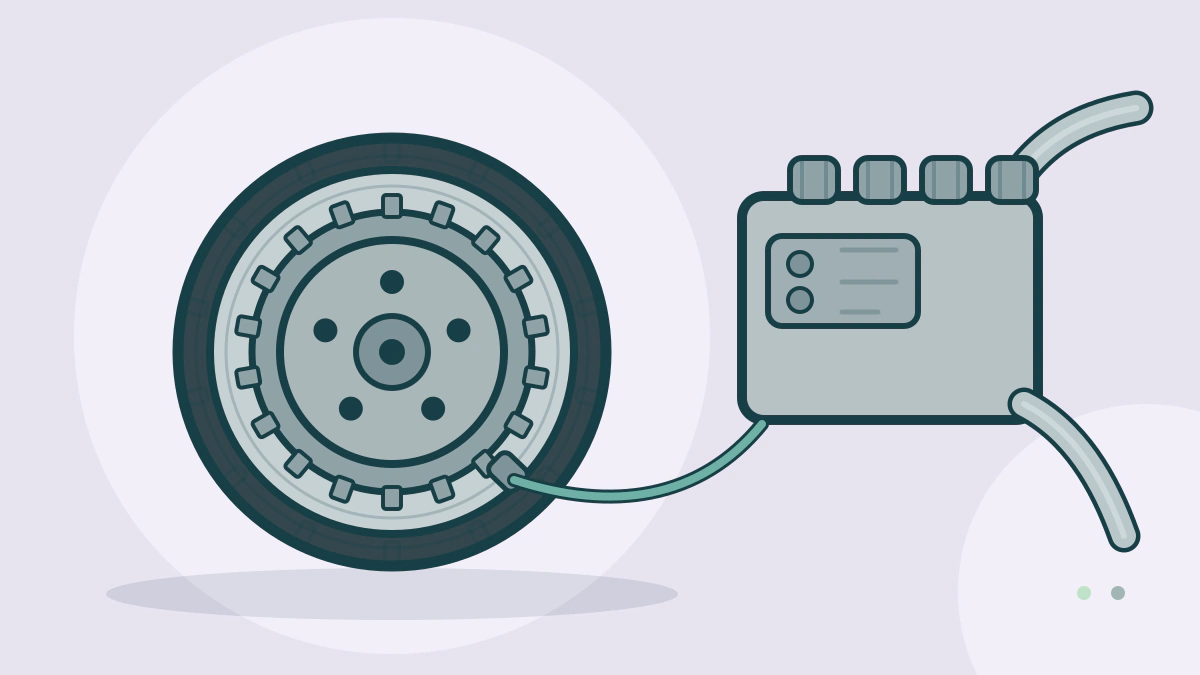
ABS stands for anti-lock braking system. Learn what the letters mean, what the federal rule requires and when the dashboard light matters.
What does ABS stand for?
ABS stands for anti-lock braking system, also written antilock braking system. The letters appear on dashboard warning lights, window stickers and service invoices.
Federal rule FMVSS No. 135 defines it as “a portion of a service brake system that automatically controls the degree of rotational wheel slip during braking” (49 CFR 571.135). That definition is the most precise one available to a US buyer.
Three steps make up the definition. The system senses how fast each wheel turns. It sends those signals to a control device. The control device signals modulator devices that adjust brake force at the wheels.
How ABS controls wheel slip
A rolling tire produces braking force and helps stabilize the car. When brake force exceeds available grip, the tire starts to slide and the wheel can lock. NHTSA’s explanation of the definition describes the sequence in those terms (NHTSA).
ABS reduces brake pressure to stop or limit that lockup. It then reapplies pressure as the wheel turns again. The aim is controlled slip rather than a locked wheel.
That matters most for steering. A locked front wheel cannot respond to steering input, so the driver loses the ability to steer around a hazard while braking hard. Keeping the wheel turning keeps that option open.
What federal rule FMVSS 135 requires
FMVSS 135 applies to passenger cars and to light multipurpose vehicles, trucks and buses up to 7,716 pounds GVWR (49 CFR 571.135). It sets performance rules, not a parts list.
| Requirement | What the rule says |
|---|---|
| Warning indicator | A brake system warning indicator must activate on any electrical functional failure in an antilock system |
| Start-up check | Indicators must activate as a check when the ignition goes to on or run |
| No disable switch | A control that lets the driver manually disable ABS, fully or partially, is prohibited |
| Failed-system braking | With a single functional failure in the ABS, the service brakes must still stop the vehicle within 85 m (279 ft) from 100 km/h |
The table shows the intent. A fault must be visible to the driver, and a broken ABS must not take the ordinary brakes with it.
The standard sets requirements for vehicles that have ABS rather than stating a universal fitment mandate. Confirm a particular used car by looking for the lamp at start-up and reading the manual section on brakes.
Why the letters matter on the dashboard
The ABS lamp is the system’s main way to tell you it has recorded a fault. FMVSS 135 requires the brake warning indicator to activate on an electrical failure in the antilock system.
Expect a brief check at start-up. The rule requires indicators to activate as a check when the ignition is turned on.
A lamp that stays lit is a fault report, not a maintenance reminder. The car usually keeps normal hydraulic brakes, because the failed-system test requires them to keep working. That does not make a lit lamp safe to ignore.
What the lamp cannot tell you is which part failed. Diagnosis needs a scan tool and a test drive. A shop should give a written estimate before work begins, as the FTC advises (FTC).
ABS and the brake warning light are different
Two lamps can appear on the same cluster. One is the ABS lamp. The other is the brake system lamp, often a circle with an exclamation mark or the word BRAKE.
Treat them differently. An ABS lamp alone points to the antilock system. A brake lamp can point to low fluid, a parking brake left on or a hydraulic fault.
If both are lit, stop safely and check the owner’s manual before driving further. The ABS warning light guide covers the possible causes in more detail.
A soft or long pedal is a different symptom with a different list of causes. The guide to a soft or spongy brake pedal explains why that complaint sits outside the ABS lamp’s job.
Common confusions about ABS
- ABS is not a guarantee of a shorter stop. It controls wheel slip; grip still comes from the tires and the road surface.
- ABS is not stability control. Stability control is a separate function, even when the two share sensors and a hydraulic unit.
- ABS is not automatic braking. It modulates pressure while the driver brakes; it does not apply the brakes for you.
- The letters mean something else elsewhere. In materials, ABS is a plastic. On a parts site, read the description rather than the acronym.
Other safety and diagnostic abbreviations, such as TPMS and the lamps on the cluster, are collected in the Automotive Glossary.
Frequently asked questions
Is ABS the same as anti-lock brakes?
Yes. ABS is the abbreviation for anti-lock braking system, and US sources also spell it antilock. A dashboard label may read ABS or Antilock. Both refer to the same system.
Do all new cars have ABS?
FMVSS 135 sets equipment and performance requirements for light vehicles that have ABS. It does not read as a universal fitment mandate. To confirm a specific vehicle, check the window sticker, watch for the lamp at start-up or read the owner’s manual.
Can the driver switch ABS off?
On vehicles covered by FMVSS 135, no. The rule prohibits a control that lets the driver manually disable ABS, fully or partially. Any mode button in the car should be read in the manual for what it actually changes.
What happens if the ABS fails?
The service brakes must still stop the vehicle within the distance set in FMVSS 135, and the warning lamp should light. Treat the car as having ordinary brakes without antilock assistance and have it checked.
Bottom line: ABS stands for anti-lock braking system, a system that manages wheel slip so the tires keep rolling. The dashboard lamp reports its faults, and the ordinary brakes remain as a fallback.