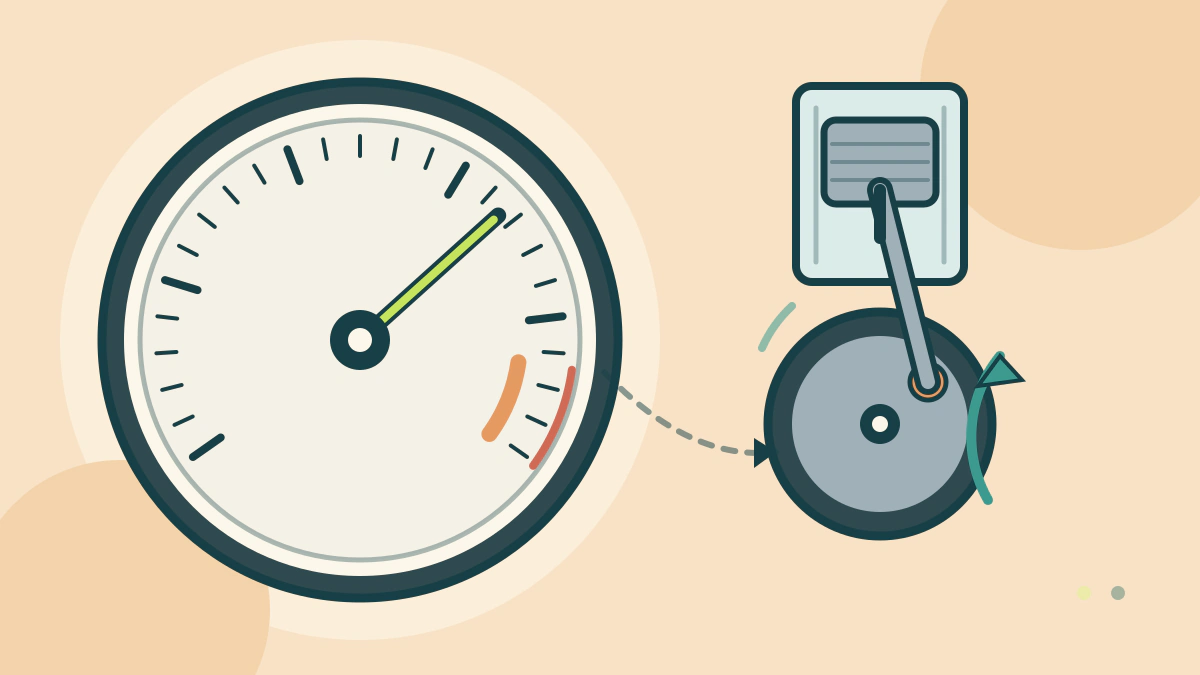
RPM means revolutions per minute. Learn what the number measures, how to read a tachometer, why engine speed differs from road speed and what a redline is.
What does rpm mean in a car?
RPM stands for revolutions per minute. It counts how many complete turns a rotating part makes in one minute, and in a car the number usually refers to the engine’s crankshaft speed. An engine turning at 3,000 rpm completes 3,000 crankshaft revolutions every minute.
RPM is one of the engine and power terms in the Automotive Glossary, and the crankshaft is the shaft that the pistons turn. The Department of Energy’s vehicle technologies office describes the sequence: burning fuel expands, the expanding gases push a piston, and the piston rotates the crankshaft. A system of gears in the powertrain then sends that motion to the wheels (DOE).
RPM measures rotational speed, not distance or power.
Where engine rpm comes from
A four-stroke gasoline engine completes its work in four piston movements: intake, compression, power and exhaust (NASA Glenn). DOE notes that most internal combustion engines in production are four-stroke cycle engines (DOE). The crankshaft keeps rotating through all four strokes, so its speed is a useful summary of how hard the engine is working.
The four-stroke engine guide walks through each stroke and the parts involved. For this term, the key point is that rpm describes rotation, while the pistons move in a straight line and the valves open and close on a separate schedule.
The useful range differs by engine design; the tachometer and owner’s manual show where it sits.
What the tachometer shows
A tachometer is the dashboard gauge that displays engine speed. Cars with a manual transmission usually have one because the driver needs it to shift; many automatics show it, and some hybrids and EVs omit it.
Your owner’s manual’s gauge section identifies the tachometer and explains any markings on it. The red zone, where it exists, marks the upper engine speed the manufacturer sets for that model. A number from another car is not your limit.
Some engines limit rpm electronically; your owner’s manual or service information says whether yours does and at what point.
Why engine rpm is not road speed
The same engine speed can produce very different road speeds in different gears. In first gear, 3,000 rpm might mean a slow crawl; in top gear, the same 3,000 rpm can be a highway cruising speed. The transmission and final drive ratio set the relationship.
That is why a car with a lower final-drive ratio turns more rpm at highway speed than an otherwise identical car with a taller ratio. It is also why a continuously variable transmission can hold engine speed steady while road speed rises. The manual transmission guide covers how a driver chooses a gear for the speed and load at hand.
Why specifications pair power with an rpm
An engine does not produce one fixed power figure at every speed. Power is the rate at which work is done, so it depends on both the torque the engine makes and how fast it turns. Manufacturers quote peak torque and peak power at particular engine speeds because those peaks occur at different points.
That is why a specification sheet pairs a power number with an engine speed instead of listing horsepower alone. The shape of the curve between idle and the redline explains why one car feels strong at low rpm and another needs to be revved. The horsepower versus torque guide explains how to read those figures without treating a single peak as the whole story.
Does rpm matter in an electric car?
Yes, but the number describes a different machine. A battery-electric car has an electric motor instead of an internal combustion engine, and a transmission that sends the motor’s power to the wheels (AFDC). The motor still spins, and its speed is still measured in revolutions per minute.
Many EVs do not show a tachometer because the driver does not shift gears. The motor’s speed rises and falls with road speed, and the control software manages the power delivery.
| Term | What it describes | Where a driver meets it |
|---|---|---|
| RPM | Crankshaft or motor revolutions per minute | Tachometer, scan data, specification sheets |
| Redline | The upper engine speed marked by the manufacturer | Tachometer red zone, owner’s manual |
| Idle speed | Engine speed with the throttle closed | Tachometer while stopped |
| Torque | Twisting force delivered by the engine | Specification sheets, acceleration feel |
| Horsepower | Rate at which the engine does work | Specification sheets, top-speed potential |
Frequently asked questions
Is rpm the same as horsepower?
No. RPM measures rotational speed, while horsepower measures the rate at which work is done. The two are related because an engine’s power depends on torque and engine speed, but a high-revving engine and a low-revving engine can make similar peak power. Compare the full specification, including the rpm at which each peak occurs.
Can I drive at high rpm all the time?
The engine is designed to operate across a range, and normal driving does not require holding it near the maximum. The owner’s manual gives the limits and any break-in guidance for your car.
Why does rpm drop when I lift off the throttle?
Closing the throttle reduces the air and fuel entering the engine, so it produces less power and the crankshaft slows. An automatic transmission may also upshift to save fuel. A brief rise in rpm during a downshift is normal, but rpm that flares without a matching gear change can point to a clutch or transmission issue.
Do electric cars have rpm?
Yes. An electric motor also rotates, and its speed can be expressed in revolutions per minute. The motor speed still changes with road speed and is managed by the vehicle’s control software.