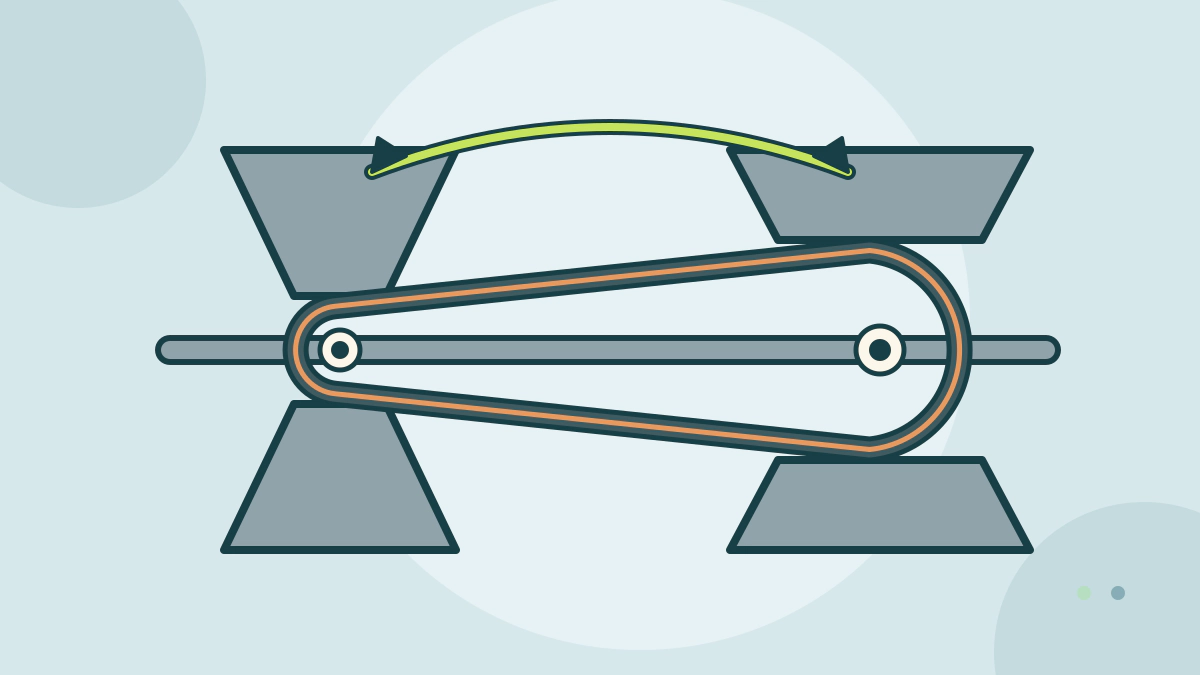
CVT stands for continuously variable transmission: a stepless automatic that uses two variable pulleys and a belt or chain instead of a fixed set of gears.
What does CVT stand for?
CVT stands for continuously variable transmission. It is an automatic transmission that changes the ratio between engine speed and wheel speed across a continuous range instead of stepping through a fixed set of gears. The DOE and EPA fuel economy site describes the common layout as a pair of variable-diameter pulleys connected by a belt or chain.
The name describes the behaviour, not a single design. Different manufacturers build the parts differently, but the defining idea is the same: no fixed steps between the lowest and highest ratio.
How the pulleys change ratio
A conventional transmission uses a fixed number of gear ratios, so the engine and the wheels can only be connected in a limited number of relationships. A pulley CVT replaces those steps with two pulleys whose effective diameter changes as they move.
Nissan’s explanation of its XTRONIC CVT describes the mechanism plainly. The transmission adjusts the width of two pulleys, which changes the arc radius of the steel belt running between them. When the engine-side pulley narrows, the belt sits at a smaller radius and the car gets a low ratio for moving off. When that pulley widens, the belt moves outward and the ratio becomes tall for cruising.
Because the pulleys move through intermediate positions, the ratio changes without a defined shift point. The DOE and EPA page calls the result an infinite number of engine-to-wheel speed ratios.
CVT compared with a geared automatic
| Feature | CVT with a belt or chain | Conventional automatic |
|---|---|---|
| Ratio selection | Continuous range between the extremes | Fixed number of ratios |
| Main parts | Two variable pulleys plus a belt or chain | Fixed gears and control elements |
| Driver sensation | No distinct steps during acceleration | Distinct gear changes |
| Efficiency | DOE lists a potential 3% to 4% gain | Depends on gear count and design |
| Service reference | Owner’s manual for that model year | Owner’s manual for that model year |
The efficiency figure is a technology estimate, not a promise for a specific car. The DOE and EPA page lists it as a potential improvement and notes that the benefit depends on the vehicle and how it is driven.
Why manufacturers use them
The DOE and EPA page lists three advantages: seamless acceleration without the jerk of changing gears, less frequent downshifting or gear hunting on hills, and better fuel efficiency. It also notes that the fuel benefit is larger in stop-and-go driving than at a steady highway speed.
Nissan makes a related point. A CVT can hold the engine at an efficient speed for a given road speed instead of waiting for a gear change, and a wider ratio range lets the same transmission serve both low-speed acceleration and relaxed high-speed cruising.
What the driver notices
Acceleration in a CVT car can sound different from a geared automatic. The engine may rise to a speed and stay there while the car gathers pace, because the transmission is changing ratio rather than stepping to the next gear. That steady note is a normal characteristic of the layout.
Some drivers describe the feel as smooth and others as disconnected. Both descriptions fit the same behaviour. The important question for a buyer is whether the car’s calibration suits the roads and driving style in question, which a test drive answers better than a specification sheet.
Common confusions
A CVT is not a dual-clutch transmission. The DOE and EPA page treats dual-clutch transmissions as a separate technology that uses two clutches and automatic shifting, with its own efficiency estimate.
A CVT also has “gears” only in the sense of ratios. The DOE and EPA page puts the word in quotation marks when it describes the infinite number of “gears”, because there is no fixed toothed wheel for each step.
Service is another point of confusion. The fluid specification and interval come from the owner’s manual for the exact model year, and they are not universal across CVTs. The transmission fluid interval guide explains why the manual, not a generic mileage figure, is the place to start.
When a CVT needs attention
Follow the owner’s manual for fluid checks and service. If the car develops a shudder, a slipping feeling, a delayed engagement or a warning message, have it diagnosed rather than changing fluid by guesswork. The slipping symptoms guide describes the observations that a technician will ask about.
Repair decisions belong with a shop that has the manufacturer’s service information for that transmission. A CVT is not a generic unit, and the correct fluid and procedure are model-specific.
Frequently asked questions
Is a CVT an automatic transmission?
Yes. A CVT changes ratio without a clutch pedal or manual gear selection, so it belongs with automatic transmissions. The DOE and EPA page covers it under advanced transmission technologies.
Does a CVT have gears?
It usually has no fixed set of toothed gears for each ratio. The common design uses a belt or chain running between two variable pulleys, and “gear” is used loosely to mean the current ratio.
Is a CVT more fuel efficient?
The DOE and EPA page lists a potential 3% to 4% improvement. Real results depend on the vehicle, the engine, the calibration and the type of driving, so compare official ratings for the exact models you are considering.
How long does a CVT last?
There is no universal answer. Life depends on the design, the loads it sees and whether the specified service is done. Follow the owner’s manual for the model year and have unusual noises or slipping checked early.