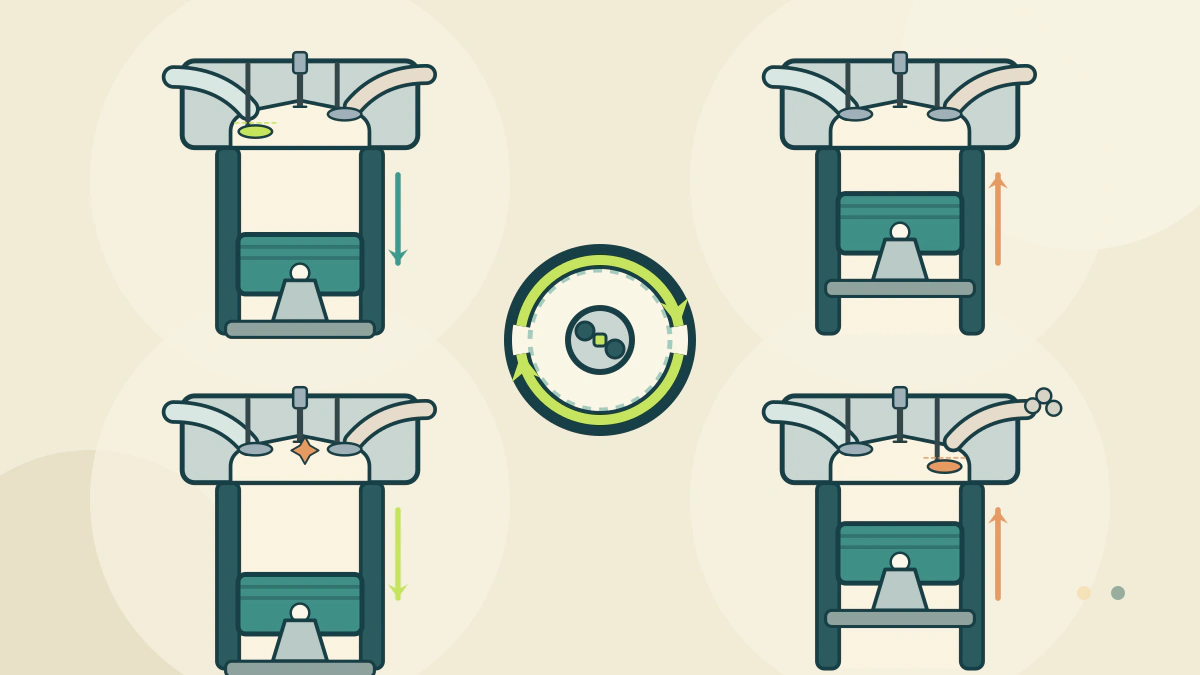
Follow a gasoline engine through intake, compression, power and exhaust, with a labelled cylinder diagram described in words and a clear energy picture.
How a four-stroke gas engine works
A four-stroke gasoline engine turns fuel and air into motion in four piston movements: intake, compression, power and exhaust. The crankshaft turns twice for each complete cycle. Most car and truck gasoline engines use this sequence.
The Department of Energy’s vehicle technologies office describes the same four processes. It also notes that most internal combustion engines in production are four-stroke cycle engines (DOE).
The four strokes, one at a time
Intake. The piston moves down with the intake valve open. The descending piston lowers pressure in the cylinder, and air, or an air-fuel mixture, is drawn in through the intake port. The exhaust valve stays closed.
Compression. Both valves close. The piston moves up and squeezes the charge into a smaller volume. Pressure and temperature rise. Near the top of the stroke, the spark plug fires.
Power. The burning mixture expands and pushes the piston down. This is the only stroke that delivers work to the crankshaft. Both valves remain closed during the main expansion.
Exhaust. The exhaust valve opens, and the rising piston pushes burned gas out. When the piston reaches the top, the exhaust valve closes and the intake valve opens for the next cycle.
NASA’s Glenn Research Center walks through the same sequence using the Wright brothers’ engine. Its description notes the open intake valve on the intake stroke and the closed valves during compression (NASA).
The parts, described as a diagram
Picture a vertical cylinder with a piston inside. The piston is connected by a rod to a crankshaft below. The crankshaft converts the piston’s up-and-down motion into rotation.
At the top of the cylinder is the combustion chamber, with two valves. The intake valve is on one side, the exhaust valve on the other, and the spark plug sits between them.
In the diagram, label the intake port and intake valve on the left, the exhaust valve and exhaust port on the right, the spark plug at the top center, the piston below the chamber, and the crankshaft at the bottom. Add arrows for intake flow into the cylinder and exhaust flow out.
The camshaft opens the valves. NASA notes that the crankshaft makes two revolutions for every one revolution of the camshaft, so each valve opens once per cycle (NASA).
Why two revolutions produce one power stroke
Each cylinder fires once every two crankshaft revolutions. With four cylinders, the power strokes can be spaced so that one cylinder is producing power while the others are on intake, compression or exhaust. That spacing is what makes a multi-cylinder engine practical.
The firing order is engine-specific. The owner’s manual or service information gives the order for a particular engine; it is not a universal number.
Where the energy goes
Even a well-tuned engine does not turn all the fuel’s energy into motion. DOE estimates that 68 to 72 percent of the energy in gasoline is lost in the engine, mostly as heat, for combined city and highway driving. Another 4 to 6 percent goes to parasitic losses, 3 to 5 percent to the drivetrain, and 18 to 25 percent reaches the wheels (fueleconomy.gov).
That is why small efficiency changes matter. It also explains why the power stroke is only part of the story: friction, pumping and heat loss consume much of the fuel’s energy.
| Stroke | Piston direction | Intake valve | Exhaust valve | What happens |
|---|---|---|---|---|
| Intake | Down | Open | Closed | Air or air-fuel charge enters |
| Compression | Up | Closed | Closed | Charge is squeezed and pressure rises |
| Power | Down | Closed | Closed | Spark ignites; expanding gas pushes the piston |
| Exhaust | Up | Closed | Open | Burned gas is pushed out |
What the cycle explains about symptoms
A misfire means a cylinder failed to burn its charge properly. The cause can be ignition, fuel, air or compression. A compression test checks the sealing of the cylinder, while a spark test checks ignition. The engine misfire guide covers the difference.
Low compression can come from worn rings, a leaking valve or a head gasket fault. A timing problem can make the valves open at the wrong moment. These are mechanical checks, not conclusions from a scan tool alone.
The cycle also explains why engine speed and load change the vacuum in the intake manifold. That vacuum is a useful diagnostic signal on engines that use a manifold pressure sensor.
The cycle in a wider engine
A four-stroke engine is commonly called an Otto-cycle engine, after Nikolaus Otto. NASA describes the ideal Otto cycle as a model of the four-stroke process; real engines lose energy to heat, friction and pumping (NASA).
Cylinder count and layout change smoothness and packaging, not the basic sequence. The inline-four, V6 and V8 comparison explains those differences. For the surrounding systems, start with the Automotive Mechanical Systems hub.
Frequently asked questions
Does a four-stroke engine need exactly four cylinders?
No. The four strokes describe what happens in one cylinder. Engines can have one, two, three, four, six, eight or more cylinders. The layout changes smoothness and packaging rather than the basic cycle.
Why does the engine turn twice for one power stroke?
The piston must complete four movements, two down and two up. Each pair of movements takes one crankshaft revolution, so the full cycle takes two.
Does the spark plug fire on every stroke?
No. In the normal four-stroke sequence, the spark occurs near the end of the compression stroke, once per cycle for that cylinder. The other strokes prepare the charge or remove the burned gas.
Is a four-stroke engine the same as an Otto-cycle engine?
The four-stroke gasoline engine is commonly described as an Otto-cycle engine. The ideal cycle is a model of the process. A real engine loses energy to heat, friction and pumping, so its efficiency is lower.