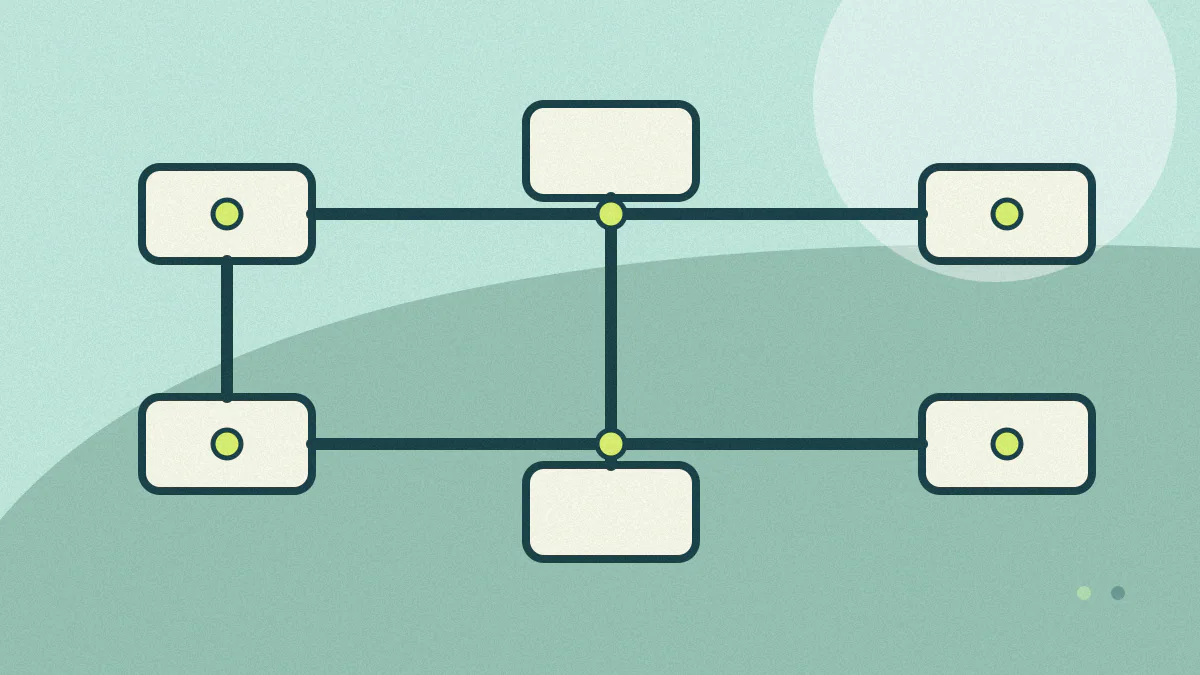
Understand how a vehicle CAN bus lets control modules exchange messages, what network faults can look like and why diagnosis requires more than reading one code.
What is a CAN bus in a car?
Controller Area Network, or CAN, is a digital communication system that lets electronic control units share messages over a common pair of wires. Instead of running a dedicated signal wire between every device, modules publish data such as wheel speed, engine status or switch position for other modules to use.
A modern vehicle may have more than one CAN network plus other network types.
Gateways connect selected traffic between powertrain, body, infotainment and driver-assistance domains.
The exact architecture is manufacturer- and model-specific.
What travels on the network?
| Message example | Possible sender | Possible users |
|---|---|---|
| Wheel speed | ABS module | Stability control, instrument cluster, driver assistance |
| Engine torque | Engine controller | Transmission, traction control, dashboard |
| Door status | Body controller | Interior lights, alarm, cluster |
| Steering angle | Steering sensor/module | Stability control, parking assistance |
CAN messages typically use identifiers that describe priority and meaning within that vehicle’s design.
The network does not work like a household internet connection, and a message identifier is not automatically the same across brands or models.
How can many modules share two wires?
Modules monitor the same twisted-wire bus and take turns transmitting.
Arbitration rules allow a higher-priority message to continue without corrupting another transmission.
Error checking helps nodes detect invalid frames.
Termination resistors at network ends reduce signal reflections.
Those concepts explain why physical details matter.
Wire twist, splice design, resistance, shielding choices and connector condition are part of the communication system.
An improvised splice or incorrect accessory connection can disturb signal integrity even if the wire still shows continuity on a basic test.
What symptoms can a CAN fault cause?
A communication fault may produce multiple warning lamps, gauges that drop out, a no-start condition, features that become unavailable or diagnostic tools that cannot reach one or more modules.
“U” diagnostic trouble codes often relate to network communication, but a code naming a lost module does not prove that module itself has failed.
The true cause could be low system voltage, a blown fuse, poor ground, water intrusion, connector damage, an open or shorted bus wire, incorrect termination, software state or another module holding the network in a faulty condition.
Symptoms may be intermittent when vibration, temperature or moisture changes the connection.
Is CAN the same as OBD-II?
No. On-board diagnostics defines standardized emissions-related information and the diagnostic connector; CAN is one communication technology that can carry diagnostic traffic. The EPA’s OBD overview explains the emissions-monitoring purpose of OBD. A consumer scan tool may expose standardized powertrain codes while manufacturer tools can access far more module-specific data.
Clearing codes does not repair the network.
It can erase timing clues and make an intermittent fault harder to reproduce.
Record all codes and module communication status before clearing anything.
How technicians diagnose a network problem
- Confirm battery state, charging voltage, fuses and grounds.
- Scan all modules and note which ones respond.
- Compare communication codes and freeze-frame or event information.
- Consult the exact vehicle wiring diagram and network topology.
- Inspect relevant connectors, splices and aftermarket installations.
- Measure resistance or waveform only with the specified procedure and suitable equipment.
- Isolate branches or modules methodically rather than replacing the module named by the first code.
Oscilloscope patterns can show voltage level, noise and distorted edges, but interpretation requires the correct network speed and manufacturer specification.
Resistance checks are normally performed with power removed according to service information; probing a live circuit incorrectly can damage electronics.
What should an owner do?
Document when the symptoms occur, which warnings appear, whether the vehicle starts and any recent battery, windshield, collision, audio or accessory work. ADAS camera calibration after windshield replacement explains why glass work can involve camera procedures.
Do not install a jumper wire across an unknown network circuit.
If critical braking, steering or powertrain warnings appear, follow the owner’s manual and arrange safe diagnosis rather than continuing to drive based on guesswork.
Vehicle networks also matter to cybersecurity. NHTSA’s vehicle cybersecurity guidance treats connected electronic systems as an engineering risk-management issue. Avoid untrusted devices in the diagnostic port and apply manufacturer software campaigns through approved processes.
Common questions
Can one bad module affect unrelated features?
Yes. Shared data or a bus electrical fault can affect several systems, though diagnosis is needed to identify the cause.
Does a U-code mean the wiring is broken?
Not necessarily. Voltage, software state, connectors, grounds and module faults can all create communication codes.
Can a cheap scanner test the entire CAN bus?
Usually not. Basic tools may read standardized engine data but lack full module access and waveform testing.
Is the diagnostic connector safe for permanent accessories?
Only when the device and vehicle manufacturer permit it. Poorly designed devices can drain the battery or interfere with communication.
Bottom line: CAN lets many systems cooperate, so successful diagnosis follows the network map and evidence rather than blaming the first silent module.