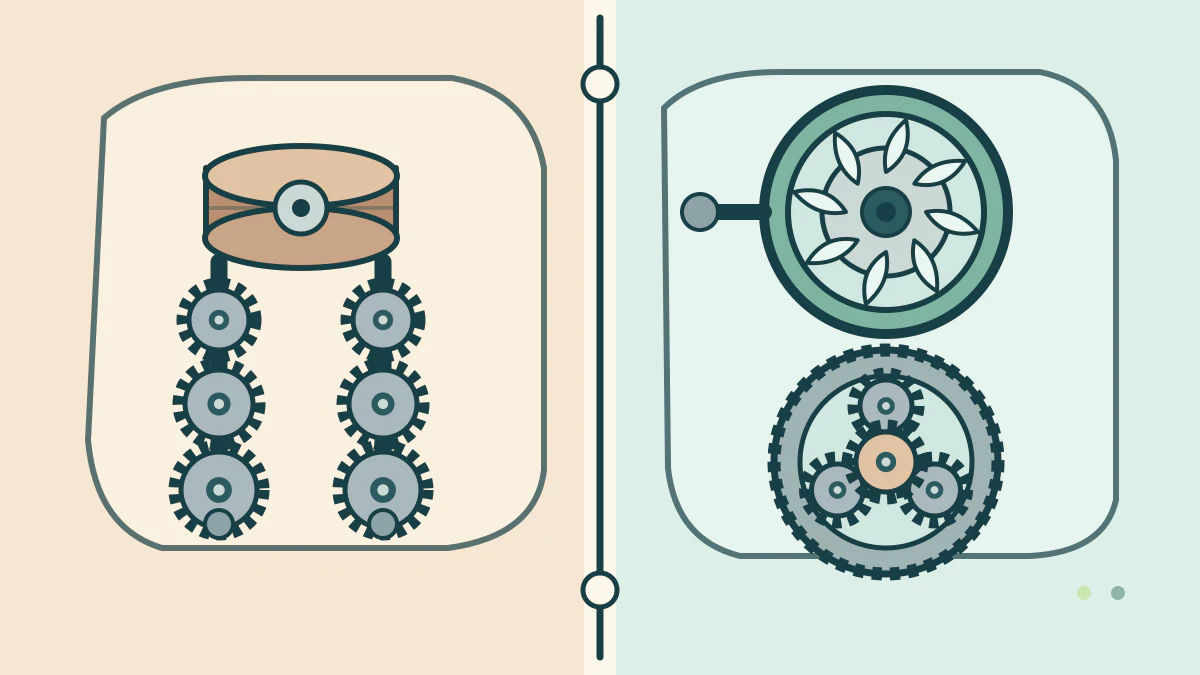
A dual-clutch uses two clutches and preselected gears; a conventional automatic uses a torque converter and planetary gears. Compare driving feel and fuel use.
What is the core difference between a DCT and a conventional automatic?
A dual-clutch transmission is an automated manual gearbox with two clutches and preselected gears, while a conventional automatic uses a torque converter and a planetary gear set. Both change gear without a clutch pedal, but they transmit power in different ways.
The difference shows up at low speed. A DCT connects the engine through clutch plates, so it has to slip a clutch to creep and launch. A conventional automatic uses fluid coupling, so it can slip smoothly while the engine keeps turning.
Neither design is universally better, and the Automotive Mechanical Systems hub covers other drivetrain layouts. The right choice depends on driving conditions, smoothness and what the owner’s manual says about service.
How a dual-clutch transmission changes gear
A DCT has two clutches. Hyundai’s explanation says one clutch controls the odd-numbered gears and the other controls the even-numbered gears (Hyundai). While the car is in one gear, the control unit preselects the next gear on the other shaft.
When a shift is needed, one clutch opens and the other closes. Bosch describes the result as shift speeds that even the fastest driver cannot match with a manual gearbox (Bosch).
There is no torque converter in this path. Hyundai’s 2026 owner’s manual calls the DCT “an automatically shifting manual transmission” and says clutch slip manages the low-speed transition instead.
Hyundai tells owners that shifts can sometimes be heard and felt, that light vibration during launch is normal, and that low-speed smoothness may improve during the first 1,000 miles.
Wet and dry clutches are not the same
DCTs are built with either a wet or a dry clutch. Hyundai’s manual for one model describes a dry-type dual clutch, while another manual describes a wet-type mechanism.
Hyundai’s press information for its eight-speed N DCT says the wet type uses two electric oil pumps to reduce friction between moving parts and to cool the clutch. A dry clutch avoids that oil circuit, so the two types do not feel the same.
How a conventional automatic changes gear
A conventional automatic uses a hydrodynamic torque converter between the engine and the gearbox. ZF describes its passenger-car torque converter as a device for smooth gear changes and low consumption, with a lock-up clutch that can bypass the fluid coupling at suitable times (ZF).
Behind it is a set of planetary gears. ZF’s eight-speed description lists four planetary gear sets and five shift elements (ZF).
The converter provides fluid coupling for starting and low-speed operation. Bosch notes that an automatic can drive off smoothly even when an engine has low torque (Bosch).
A lock-up clutch reduces converter slip once the car is moving, but the converter still provides the smooth launch and creep many drivers expect.
Where the two designs feel different
| Driving situation | Dual-clutch transmission | Conventional automatic |
|---|---|---|
| Launch from rest | Clutch slip; may feel direct or slightly hesitant | Fluid coupling; usually smooth and gradual |
| Creeping in traffic | Can shudder or feel jerky at low speed | Usually smooth, with continuous creep |
| Upshifts | Fast, with the next gear preselected | Smooth, with some torque-converter cushioning |
| Repeated low-speed maneuvering | Clutch heat becomes a consideration | Converter heat becomes a consideration |
| Efficiency potential | DOE estimates 3 to 4 percent improvement | Torque converter and pump losses reduce efficiency |
The Department of Energy says a DCT combines the efficiency of a manual transmission with the convenience of an automatic. It also says DCTs are generally not quite as smooth as regular automatics, though manufacturers have improved them (DOE).
The same page estimates a 3 to 4 percent efficiency improvement for a DCT. That is a technology-level estimate, not a promise for a particular model.
What to check on a test drive
Drive the car in the conditions you face most often. Try a slow creep, a gentle hill start, a parking-lot maneuver and a normal merge. A DCT’s low-speed behavior is easiest to judge in stop-and-go driving.
Listen for clutch noise and feel for shudder. Hyundai says clicking during engine start and shut-down is part of the DCT self-test. A repeated shudder, a delayed engagement or a warning message is not something to dismiss.
Ask for the service history and read the fluid section of the owner’s manual. DCT and automatic fluids are not interchangeable, and the procedure can differ by model. The guide to transmission fluid change intervals explains why the manual sets the schedule.
Which design suits which driver?
A DCT rewards a driver who wants quick shifts, a direct feel and strong efficiency, but it asks for smoother low-speed inputs. A conventional automatic rewards smooth creep, relaxed launching and predictable traffic behavior.
Neither choice removes the need for maintenance. A used car’s service record, warning lights and test-drive behavior matter more than the marketing name. For the wider history, see the history of automatic transmissions and the explanation of how a CVT works.
Frequently asked questions
Is a DCT the same as an automatic?
Not mechanically. A DCT is an automated manual with two clutches and no torque converter. A conventional automatic uses a torque converter and planetary gears. Both are automatic in use because neither has a clutch pedal.
Are dual-clutch transmissions reliable?
The design can be durable, but the clutch and its controls are wear and heat-sensitive parts. Reliability depends on the clutch type, programming, cooling and service history. Check for shudder and delayed engagement on a test drive.
Does a DCT use more fuel than an automatic?
Usually not. The Department of Energy estimates a 3 to 4 percent efficiency improvement for a DCT compared with a conventional automatic. Real fuel use depends on the vehicle and how it is driven.
Can I tow with a dual-clutch transmission?
Check the vehicle’s owner’s manual and tow rating before assuming. Clutch heat during repeated low-speed maneuvering is a design consideration, and some models have specific limits.