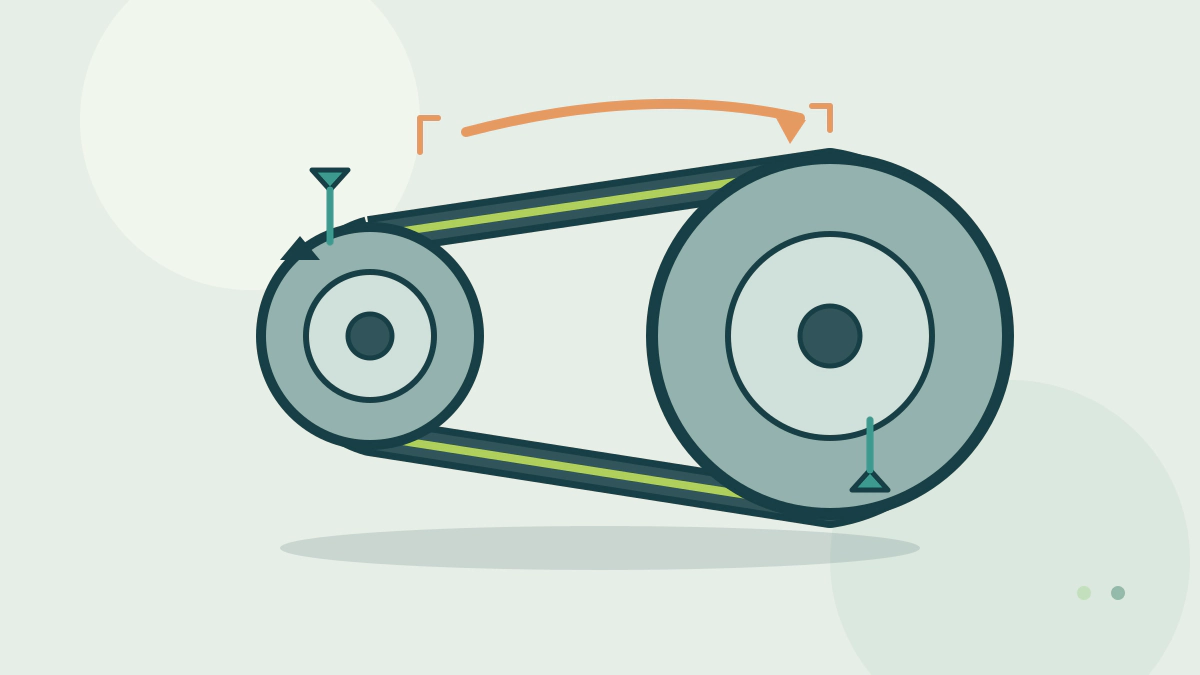
A CVT changes ratio with two moving pulleys and a steel belt or chain, then uses a launch device and a lockup clutch to move the car from rest.
How does a CVT change ratio without fixed gears?
A CVT changes ratio by moving two pulley halves closer together or further apart, which changes the radius where a steel belt or chain runs. The DOE and EPA fuel economy site describes the layout as a pair of variable-diameter pulleys connected by a belt or chain. That pair produces an infinite number of engine-to-wheel speed ratios instead of a fixed set of steps.
The automotive glossary entry explains what the three letters mean. This article follows the power through the parts, from the engine to the wheels.
What the two pulleys do with the belt
Each pulley is a pair of cone-shaped halves facing each other. The gap between them forms a V-shaped groove. The belt or chain sits in that groove, and the radius where it sits depends on how wide the gap is.
Nissan’s XTRONIC CVT page describes the effect. The transmission adjusts the width of two pulleys and changes the arc radius of the steel belt running between them. Narrow the engine-side pulley and the belt sits at a small radius, which gives a low ratio for moving off. Widen it and the belt moves outward, which gives a tall ratio for cruising.
Subaru’s technology article describes its Lineartronic CVT the same way: a belt, chain and pulley system rather than a fixed gear set.
What gets the car moving from a stop
On Nissan’s design, the belt is not the only part involved in moving off. Nissan states that XTRONIC CVT transfers engine output through a torque converter before it reaches the pulleys. The converter works like a clutch at that stage, and it also increases torque when the car moves off.
After take-off, when the converter is no longer needed, a lockup damper bypasses it. Running through the fluid lowers efficiency, so the lockup point is part of the fuel-saving strategy.
That division of labour explains the rest of the design. The pulleys set the ratio, and the converter handles the start.
How the transmission chooses a ratio
The control system does not step through gears. It moves the pulleys toward the ratio that keeps the engine near an efficient speed for the road speed and the driver’s demand.
Nissan says the transmission selects the most suitable ratio automatically and keeps the engine at its most efficient rotation for a steady speed. The same page says a wider ratio range lets one unit serve both low-speed acceleration and relaxed high-speed cruising.
Nissan says XTRONIC reduces transmission time by around 30 percent compared with its earlier unit, which is why the engine answers quickly when the pedal moves.
| Driving situation | Pulley position | What the driver notices |
|---|---|---|
| Pulling away | Engine-side pulley narrow, small belt radius | Low ratio and strong acceleration |
| Gentle acceleration | Gap opens gradually | Road speed rises, engine note stays fairly steady |
| Climbing or passing | Ratio moves back toward low | Engine speed rises and holds |
| Steady highway cruise | Engine-side pulley wide, large radius | Low engine speed for the road speed |
The control unit decides the actual ratio at each moment.
Why the engine note stays steady
In a geared automatic, each shift drops the engine speed and starts it climbing again. In a CVT the ratio moves continuously, so there is no step for the driver to hear.
Nissan calls the result seamless, with no shift changes during acceleration and deceleration. The DOE and EPA page lists the same idea as an advantage: seamless acceleration without the jerk or jolt of changing gears.
Some drivers like that smoothness. Others miss the sound and feel of a shift. Both reactions describe the same behaviour, and a test drive answers the question better than a specification sheet.
Where the layout has limits
How much torque a belt or chain CVT can carry is a design limit set by the manufacturer, not a single number that covers every unit. That is why towing and performance claims should not rest on the transmission type alone.
Towing capacity and cooling requirements come from the owner’s manual and the vehicle’s published tow rating. Read them before adding a trailer, and have the transmission checked if it behaves differently under load.
Service is also model-specific. The fluid specification and interval come from the owner’s manual for the exact model year. The transmission fluid interval guide explains why a generic mileage figure is a poor substitute.
A shudder, a slipping feeling or a delayed engagement is a diagnostic question, not proof that the unit is worn out. The slipping symptoms guide lists the observations a technician will ask about. The Automotive Mechanical Systems hub covers the related drivetrain parts.
Frequently asked questions
Does a CVT use a torque converter?
Many belt and chain CVTs do. Nissan says its XTRONIC CVT transfers engine output through a torque converter, then bypasses it with a lockup damper after take-off. Other designs use a different launch device, so check the service information for the exact car.
Why does a CVT hold one engine speed?
Because the ratio changes continuously instead of stepping to a new gear. Nissan describes the transmission keeping the engine at an efficient rotation for the road speed, and the DOE page describes the result as seamless acceleration.
Is a CVT good for towing?
There is no general answer. Towing capacity, cooling and fluid service depend on the exact vehicle. Use the owner’s manual and the published tow rating, and have the transmission checked if it behaves differently under load.
How often does CVT fluid need changing?
Follow the owner’s manual for the model year. Intervals and fluid specifications differ between CVTs, and the fluid interval guide makes the same point. A generic mileage figure is not a substitute for the manual.