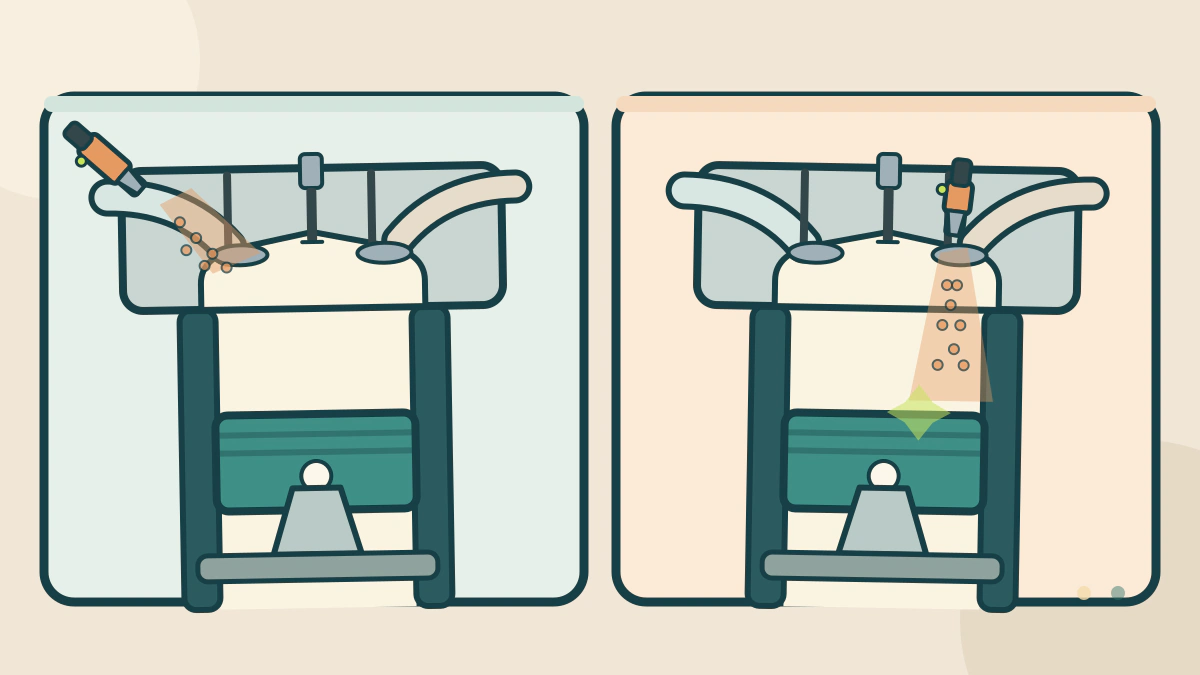
Compare direct and port fuel injection: where each injector sprays, how the mixture is prepared, and why some modern engines use both systems together.
Direct injection vs port injection: what is the difference?
Port injection sprays fuel into the intake port, where it mixes with air before the intake valve opens. Direct injection sprays fuel straight into the cylinder, just before or during combustion. Both use computer-controlled injectors. The difference is where the fuel meets the air.
The federal fuel economy site draws the same line between the two layouts (fueleconomy.gov).
Where each injector sits, described as a diagram
Picture a cylinder head cut in half. At the top left is the intake port, a curved passage leading to the intake valve. At the top right is the exhaust valve and exhaust port. The spark plug sits between them, and the piston is below.
In a port-injection diagram, the injector is mounted in the intake port and aimed at the back of the intake valve. Fuel sprays into the port, and the incoming air carries the mixture into the cylinder.
In a direct-injection diagram, the injector is mounted through the cylinder head with its tip inside the combustion chamber. It sprays toward the piston crown or the spark plug. The fuel never passes the intake valve.
Why direct injection can improve efficiency
Fuel evaporating inside the cylinder cools the incoming charge. Cooler air is denser, and a cooler mixture resists knock. That allows a higher compression ratio or more efficient spark timing. DOE estimates an efficiency gain of about 1 percent (fueleconomy.gov).
Toyota’s description of its D-4 system makes the same point. The fuel is injected close to the spark plug, and its vaporization cools the intake air, which improves volumetric efficiency (Toyota).
Direct injection also makes stratified charge possible. A richer mixture can be kept near the spark plug while the rest of the chamber is leaner. That can reduce fuel use at light load, but it demands precise control of the spray and the air motion.
Why port injection still has advantages
Port injection gives fuel more time to mix with air before the valve opens. The mixture reaching the cylinder is usually more uniform, and the injectors work at lower pressure. Toyota’s comparison table labels direct injection as high-pressure in-cylinder injection and port injection as low-pressure in-port injection (Toyota).
Port injection also washes the intake valve. Fuel and detergent keep deposits from building on the back of the valve. In a direct-injection engine, no fuel passes over that valve, so oil vapor and other material can bake onto it.
An SAE paper on intake valve deposits describes the mechanism. Direct-injection engines lack the fuel-washing effect typical of port injection, so deposits accumulate over time. Heavy deposits can worsen combustion, cause rough running and stick a valve (SAE). The paper notes that vehicles with these engines are often forced into expensive maintenance to remove the deposits.
Some engines use both systems
The cleanest answer to “which is better” is that some manufacturers use both. Toyota’s D-4S system has two injectors per cylinder: one direct and one port. It can run both systems together or direct injection alone, depending on engine speed. Toyota says the combination mixes air and fuel evenly, improving throttle response, power and torque without sacrificing fuel efficiency (Toyota GT86).
An SAE technical paper on a 3.5-liter V6 describes the same layout. One injector produces a dual-fan spray inside the cylinder, and a second injector sits in the port. The paper credits the pair with strong full-load output and lower cold-start hydrocarbons (SAE).
This blended approach targets the weak spots of each method.
How common is direct injection?
Direct injection is common. DOE reports that it reached 55.3 percent of new light-duty vehicles produced in model year 2020, based on preliminary EPA data (DOE). Some engines use direct injection only, some use port injection only, and some blend the two.
| Feature | Port injection | Direct injection |
|---|---|---|
| Where fuel is sprayed | Intake port, behind the valve | Combustion chamber |
| Mixing time before ignition | Longer | Very short |
| Fuel pressure | Lower | Higher |
| Charge cooling | Limited | Strong, from fuel vaporization |
| Intake valve washing | Yes | No |
| Main deposit concern | Not the intake valve | Intake valve deposits |
What this means for a used car
Ask which system the engine uses before assuming a maintenance routine. A direct-injection engine may need a different intake-valve service than a port-injection engine. The owner’s manual or the manufacturer’s service information is the place to confirm the schedule.
Fuel grade and oil specification also deserve attention. The direct-injection fuel system operates at high pressure, and the injector tips are exposed to combustion.
If a warning light is on, do not assume the injection type is the cause. A misfire or a fuel-trim code can come from many sources. The engine misfire guide explains the diagnostic path, and the fuel injection history explains how the systems developed. For the surrounding hardware, start with the Automotive Mechanical Systems hub.
Frequently asked questions
Is direct injection better than port injection?
Not automatically. Direct injection can improve charge cooling and knock resistance. Port injection mixes fuel earlier and keeps the intake valve cleaner. Some engines combine both to get the strengths of each.
Why do direct-injection engines get carbon buildup?
Fuel is sprayed into the cylinder, so it does not wash the back of the intake valve. Oil vapor and other material can collect there. The rate depends on the engine, the oil and how the vehicle is driven.
Can I add port injection to a direct-injection engine?
That is a major engineering change, not a maintenance task. It affects the intake, the fuel system and the calibration, and it may have emissions consequences. This guide does not recommend it.
Does direct injection require premium fuel?
Only if the manufacturer says so. Injection type does not set the octane requirement. Compression ratio, boost and calibration do. Check the fuel label and the owner’s manual.