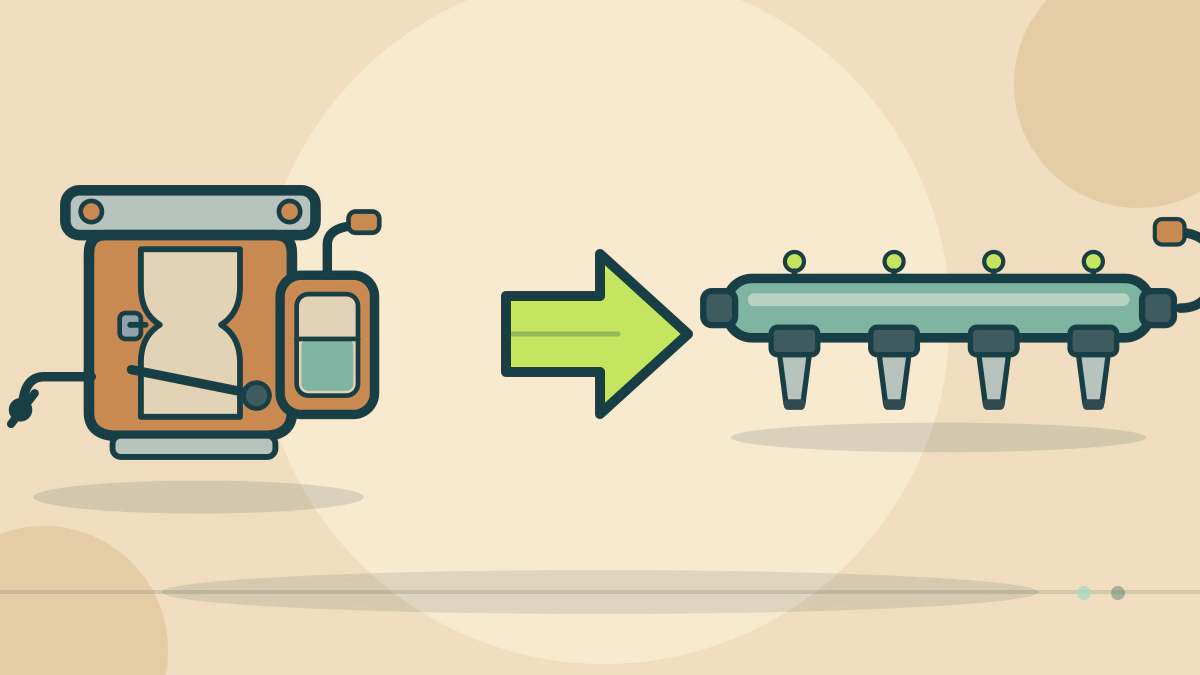
See how emissions rules and catalytic converters pushed gasoline engines from carburetors to port injection, then to direct injection.
Why did fuel injection replace carburetors?
Fuel injection replaced carburetors because it meters fuel more precisely, and US emissions rules demanded that precision. Catalytic converters needed a tightly controlled air-fuel ratio, and a carburetor could not hold it reliably across all driving conditions. The change was gradual: electronic injection appeared in the late 1950s, but port injection did not dominate new US gasoline engines until the 1990s.
A carburetor uses airflow through a venturi to draw fuel into the intake stream. But it depends on small passages, jets and moving parts, and it adjusts poorly to changes in temperature, altitude and load. Fuel injection uses pressurized fuel and electrically controlled injectors, so the computer can set the fuel quantity for each condition. The Automotive History hub covers other engineering changes.
When did electronic fuel injection first appear?
Bendix published an SAE paper on its Electrojector system in 1957. That system reached a limited run of 1958 Chryslers, but most were converted back to carburetors, according to an academic history of automotive software. It was an early demonstration, not mass adoption.
Bosch’s Jetronic made electronic injection a production success. Bosch’s history says the company unveiled it at the Frankfurt motor show on September 14, 1967. It went on sale first in the US because of California’s emissions rules, and a Jetronic-equipped Volkswagen 1600 debuted in Germany in June 1968.
How did emissions rules force the change?
The Clean Air Act of 1970 required a 90 percent reduction in emissions from new automobiles by 1975, according to EPA’s timeline. That deadline pushed automakers toward catalytic converters. The same timeline says the first converters were built for 1975 and that unleaded gasoline was introduced because lead would damage the catalyst.
A catalyst works best when the air-fuel ratio stays near the chemically correct point. An academic review in Atmosphere explains that three-way catalysts require feedback control from an exhaust oxygen sensor, and that the engine must be held near the stoichiometric ratio. A carburetor cannot hold that window as precisely as electronic injection.
How did the transition actually happen?
The first step was electronic control of the existing fuel system, followed by electronic injection. The academic history says General Motors introduced a computer-controlled engine management system in 1980, and that Ford, Chrysler, Honda and Nissan had their own by 1983. Those systems controlled fuel delivery and ignition together, which made tighter mixture control practical.
Port fuel injection became the dominant design in the 1990s. The Atmosphere review says carburetors were used until the 1980s, when injection replaced them, and that port injection appeared in more than 90 percent of spark-ignition engines sold from 1995 to 2010. In a port-injection engine, the injector sprays fuel into the intake port near the intake valve, so the cylinder gets a well-mixed charge.
| Year | Milestone in the carburetor-to-injection transition |
|---|---|
| 1957 | Bendix publishes an SAE paper on the Electrojector electronic injection system |
| 1958 | Chrysler offers the Electrojector on a limited run of cars; most are converted back to carburetors |
| 1967 | Bosch unveils the Jetronic at the Frankfurt show; the Volkswagen 1600 follows in 1968 |
| 1975 | US cars get catalytic converters and unleaded gasoline |
| 1980 | GM introduces a computer-controlled engine management system |
| 1995-2010 | Port fuel injection appears in more than 90 percent of new US spark-ignition engines |
What changed with direct injection?
Direct injection moves the injector into the combustion chamber. The Atmosphere review says direct injection rose from 8 percent of new US gasoline vehicles in 2010 to 57 percent in 2020. At higher loads the fuel is injected during the intake stroke to form a nearly uniform mixture. At lower loads the timing can be delayed to create a stratified charge near the spark plug, which lets the engine run leaner and improves fuel economy.
The review also notes that port injection produces very low particulate emissions because fuel and air are mixed before combustion.
What does this mean for owners of older cars?
Carbureted and fuel-injected engines call for different diagnostic steps. A carburetor has mechanical metering parts and vacuum circuits. A modern system has sensors, a fuel pump, injectors and a computer, so the service manual’s test sequence matters. The Automotive Mechanical Systems hub covers the systems.
Fuel injection also changed maintenance. Injectors and fuel pumps are serviced by condition and the manufacturer’s schedule, not a universal interval. The owner’s manual for the model year gives the required fuel, the intervals and the fuel-pressure warnings. Before opening a fuel system, consult the manual and service information for the depressurization procedure.
A carbureted car and an injected car of the same size may differ in cold-start behavior, idle quality and altitude response. Fuel delivery is one part of a larger engine design, along with displacement, which the engine displacement guide explains.
Frequently asked questions
Did fuel injection replace carburetors because of performance?
Partly, but emissions rules were the main driver. Bosch says a carbureted Volkswagen 1600 could not have met the US standards that took effect for 1968. Fuel injection brought other benefits, but regulation made it necessary.
When did the first electronic fuel injection appear?
Bendix published its Electrojector paper in 1957, and the system reached a limited number of 1958 Chryslers. It was unreliable, and most of those cars were converted back to carburetors. Bosch’s Jetronic, introduced in 1967, was the first electronic system to succeed in mass production.
What is the difference between port and direct injection?
Port injection sprays fuel into the intake port, outside the cylinder. Direct injection sprays it into the combustion chamber. Port injection mixes fuel and air before the intake valve, while direct injection allows stratified or lean operation and can improve fuel economy.
Are carburetors still used on new cars?
No. The Atmosphere review says carburetors were replaced in the 1980s, and port fuel injection appeared in more than 90 percent of new US spark-ignition engines from 1995 to 2010.