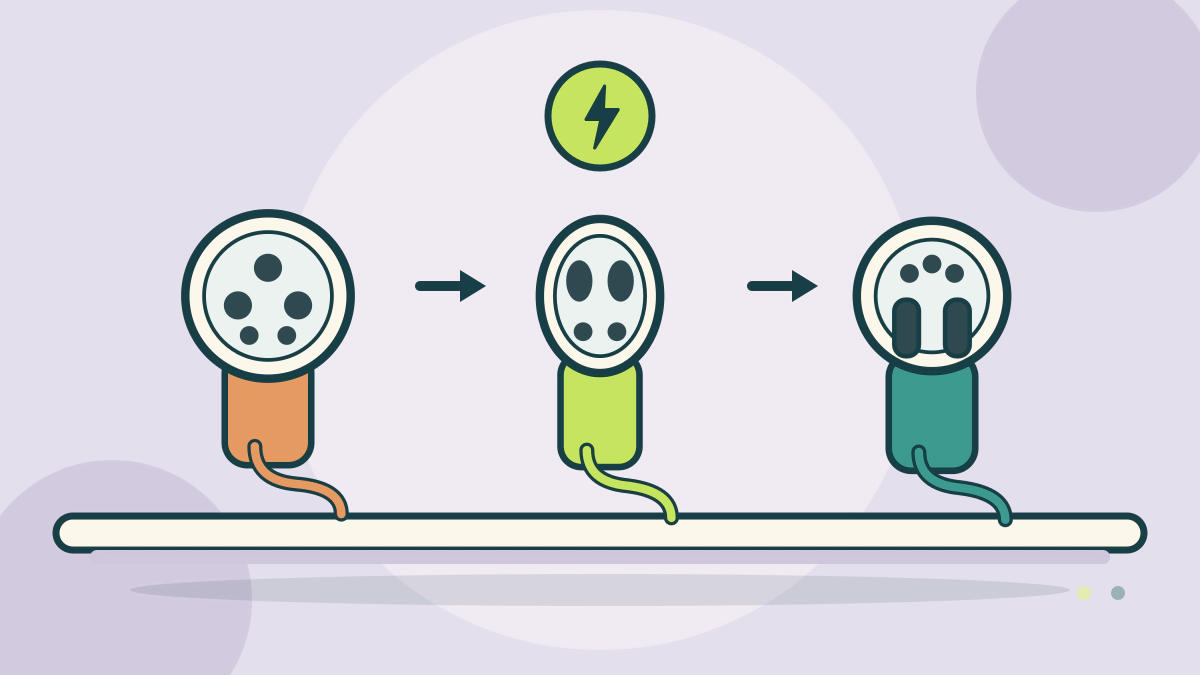
Trace US EV charging plugs from the first SAE J1772 edition through CCS and CHAdeMO to Tesla's NACS design and the SAE J3400 standard.
How did US EV charging connectors evolve?
The US began with one round AC plug for electric cars, then added competing DC fast-charging connectors, and is now consolidating around SAE J3400, the standard written from Tesla’s NACS design. Each step was a compatibility problem as much as an engineering one.
The connector plugs into the car; the inlet is the socket on the vehicle. A shared standard lets any compliant car use any compliant charger, which is why this history affects a buyer.
The AC plug arrived before the modern EV market
SAE International’s J1772 standard is older than the modern electric car boom. Its published editions begin in October 1996, with revisions in November 2001, January 2010, two in 2012 and October 2017 (SAE J1772). The earliest editions predate the modern EV market.
J1772 is the connector used for Level 1 and Level 2 AC charging in the US. The Department of Energy’s Alternative Fuels Data Center describes a portable Level 1 cordset with a household NEMA plug on one end and a J1772 connector on the other, and says Level 2 equipment uses the same J1772 connector (AFDC). DOE’s 2023 charging-network review says J1772 was used by all plug-in manufacturers except Tesla (NREL).
One cable could charge a Nissan Leaf, a Chevrolet Bolt or a plug-in hybrid at home or at a public Level 2 post. That common AC plug did not solve DC fast charging.
DC fast charging split the plug into three families
Fast charging needs larger conductors and a different conversation between car and charger. The US ended up with three DC connector types.
CCS1, also called SAE J1772 combo, keeps the five J1772 pins and adds two bottom DC pins. One port accepts AC Level 1, Level 2 and DC fast charging (Joint Office). CHAdeMO is a separate DC connector that AFDC describes as common among Japanese automakers (AFDC). Tesla built its own connector and Supercharger network instead of following CCS1, and its cars historically used an inlet exclusive to Tesla (NREL).
CCS1 became the connector most new US EVs used, while CHAdeMO served a smaller group of models. Tesla’s design worked only with Tesla cars and Tesla chargers, with adapters for other networks.
Tesla’s plug became the industry standard
In November 2022 Tesla announced it was opening its connector design to other charging providers and vehicle manufacturers, according to DOE’s charging-network review (NREL). The design became known as the North American Charging Standard, or NACS.
The standards process moved quickly after that. In May 2023, federal highway rules allowed J3400/NACS adapters at federally funded DC fast chargers as long as a CCS1 connector was also present. SAE formed a J3400 task force in June 2023 and published a Technical Information Report in December 2023 (Joint Office). In August 2024, SAE’s EV Coupler Task Force voted to establish J3400 as a Recommended Practice.
Automakers also committed to building J3400 inlets into new vehicles beginning in 2025 (Joint Office). J3400 uses the same pins for AC and DC, and the Joint Office says the connector is rated for DC supply up to 1,000 volts and 1,000 amps with adequate cooling (Joint Office).
A timeline of the US connector
| Year | Change | What it meant |
|---|---|---|
| 1996 | First SAE J1772 edition | A common AC plug predates the modern EV market |
| 2010 | J1772 revised | The same AC standard, updated |
| 2012 | Two J1772 revisions | The AC connector settled before the DC standard |
| Nov 2022 | Tesla opens its connector design | NACS becomes available to other automakers |
| 2023 | SAE J3400 task force and Technical Information Report | NACS becomes an open standards project |
| 2024 | J3400 voted to Recommended Practice | A path to a standard that regulations can cite |
This shift belongs in the broader Automotive History record: a proprietary plug became a document any manufacturer can use.
What has not changed for drivers
A new connector shape does not raise the car’s charging limit. The charger, the car’s onboard equipment and the battery’s condition set the rate, so a J3400 car can still charge slowly on a weak charger. The EV charging curve guide explains how that rate changes.
Adapters will remain part of US charging for years because the fleet carries all three DC designs. Federally funded DC fast charging ports must still charge a CCS1-compliant vehicle (Joint Office), and J1772 remains the Level 2 plug at home and at many public posts. The EV charging adapter guide covers matching an adapter to a car and station.
AFDC also notes newer work that sits outside the passenger-car plug: SAE J3068 for three-phase AC charging at commercial sites and the Megawatt Charging System under development for heavy-duty DC charging (AFDC). None of it replaces J1772 or J3400 for a typical car today.
Frequently asked questions
What is the difference between J1772 and CCS1?
J1772 is the five-pin connector used for AC Level 1 and Level 2 charging. CCS1, or SAE J1772 combo, uses the same five pins and adds two bottom DC pins so one port can also accept DC fast charging (Joint Office).
Is NACS the same as J3400?
NACS is the name Tesla gave its connector design when it opened the design in 2022. J3400 is the SAE standard based on that design, developed so any supplier or manufacturer can use it (Joint Office).
Do I need an adapter to use a Tesla Supercharger?
It depends on the car and the station, so check the manufacturer’s adapter guidance rather than assuming. The Joint Office says automakers committed to providing J3400 adapters to owners of CCS vehicles beginning in 2024, and that not every adapter works with every model or charger (Joint Office). Station compatibility can also differ by site.
Will CCS1 disappear now that J3400 is arriving?
Not immediately. Federal rules still require federally funded DC fast charging ports to charge a CCS1-compliant vehicle, and the existing fleet will carry CCS1 inlets for years (Joint Office). The transition changes new-vehicle inlets and station hardware.