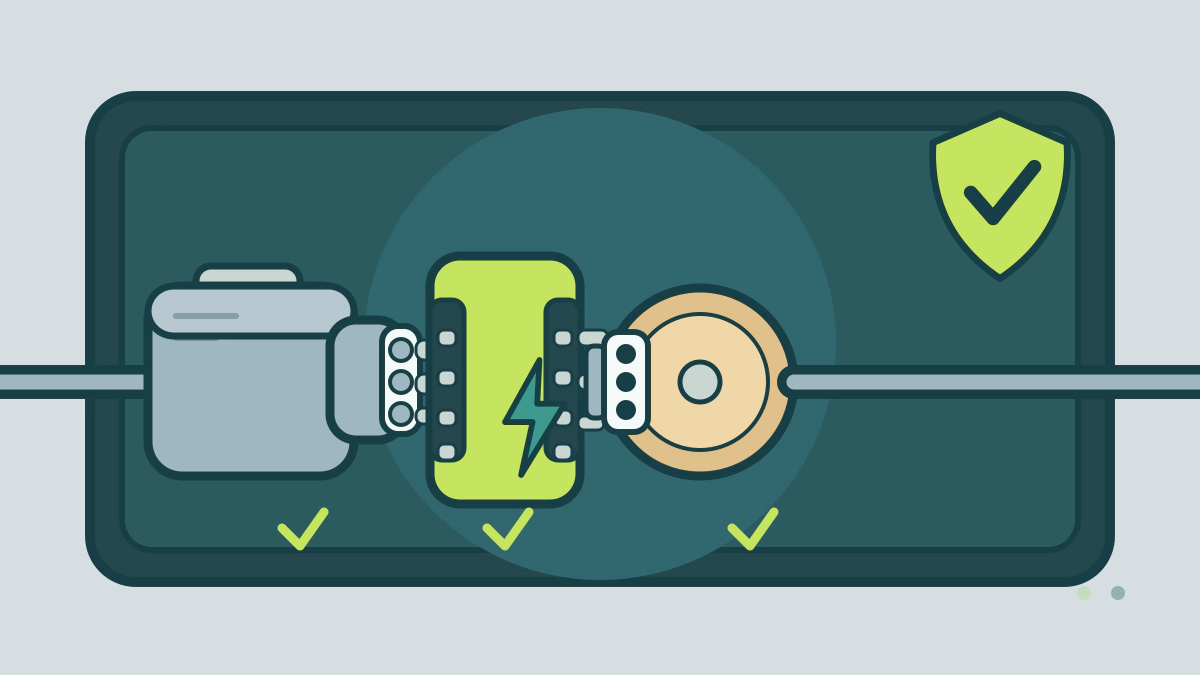
Charging adapters bridge connector types, but AC and DC versions are not interchangeable; use the adapter the vehicle maker approves for that car and station.
Do EV charging adapters make any connector fit any car?
An adapter changes the physical connection, but it cannot add a capability either the car or charger lacks. The Joint Office defines an adapter as hardware that lets an EV connect to a charger it otherwise could not connect to directly. [Joint Office]
The US network still has several connector families, so adapters are common during the transition to SAE J3400, based on Tesla’s NACS design. [Joint Office]
The connector families you are matching
| Connector | AC or DC | Typical use |
|---|---|---|
| J1772 | AC | Level 1 and Level 2 home and public charging |
| CCS1 | AC and DC | Level 1, Level 2 and DC fast charging; adds two DC pins |
| J3400 (NACS) | AC and DC | Same pins for AC and DC; Tesla and newer EVs |
| CHAdeMO | DC | DC fast charging on some older EVs |
AFDC says the CCS connector uses the same five-pin layout as J1772 with two additional bottom pins for DC fast charging. It lists three DC fast charging systems in the US: CCS, CHAdeMO and J3400. [AFDC]
J3400 is the SAE standard for NACS; the Joint Office says it works for AC Level 1, Level 2 and DC fast charging, and is compatible with J1772 for AC through an adapter. [Joint Office]
AC adapters and DC adapters are different products
Ford’s Fast Charging Adapter instructions make the split clear. The adapter is for DC fast chargers, including designated Tesla Superchargers. It is not compatible with Level 1 or Level 2 AC chargers, including Tesla Destination Chargers and home chargers with NACS connectors. A different adapter is needed for AC NACS charging. [Ford]
Ford also warns drivers not to use NACS AC adapters with NACS DC fast chargers, saying the mistake may damage the vehicle in a way the warranty does not cover. [Ford]
The Joint Office report explains the engineering reason. DC adapters handle much more voltage and current than AC adapters; a typical CCS-to-J3400 adapter should carry up to 350 kW, while AC adapters operate at up to 80 amps at 240 volts. The report includes one AC adapter variant because of the risk it is misused as a DC adapter. [Joint Office report]
Why the vehicle maker’s adapter is the safe default
Until UL 2252 certified adapters are available, the Joint Office tells drivers to use only the adapter provided by their vehicle manufacturer for their specific vehicle. It adds that not all adapters work for all models of vehicles or chargers. [Joint Office]
The Joint Office is working with UL Solutions on UL 2252, an outline for adapters used with EV couplers. It covers electrical safety, mechanical integrity, heat, moisture, dust and connector compatibility. [Joint Office report]
Ford warns: only use NACS DC adapters sold or provided by Ford or Tesla at Tesla Superchargers, Tesla prohibits other adapters there, and Ford does not guarantee compatibility with aftermarket adapters. [Ford]
Fitting the car is only half of compatibility
The station also has to accept the session. Ford says its adapter works at designated Tesla Superchargers and other NACS DC fast chargers, not every NACS site. [Ford]
Federal rules add another layer. For federally funded DC fast charging, the Joint Office says adapters should be permanently attached and integrated by the charger manufacturer, and stations must meet 23 CFR 680 requirements. [Joint Office]
A road-trip charger may already have the adapter attached, or may not allow a driver-supplied one. Check the station’s instructions.
What to check before you plug in
- Confirm the adapter is labelled for AC or DC, matches your car’s inlet, and is approved for your model year. Ford, for example, says its DC adapter does not work with its plug-in hybrids or the 2012-2016 Focus Electric. [Ford]
- Confirm the station is one the maker approves, not merely one with a matching plug.
- Use one adapter only. Ford says it does not recommend combining adapters. [Ford]
- Follow the maker’s connect and disconnect order.
If an adapter is damaged, overheated or does not latch cleanly, stop and use another charger. Ford and the Joint Office warn of serious injury and property damage.
Adapters do not bridge different charging systems
An adapter addresses a connector difference, not a protocol difference. It does not turn a CHAdeMO station into a CCS station or make a car accept a charging system it was not built for. The Joint Office report describes adapters as devices for different connector designs that share underlying electrical protocols. [Joint Office report]
The first question is not which adapter fits, but which connector and charging system your car supports and this station delivers.
For the session itself, see what an EV charging curve is and Level 1 vs Level 2 vs DC fast charging. The EV Charging hub covers the rest of the charging basics.
Frequently asked questions
Can I use a Tesla Supercharger adapter on any electric car?
Only if the car maker supports that adapter and the station is approved for it. Ford limits its adapter to designated Tesla Superchargers and other NACS DC fast chargers; Tesla prohibits other adapters at its stations, according to Ford.
Is a NACS-to-CCS adapter safe for home Level 2 charging?
No. Ford says its DC fast charging adapter is not compatible with Level 1 or Level 2 AC charging, including Tesla Destination Chargers and home NACS chargers. AC NACS charging needs a different adapter, and Ford warns against using an AC adapter on a DC fast charger.
Do adapters slow down fast charging?
An adapter does not raise the car’s charging limit or the station’s output. The session is still shaped by the vehicle’s charging curve, battery temperature, state of charge and the station’s capability; the car decides the rate.
Can I stack two adapters to make a connection?
Ford says it does not recommend combining adapters, and its instructions call for one approved adapter used as directed. Stacking adds connections the maker did not test.