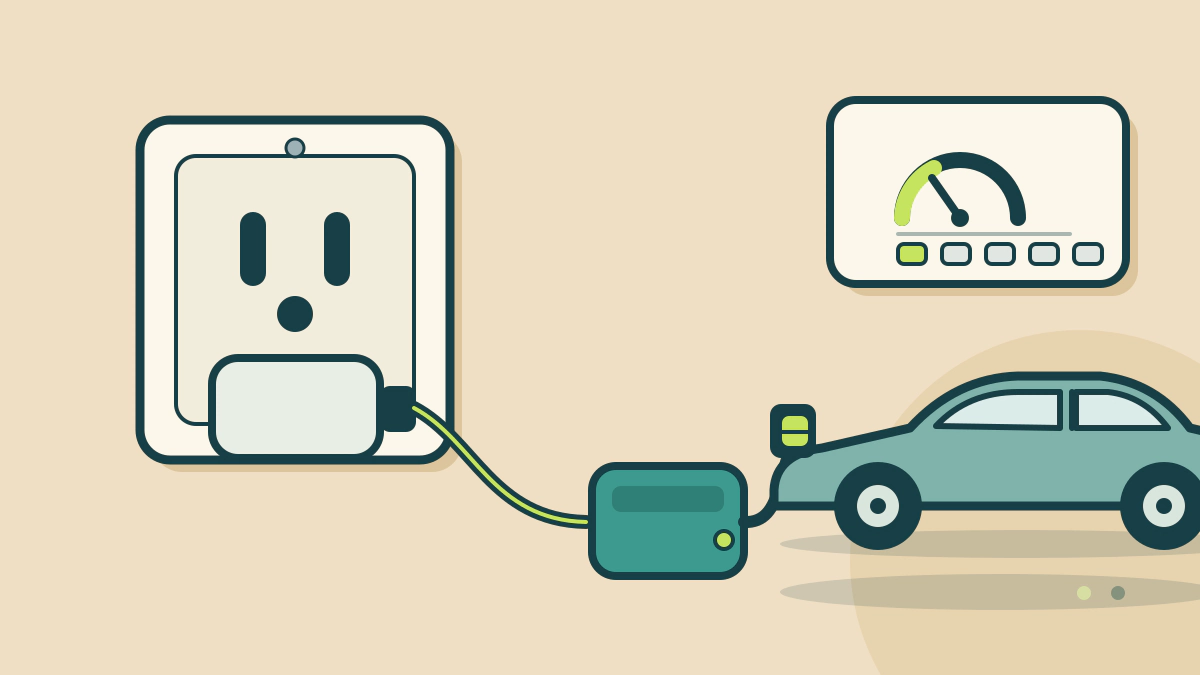
See what a 120-volt household outlet can add to an EV, what the circuit and cord require, and how to estimate an overnight charge with simple arithmetic.
Can an EV charge from a standard 120-volt outlet?
Yes. Most EVs come with a Level 1 charging cord that plugs into a common 120-volt household outlet, and it typically adds only a few miles of range per hour, which suits some commutes and not others. The DOE Alternative Fuels Data Center says most EVs ship with a portable Level 1 cordset, with a standard household plug such as a NEMA 5-15 on one end and a J1772 connector on the other.
The 2023 Chevrolet Bolt EUV owner manual describes the same option as Level 1 (120 volt) charging.
What the outlet and circuit must provide
The AFDC home-charging page says Level 1 can meet daily needs when a power outlet on a dedicated branch circuit is available near the parking spot. It notes that EV charging is a continuous load under the National Electrical Code, and Article 625 covers most charging equipment.
The Bolt manual adds owner-level requirements:
- The original charge cord needs a 120-volt circuit with at least 15 amps of capacity.
- The outlet, wiring and protection devices should be inspected for a 12-amp continuous load.
- Do not use an outlet that is worn, damaged, ungrounded or unable to hold the plug firmly.
- Do not use an outlet on a circuit with other electrical loads.
- When charging outdoors, use an outlet that is weatherproof while in use.
The manual says charging can stress a building’s electrical system, so have an electrician inspect the circuit first.
Safety rules the manual states plainly
The Bolt manual puts several warnings under a danger heading. Do not use extension cords, multi-outlet power strips, splitters, grounding adapters, surge protectors or similar devices. Check the outlet and plug while charging and stop if either is hot, then have an electrician service the outlet.
The manual also says to keep the cord out of standing water and mount it to reduce strain on the outlet.
How much range an hour of charging adds
Estimates differ; the table keeps each figure with its source.
| Source | Setting | Range added per hour |
|---|---|---|
| 2023 Bolt EUV manual | 120 V at 8 amps | About 2.8 miles |
| 2023 Bolt EUV manual | 120 V at 12 amps | About 4 miles |
| DOE AFDC | Level 1, based on 1.9 kW | About 5 miles |
| ENERGY STAR | Level 1 | 2 to 5 miles |
ENERGY STAR notes that Level 1 is less efficient than Level 2 and adds range slowly. The AFDC figure assumes a particular power level, so no number is a promise.
The arithmetic for an overnight session
The basic calculation is amps times volts for power, then power times hours for energy.
At the 12-amp setting: 12 A x 120 V = 1,440 W, or 1.44 kW. Over 8 hours, that is 1.44 kW x 8 h = 11.5 kWh drawn at the outlet. At 8 amps, the same arithmetic gives about 7.7 kWh.
Now convert that energy to miles with an illustrative efficiency. If a car uses 30 kWh per 100 miles, 11.5 kWh corresponds to about 38 miles. The real gain will be lower after charging losses and cabin heating.
Use your own miles per kWh and overnight hours; this is arithmetic, not a test result.
Why the car may add less than the outlet allows
The Bolt manual explains one common cause. Its Level 1 cord limit has Reduced (8 amps) and Maximum (12 amps) settings, and the setting resets to 8 amps each time the vehicle is driven. If you expect 12-amp charging and never reselect it, the session runs slower.
Other causes include a cold battery, cabin heating, a nearly full battery and charging losses. The same manual says a full charge takes longer in extreme temperatures. For the broader comparison, read Level 1 vs Level 2 vs DC fast charging.
When 120 volts is enough, and when it is not
ENERGY STAR suggests 120-volt charging for drivers covering less than 40 miles a day or for plug-in hybrids. Chevrolet says Level 1 can cover an average daily commute of 40 miles per charge. Those are broad guides, not guarantees.
A 120-volt cord is a poor fit when you drive far more than that, own a large battery, share one outlet between two EVs, or return late with only a few hours before departure. In those cases a 240-volt circuit does the same job in less time. Compare the options in how to choose a home EV charger.
Before relying on an outlet, confirm the circuit with an electrician, set the cord to a supported current and watch the first sessions for heat. Stop using the outlet if anything is damaged or uncertain.
Frequently asked questions
Can I use an extension cord to reach my car?
No, not according to the Bolt manual, which prohibits extension cords, power strips, splitters and similar devices. Use the manufacturer’s cord and a suitable outlet, or have an electrician add a circuit.
How long does a full charge take on 120 volts?
It depends on battery size and starting charge. The Bolt EUV manual lists about 79 hours at 8 amps and about 55 hours at 12 amps for that vehicle. For the variables behind that range, read how long it takes to charge an electric car.
Will 120-volt charging damage the battery?
The Bolt manual presents Level 1 as a normal charging method, and the car manages the session. The bigger risks concern the outlet, cord and circuit.
Can I charge in the rain?
The AFDC says outdoor charging is safe, even in rain, when the installation and equipment are rated for outdoor use. The Bolt manual says to use an outlet that is weatherproof while in use and to keep the cord out of standing water.