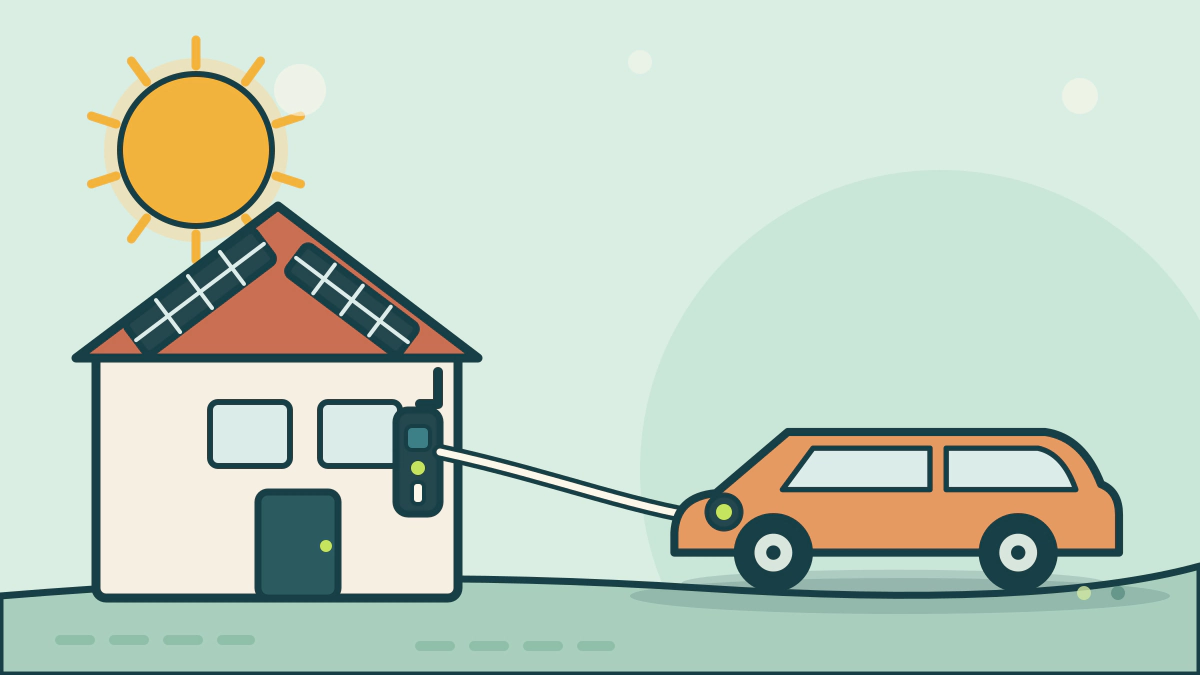
Rooftop solar can supply an EV through the house wiring, but production, inverter and charger limits decide how many miles the array really covers.
Can solar panels charge an EV?
Yes. A home solar array can supply the electricity an EV uses, but the panels do not connect to the car’s charge port. The array makes direct current, an inverter changes it to alternating current, and the charger sends that AC power to the car. The vehicle’s onboard charger converts it back to DC.
Each part of that chain sets a different limit.
The path from roof to battery
| Stage | What flows | Where the conversion happens |
|---|---|---|
| Solar array | DC | Panels on the roof or ground |
| Inverter | DC to AC | Central inverter or microinverters |
| Home circuit | AC | Electrical panel and charger branch circuit |
| EV charger | AC | Wall-mounted unit or portable cordset |
| Vehicle | AC to DC | Onboard charger |
DOE’s solar office says inverters convert the direct current produced by photovoltaic modules into alternating current, which is what homes and most appliances use. A system can use one inverter for the whole array or a microinverter on each panel. [DOE]
For home charging, the charger’s AC output and the car’s onboard charger matter more than the panels. AFDC says a typical residential Level 2 unit runs at up to 30 amps and 7.2 kW and needs a dedicated 40-amp circuit under NEC Article 625. [AFDC]
Adding panels changes where the energy comes from, not the rate the car accepts.
Does the sun have to shine while the car charges?
No. A grid-connected array can earn credit during the day and the car can charge later. DOE calls household solar behind-the-meter, because the meter measures what the house buys from the utility. Under net metering, the utility subtracts the solar system’s output from the customer’s consumption and credits power exported to the grid. [DOE]
The value depends on state rules and the utility, so check the rate design before sizing an array around an EV.
Timing affects how much solar energy the car uses directly. An AFDC report on solar plus EV charging found a mismatch of several hours between peak solar production and peak charging demand. Daytime workplace charging lines up better than evening home charging, which is when many drivers plug in. [AFDC report]
The kWh arithmetic for a home array
Production estimates belong in kilowatt-hours, not panel watts. PVWatts, the National Laboratory of the Rockies calculator, estimates annual and monthly output from a location, array tilt, orientation and system losses. [PVWatts]
Use a labelled example to see how the numbers connect. The production figure below is an assumption for arithmetic only; run PVWatts for a specific address.
| Input | Example value | Calculation |
|---|---|---|
| Array size | 6 kW | Given |
| Annual yield | 1,400 kWh per kW | Assumption, not a site estimate |
| Annual production | 8,400 kWh | 6 x 1,400 |
| Average daily production | About 23 kWh | 8,400 / 365 |
| EV consumption | 27 kWh per 100 miles | AFDC example |
| Miles supported per day | About 85 miles | 23 / 0.27 |
| Miles supported per year | About 31,000 miles | 8,400 / 0.27 |
AFDC uses 27 kWh per 100 miles in its home-charging cost example, which is 0.27 kWh per mile. [AFDC]
Those results are averages before charging losses. PVWatts also warns that a single year can differ from the long-term typical value, with annual output varying by as much as 10 percent. [PVWatts help]
Seasonal output varies far more than the annual total, so the daily average is a planning figure, not a promise for any week.
What solar does not change about EV charging
Three limits are easy to miss.
- Charging speed. The onboard charger and the circuit set the AC rate. A larger array does not raise either one.
- Power during an outage. DOE says many grid-tied systems detect islanding and disconnect during an outage to protect workers and equipment. Without a battery or backup design, the car will not charge from the panels while the grid is down. [DOE]
- A zero-emissions claim. AFDC notes that an owner would need to buy and retire renewable energy certificates for the load not supplied directly by on-site solar to claim zero emissions. [AFDC report]
These points separate the energy question from the charging-power question.
What to check before sizing an array around an EV
Start with the car’s real consumption. AFDC notes that EV efficiency can be measured in kWh per 100 miles, which turns annual miles into annual energy. Compare that with PVWatts output.
Next, ask the utility about net metering, interconnection and any limit on system size. DOE notes that whether a system qualifies, the eligible size, rates and bill credits depend on state and utility policy. [DOE]
Finally, have a licensed electrician confirm the panel capacity and charger circuit. AFDC recommends certified equipment and a certified electrical contractor, and notes that some homes need added capacity for Level 2 charging. [AFDC]
Keep the units straight. kW and kWh are different measurements, and tracking EV energy expenses shows how billed energy compares with what the car stores.
For the charging side of the plan, see Level 1 vs Level 2 vs DC fast charging and the EV Charging hub.
Frequently asked questions
Can I connect solar panels directly to an EV?
No, not in a normal home installation. The panels produce DC, the inverter makes AC, and the car’s onboard charger converts it back to DC. A home array supplies the house circuits, not the charge port.
Will an EV charged from solar be free to run?
Not exactly. If you own the array, most of the fuel cost is the installed system plus any grid electricity you still buy. Net metering credits vary by utility and state.
Can I charge at night from my own panels?
Not directly. Without a home battery, nighttime charging draws from the grid. Net metering may credit daytime exports that offset that purchase, depending on utility rules.
Is solar charging faster than grid charging?
No. The charger circuit and the car’s onboard charger set the AC rate; the source of the electricity does not change it.