Learn how V2L, V2H and V2G differ, what hardware each needs, why utilities require interconnection, and how warranty terms affect home backup.
What does bidirectional EV charging mean?
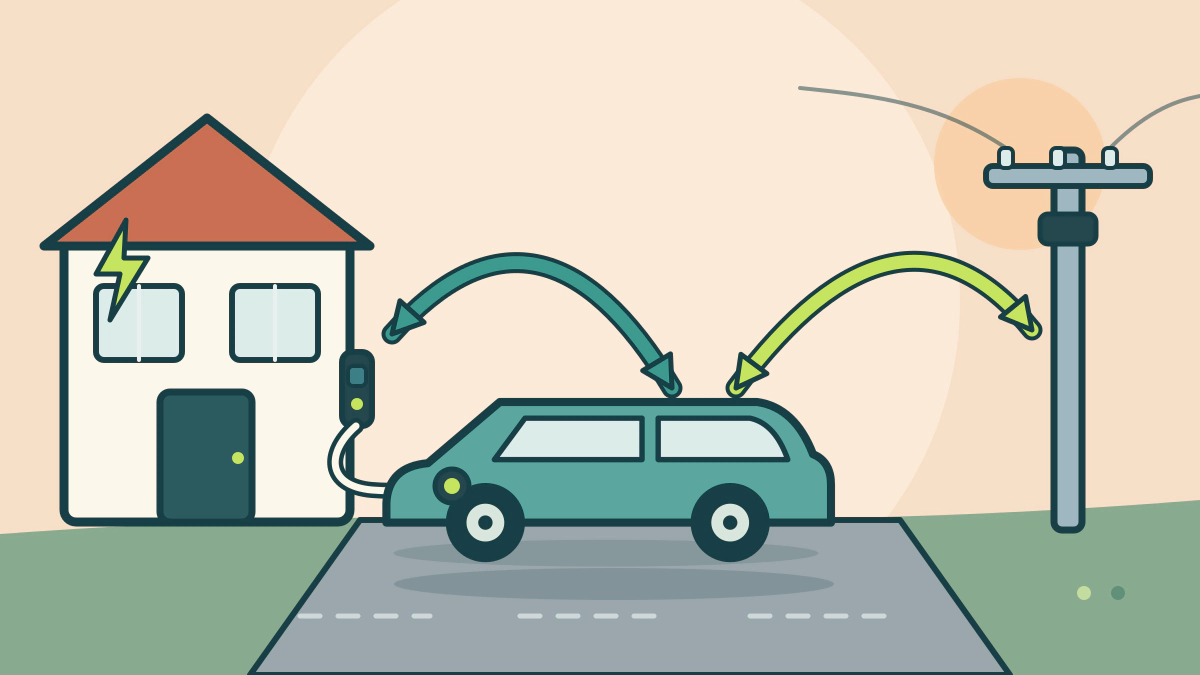
Bidirectional charging means the vehicle battery can both receive electricity and send it back out to an external load. DOE’s Federal Energy Management Program defines a bidirectional EV as one that can charge from electric vehicle supply equipment and discharge to an external load when paired with equipment that supports the same flow. [DOE FEMP]
The umbrella term is V2X, or vehicle-to-everything. A one-way managed system, V1G, only shifts when the car charges; it never sends energy back. [AFDC]
The four modes you will see
| Mode | What it powers | Extra equipment | Utility approval |
|---|---|---|---|
| V2L, vehicle-to-load | Appliance, tool or off-board load | Car outlet or maker adapter | None for an isolated load |
| V2H, vehicle-to-home | One house’s circuits | Bidirectional charger plus transfer equipment | Depends on grid-parallel export |
| V2B, vehicle-to-building | Many building loads | Disconnect switch, certified charger, building controls | Often |
| V2G, vehicle-to-grid | The public grid | Certified charger, net meter, interconnection agreement | Yes |
AFDC describes V2L as an individual off-board load, V2B as a whole building, and V2G as the grid. It says V2B needs a disconnect switch, certified bidirectional equipment and building controls; V2G needs a net meter and close utility involvement. DOE’s 2025 vehicle-grid report groups the modes as power to homes (V2H), buildings (V2B) and the grid (V2G). [DOE]
A battery stores direct current, while a house and grid use alternating current. The inverter can sit in the vehicle or the charging equipment.
PNNL’s standards review says SAE J3072 sets requirements for V2G over AC connections with an onboard vehicle inverter. It also says ISO 15118-20 defines messages that support bidirectional power transfer between vehicle and charger. [PNNL]
A bidirectional-capable car is not enough: charger, installation and vehicle must support the same mode. Tesla says its Cybertruck uses onboard inverters certified to UL 1741. [Tesla]
V2L is the simple end of the range
V2L is the mode most drivers meet first. AFDC says it is common at remote worksites and campsites.
A 2026 Kia US owner’s manual describes the limits. The car supplies AC power from its high-voltage battery; the driver sets a discharge limit. Power cuts off at that limit, and overheating blocks discharge. The manual warns against oversized appliances, damaged cords and linked power strips. It also says failure from modifying the V2L connector is not covered by the warranty. [Kia manual]
V2L does not use the home’s panel or a transfer switch, so it is not home backup.
V2H and V2B need a transfer point
Home backup needs a way to disconnect from the utility before the vehicle energizes the premises. Otherwise power can flow backward into lines workers believe are dead.
Tesla’s system uses a Powershare Gateway and Universal Wall Connector, or Powerwall 3, and requires a certified installer. Tesla says it detects an outage and supplies the home with up to 11.5 kW of continuous power. [Tesla]
PG&E says a system that can discharge while the grid is operating must be interconnected under Electric Rule 21. One that discharges only during an outage can be installed as backup generation only. [PG&E]
V2B applies the same idea to a whole building, with added controls so power is not fed back into the grid. [AFDC] Backup-only still needs transfer equipment and a permitted installation.
V2G is the regulated end
V2G sends power to the grid. DOE says it can support demand management and grid services, but paying programs are not widely available. Ask your utility whether its interconnection agreement permits reverse flow. [DOE FEMP]
PG&E’s V2X program requires an approved vehicle and charger, a Rule 21 interconnection agreement, a time-of-use rate, and an electrician certified through the Electric Vehicle Infrastructure Training Program. Study fees apply but are reimbursed.
Availability is patchy. Tesla’s grid support is limited to Cybertruck and limited markets. [Tesla]
Warranty caveats for home backup
Tesla’s 2026 New Vehicle Limited Warranty for Model 3 and Model Y excludes damage from using the vehicle as a stationary power source unless it explicitly supports Powershare, the required equipment is professionally installed, and a Tesla-approved charging accessory is used. It separately excludes permanent or long-term power use with unusually high throughput, unless the owner is enrolled in a Tesla-supported grid support program. [Tesla warranty]
Charging equipment not included with the vehicle has its own warranty.
Is bidirectional charging worth it for a typical owner?
V2L is the cheapest useful version when the car has an outlet or adapter. It covers tools, camping and small appliances within the car’s power limit.
V2H costs much more: charger, gateway or transfer equipment plus professional installation. Tesla lists hardware near $1,950 and installation around $2,000 to $4,000 without a Powerwall. [Tesla] That can be attractive where outages are frequent and a battery or generator would cost more.
Before buying, check the approved list, your utility’s interconnection rule, the warranty position and whether you need whole-home or critical-load backup. For more on charging, see the EV Charging hub, what an EV charging curve is and Level 1, Level 2 and DC fast charging.
Frequently asked questions
Do I need a special charger for bidirectional charging?
It depends. V2L may use a built-in outlet or adapter. V2H and V2G need bidirectional equipment, because a one-way charger cannot export.
Can I power my whole house with any electric car?
No. The vehicle, charger, transfer equipment, warranty and utility rules must all support the plan. Many cars offer only V2L for appliances.
Is V2G the same as V2H?
No. V2H supplies a home, often during an outage, and can avoid grid export. V2G exports to the grid and normally needs an interconnection agreement.
Does bidirectional charging void my warranty?
Not automatically, but makers set conditions. Tesla’s Model 3 and Model Y warranty excludes stationary power use unless the vehicle supports Powershare and approved equipment is professionally installed.