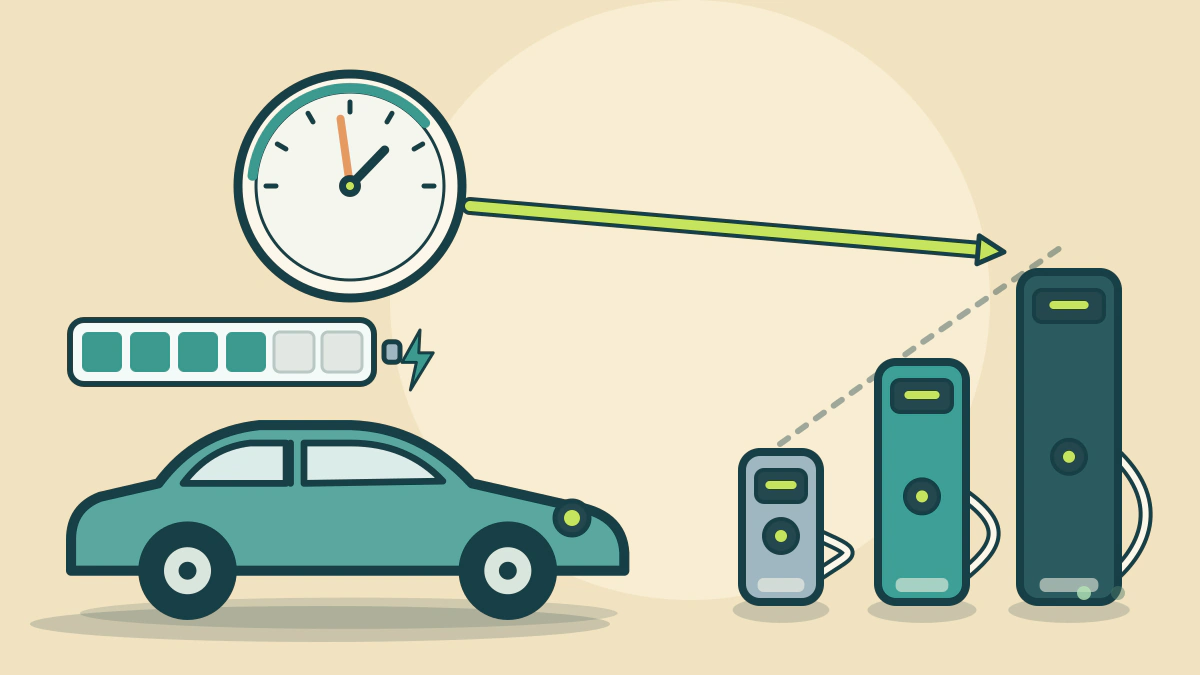
See how EPA label charge times are defined, what each charging level adds per hour, and how to estimate a session from battery size and charger power.
How long does it take to charge an electric car?
Charge time is the energy your battery needs divided by the power the charger and the car can accept, so the same car can take about an hour or more than a day depending on the outlet. A 240-volt home charger usually refills a depleted pack overnight; a standard 120-volt cord is much slower, while DC fast charging adds a large amount of range in a short stop. No single figure fits every model, because window-sticker and manual numbers are estimates under stated conditions.
What the charge time on the window sticker means
Every new EV’s fuel economy label includes a charge time. EPA’s explanation of the electric vehicle label defines it as the time needed to charge a fully empty battery using 240-volt service. All vehicles with external charging get a 240-volt figure, even if the car can also use 120 volts. EPA adds that using a lower voltage results in longer charging times and points owners to the manufacturer for complete charging information.
Two consequences follow. The label time starts from empty, which drivers rarely do. And it uses one fixed voltage, so it cannot describe a DC fast-charging stop.
How much range each charging level adds
| Charging option | Supply | EPA estimate | DOE AFDC estimate |
|---|---|---|---|
| Level 1 | 120 V AC | About 5 miles per hour | 2 to 5 miles per hour |
| Level 2 | 240 V AC | About 25 miles per hour | 10 to 30 miles per hour |
| DC fast | High-power DC | About 100 to 300+ miles per 30 minutes | 100 to 200+ miles per 30 minutes |
EPA’s figures carry a footnote. The Green Vehicle Guide charging basics page states that its miles-per-hour estimates assume 1.9 kW for Level 1 and 6.6 kW for Level 2. The DOE Alternative Fuels Data Center gives the same categories as ranges rather than single values.
These are miles added per hour, not the time to fill a battery, and a more efficient car gains more miles from the same electricity.
The arithmetic: hours equal kWh divided by kW
The core calculation is simple: take the energy you need in kilowatt-hours, divide by the power delivered in kilowatts, and you get hours.
Suppose a car needs 60 kWh added and the equipment delivers 6.6 kW at the battery. That is:
60 kWh divided by 6.6 kW = 9.1 hours, or about nine hours.
The same 60 kWh through a 120-volt Level 1 connection at EPA’s 1.9 kW assumption would be:
60 kWh divided by 1.9 kW = 31.6 hours, or more than a day.
Both results are labelled arithmetic, not a promise for a particular model. Real sessions run longer: some energy is lost as heat, the car’s onboard charger caps AC power, and the battery does not accept its maximum rate across the whole session. That behaviour is what a charging curve describes.
Kilowatts measure power and kilowatt-hours measure energy, so mixing them produces nonsense. Our guide to kW versus kWh covers the distinction.
Why the manufacturer’s table can differ from yours
Kia publishes a useful example in its EV6 owner’s manual. For the standard battery, AC charging takes about 9 hours at room temperature to reach 100%. The extended battery takes about 11 hours 45 minutes. Portable charging from a household outlet takes about 25 and 33 hours respectively. On DC, a 350 kW charger takes about 18 minutes from 10% to 80% for either pack, and a 50 kW charger takes about 63 or 73 minutes.
The manual adds a notice: battery condition, charger specifications and ambient temperature can change the time required. That applies to every figure in this article.
Note the window chosen: Kia’s DC figures stop at 80% while its AC figures run to 100%, so comparing them directly would overstate DC speed to full. See why DC fast charging slows near full.
Matching an estimate to your own week
Start with miles, not battery capacity. Driving 40 miles a day at about 5 miles gained per hour on a 120-volt outlet needs roughly eight hours plugged in, which an overnight stop covers. EPA notes that many commuters under 40 miles a day find Level 1 sufficient overnight.
For a fully depleted larger pack, the DOE consumer guide says Level 2 can generally charge an all-electric vehicle overnight. That describes typical overnight hours, not a guaranteed time.
If a stop has to be quick, station power, the car’s peak acceptance, battery temperature and starting charge all matter. Our comparison of Level 1, Level 2 and DC fast charging covers the hardware, and the EV Charging hub collects related guides.
Frequently asked questions
Does a bigger battery always take longer to charge?
Not automatically. Time depends on the energy needed and the power accepted. A large pack on a powerful DC charger can gain useful range faster than a small pack on a 120-volt outlet. The chosen charge window also matters.
Is DC fast charging always faster than Level 2?
For a short stop, usually yes, because DC power is far higher. Near a full battery the rate falls, and EPA says charging beyond 80% can sometimes double the time spent. Level 2 remains sensible for hours-long overnight charging.
Why is my car charging slower than the label time?
The label assumes 240 volts and a fully empty battery. Cold or hot weather, a shared charger, a lower-amperage circuit and a high starting charge can all reduce the rate. Check the equipment and the manual before assuming a fault.
Can I estimate charge time from range instead of battery size?
You can, if you know the car’s efficiency. Divide the miles you need by miles per kWh, then divide by charging power. The label’s kWh per 100 miles figure gives that efficiency directly.