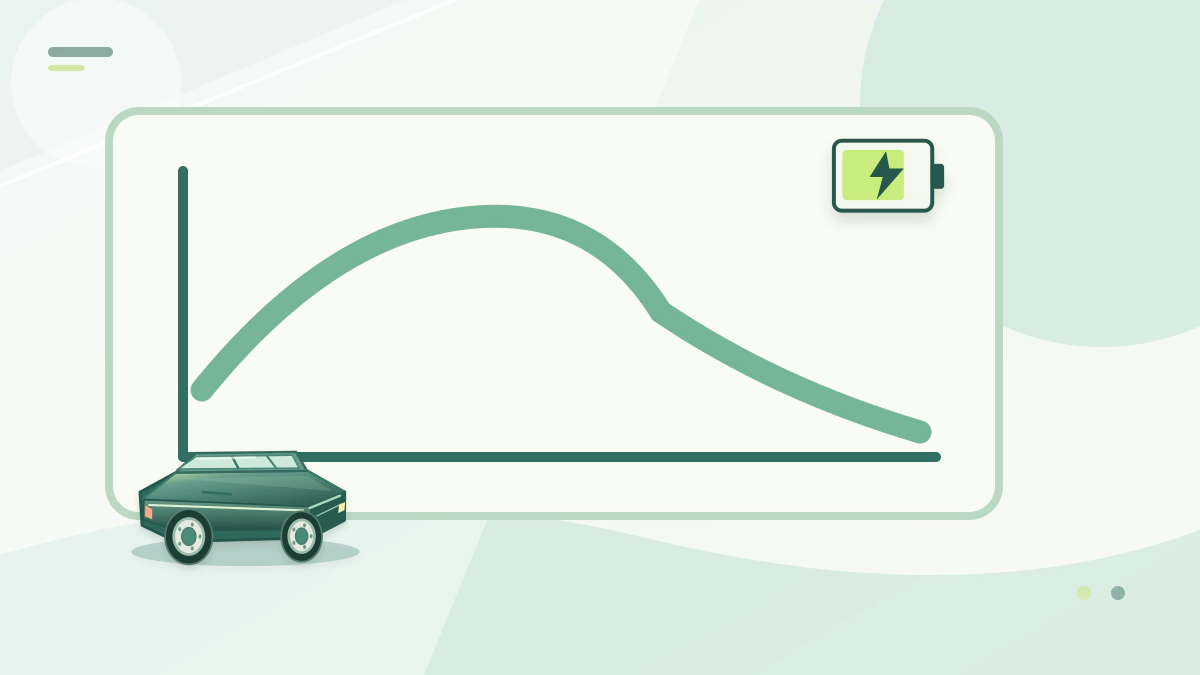
Why DC fast charging often tapers at high state of charge, what affects the curve, and when charging to 80% rather than 100% is more time-efficient on a road trip.
Why does fast charging slow near 80%?
During DC fast charging, a station supplies high-voltage electricity and the vehicle’s battery-management system (BMS) requests a level of power the pack can safely accept.
As the state of charge rises, the battery’s voltage and internal cell conditions change.
The vehicle typically reduces requested power to protect cells and control heat, so the final part of the session may be much slower than the beginning.
80% is a useful road-trip planning rule, not a hard technical boundary. Some EVs taper earlier, later or in several stages.
Station capability, battery temperature, pack design and initial state of charge can all change the curve.
What determines the speed you actually see?
| Factor | Typical effect | What to check |
|---|---|---|
| Battery SOC | High charge often leads to a pronounced power taper | Vehicle’s current percentage and charging curve |
| Battery temperature | Cold or hot packs may accept less power | Manufacturer preconditioning guidance |
| Vehicle max charge acceptance | A 350-kW charger cannot force 350 kW into every car | Rated peak and typical sustained charging profile |
| Station/cable constraints | Power may be lower than advertised maximum | Station status, shared power and charging display |
| Pack health or warnings | The BMS may reduce power when a fault or limitation exists | Diagnostic warning and service guidance |
Charging power is measured in kilowatts (kW).
Energy transferred is measured in kilowatt-hours (kWh). A displayed peak kW does not predict the entire session time because power varies during the charge.
For a primer see kW versus kWh.
Example: why the last 20% can take longer
This is a hypothetical illustration, not a model’s measured curve.
Suppose a 60-kWh usable battery charges 20% to 80%, adding about 36 kWh.
If average battery-side power during that range is 90 kW, the simplified energy/power estimate is about 24 minutes, excluding charging losses and session overhead.
Now assume the final 80% to 100% adds 12 kWh but averages only 20 kW due to taper.
That portion alone would take about 36 minutes under the same simplified calculation.
The actual average powers vary by car and temperature; the point is that less energy can take more time near full.
What EPA and DOE say about the last stretch
The EPA charging basics page says DC fast charging is faster near empty and slows near full. It says charging beyond 80% tends to be significantly slower.
EPA adds that reaching 100% can sometimes double the time spent charging. Suppose a stop took 30 minutes to reach 80%. Doubling would mean about 60 minutes to reach 100%.
That would put 30 extra minutes into the last 20 points. Because EPA says sometimes, your own car may differ.
FuelEconomy.gov gives a second reason. It says charging losses include the battery’s resistance to charging, which increases as the battery reaches capacity.
It also says these losses vary with the vehicle, charging system, battery state and weather.
How to plan a faster DC charging stop
- Check your route’s next charging site, connector and live operational status.
- If supported, use the car’s navigation to enable battery preconditioning in advance.
- Start the session with enough reserve to arrive safely—not an extremely low charge target copied from another driver.
- Watch current kW as well as the percentage; compare with your vehicle’s documented charging behavior.
- On a multi-stop trip, leave when you have sufficient range plus reserve to reach the next reliable option.
- Charge beyond 80% when needed for the next destination, weather, towing or limited charger availability.
EPA notes that charging past around 80% can become considerably slower on many EVs.
That guidance concerns time efficiency on DC chargers, not a universal prohibition against reaching 100%.
When slow charging is a warning sign
An unusually slow session can simply reflect a cold pack, power-sharing, station limits or high SOC. However, repeated unexplained slow charging, charger faults or battery warnings should prompt diagnosis. Do not bypass thermal or safety protections.
Common questions
Will using a 350-kW station always be faster than a 150-kW one?
No. The vehicle may accept much less power than either station offers, or taper quickly. The actual charging curve and conditions determine time.
Is 80% always the correct place to unplug?
No. It is often a useful high-speed road-trip threshold, but destination distance, available chargers, weather and manufacturer instructions may justify another target.
Can charging stop abruptly near 100%?
Many charging sessions end automatically at a configured limit or vehicle-set target. If charging unexpectedly stops with fault warnings, follow the car and station’s troubleshooting and safety instructions.