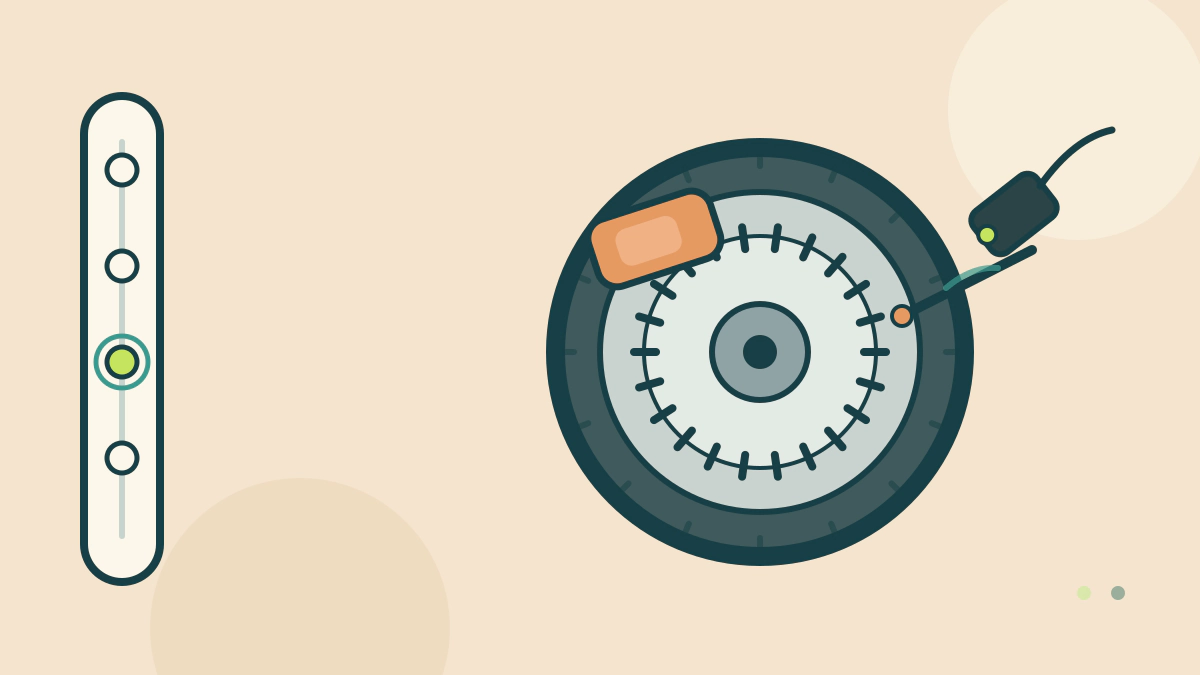
Anti-lock brakes reached US cars in 1971 and went digital in 1978, but ABS became standard through the 2012 stability-control rule, not an ABS law.
When did anti-lock brakes reach passenger cars?
Production anti-lock brakes reached US passenger cars in 1971, the first digitally controlled version arrived in 1978, and ABS became standard in the United States through the 2012 stability-control rule rather than a stand-alone ABS mandate.
Two companies claim a first. Chrysler put a four-wheel anti-skid system on the 1971 Imperial; Mercedes-Benz and Bosch put a digital system on the 1978 S-Class.
Aircraft and patents came before cars
Anti-lock brakes were not invented for cars. The Insurance Institute for Highway Safety notes that the technology was first developed for airplanes (IIHS).
Mercedes-Benz traces its work to 1953, when Hans Scherenberg applied for a patent on preventing wheel lock. The company began working with the electronics firm Teldix in 1966 and presented an analogue-electronic system in 1970 (Mercedes-Benz). It proved the idea worked but was not ready for mass production.
Chrysler’s 1971 Sure-Brake
Chrysler offered Sure-Brake as an option on the 1971 Imperial. An SAE technical paper by Chrysler and Bendix engineers calls it “the first production four-wheel slip control system for passenger cars in the United States” (SAE).
The system watched wheel speed and modulated pressure to keep the wheels rolling. It was a genuine four-wheel system, not a rear-wheel-only helper. It was also an expensive option on a low-volume luxury car, so it did not spread. A system can be first in production and still fail to become the template for later cars.
Bosch and Mercedes made it digital
Bosch began in-house development in 1969, took a stake in Teldix in 1973 and showed its production-ready ABS 2 in 1978 (Bosch). Mercedes-Benz offered it on the S-Class from late 1978 and calls that car the first series-production vehicle available with ABS (Mercedes-Benz).
The digital controller was the breakthrough. It was more reliable and easier to build in volume than analogue electronics. Mercedes made ABS standard across its passenger-car range in 1992 (Mercedes-Benz).
Mercedes’ “first series-production” claim and SAE’s 1971 Chrysler paper cannot both be first under one definition. The difference appears to be scope: a limited option on one American luxury model versus a system Mercedes later made standard. The sources read here do not settle the wording.
What ABS does, and what it does not do
ABS uses wheel speed sensors to detect a wheel about to lock. The controller reduces, holds and reapplies brake pressure. NHTSA’s 1996 consumer guide says the system can cycle as many as 15 times per second and that the driver should keep firm pressure on the pedal (NHTSA).
The pedal may pulse or vibrate. That is normal. Pumping the pedal can defeat the system, which is why advice changed from the old habit of pumping the brakes.
ABS is not mainly a stopping-distance device. NHTSA’s long-term evaluation says the principal goals are to prevent skidding and loss of control and to let the driver steer during hard braking (NHTSA). In NHTSA’s track tests, four-wheel ABS shortened stops by about 5 percent on dry concrete and about 14 percent on wet asphalt or concrete. On gravel it lengthened stops by about 28 percent.
Why the US got ABS without an ABS law
NHTSA’s evaluation states that ABS was never explicitly required for passenger vehicles under 10,000 pounds. The agency deferred an ABS requirement indefinitely in 1996 after early crash data showed mixed results (NHTSA).
The rule that changed the fleet was Federal Motor Vehicle Safety Standard 126, which required electronic stability control on new passenger vehicles after September 1, 2011. Every ESC system at the time incorporated ABS hardware, so the ESC rule effectively put ABS on every new car and light truck (NHTSA).
Other vehicles were covered earlier. Georgia’s driver services manual notes that ABS was required on air-brake truck tractors built on or after March 1, 1997 (Georgia DDS). In Europe, ABS became mandatory for new cars in 2004 (Continental).
A short chronology
| Year | Event | Why it mattered |
|---|---|---|
| 1970 | Mercedes and Teldix show an analogue anti-lock system | Proves the concept in a car |
| 1971 | Chrysler offers Sure-Brake on the Imperial | First US production four-wheel anti-skid system |
| 1978 | Bosch ABS 2 and the Mercedes S-Class option | Brings digital control and series production |
| 1992 | Mercedes makes ABS standard on its passenger cars | Shows the cost had fallen for a full range |
| 1997 | US rule requires ABS on air-brake truck tractors | Separate mandate for heavy vehicles |
| 2011 | FMVSS 126 ESC requirement takes full effect | Brings ABS hardware to nearly every new light vehicle |
The dates come from the sources above. The table combines company milestones with regulatory dates, so it is a sequence, not a production count.
For the difference between ABS and stability control, see ABS versus electronic stability control. For a symptom often confused with ABS operation, see why a car vibrates when braking. The Automotive History hub has the rest of the safety timeline, including when cars got airbags.
Frequently asked questions
What was the first car with anti-lock brakes?
It depends on the definition. SAE records Chrysler’s Sure-Brake on the 1971 Imperial as the first US production four-wheel anti-skid system. Mercedes-Benz calls its 1978 S-Class the first series-production car with ABS.
Did the US require ABS on all passenger cars?
Not directly. NHTSA never issued a stand-alone ABS mandate for light vehicles. ABS became effectively universal because the 2011 stability-control rule required ESC, and ESC systems use ABS hardware.
Does ABS always shorten stopping distance?
No. NHTSA’s track tests found shorter stops on dry and wet pavement but longer stops on gravel. The main purpose is to keep the wheels rolling so the driver can steer and the car stays stable.
Why does the brake pedal pulse during hard braking?
The pulse is the system releasing and reapplying pressure many times per second. NHTSA advises the driver to keep steady pressure on the pedal and not pump it. A pulsing pedal during a hard stop is normal.