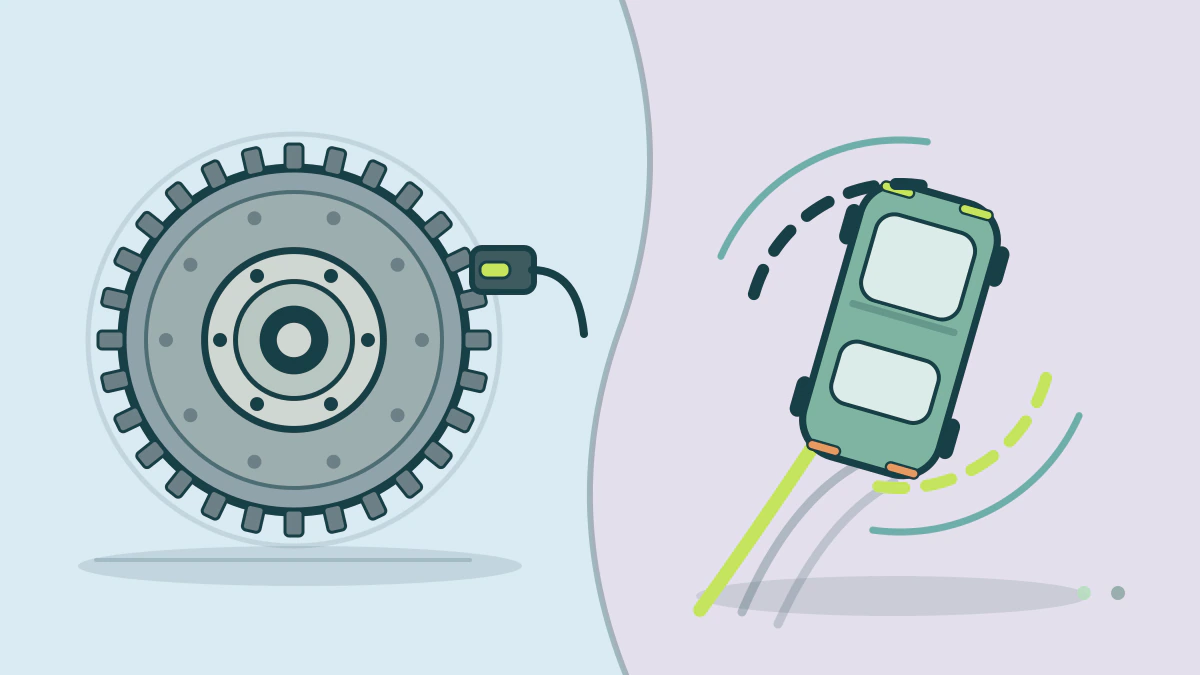
ABS stops wheels locking under braking; stability control uses the same hardware to correct a skid. Compare what each does and what the rules require.
ABS vs stability control: what is the difference?
ABS prevents the wheels from locking during braking so the driver can keep steering; electronic stability control compares the car’s actual path with the driver’s steering input and brakes individual wheels to correct a skid. ABS manages wheel slip in a straight line; stability control manages the car’s rotation around its vertical axis.
Both systems use wheel-speed sensors and the hydraulic brakes. That shared hardware is why the two are often confused.
What ABS is required to do
FMVSS No. 135 defines ABS as a portion of the service brake system that automatically controls the degree of rotational wheel slip during braking. The rule’s stated purpose is safe braking performance in normal and emergency conditions.
The same standard prohibits a control that lets the driver manually disable ABS, fully or partially. That is a practical difference: there is no “ABS Off” button on a compliant light vehicle.
ABS works when the driver presses the brake. It cannot add grip that the road does not offer, and it does not replace winter tires or a safe following distance. Its benefit is steering control, because a locked wheel cannot turn.
What ESC is required to do
FMVSS No. 126 defines ESC as a system that applies and adjusts brake torque at individual wheels to create a correcting yaw moment. It must use a closed-loop algorithm to limit both oversteer and understeer.
The rule requires the system to apply brake torque individually at all four wheels. It must work during acceleration, coasting and braking, except when the driver has switched it off, speed is below 20 km/h (12.4 mph), the car is reversing, or the system is initializing. It must remain able to activate even if ABS or traction control is working.
That is the clearest way to separate the two: ABS is a braking function, while ESC is a stability function that uses braking as one of its tools.
Side-by-side comparison
| Question | ABS | Electronic stability control |
|---|---|---|
| Main job | Prevent wheel lock during braking | Correct oversteer or understeer |
| What it monitors | Wheel speed and slip | Steering angle, yaw rate, lateral acceleration and wheel speeds |
| When it acts | Under braking | Acceleration, coasting or braking, above about 12 mph |
| How it acts | Modulates brake pressure at the slipping wheel | Brakes individual wheels and may reduce engine torque |
| Driver disable control | Prohibited by FMVSS 135 | Allowed by FMVSS 126 |
| Federal rule | FMVSS No. 135 | FMVSS No. 126 |
The table simplifies the sensor sets; the regulatory distinction applies across cars.
The off switch is the biggest owner difference
FMVSS 126 permits an “ESC Off” control, but requires the system to return to its default mode at the start of each ignition cycle. A driver may switch it off for a reason such as freeing a car from snow or mud, but the car is designed to come back with stability control on.
ABS has no equivalent. FMVSS 135 says a control to disable ABS is prohibited. If the ABS lamp is on, the system has reported a fault; the ordinary brakes normally remain, but the antilock function may be unavailable.
What the lights mean
A brief ABS lamp at startup is a bulb check. An ABS lamp that stays on while driving means the system has detected a fault. ABS Warning Light: Common Causes explains the checks and when a brake warning lamp alongside it changes the urgency.
An ESC lamp can flash while the system is working and stay on when there is a malfunction. Some cars use the same or adjacent telltales, so read the owner’s manual for the symbol layout. A flashing lamp during a slippery corner is not a fault.
If you are new to the abbreviation, What Does ABS Stand For? covers the term itself.
What the systems cannot do
ESC cannot overcome physics. IIHS says ESC lowers the risk of a fatal single-vehicle crash by about half and a fatal rollover crash by as much as 80 percent. It also explains that the system engages when it senses instability and helps bring the car back into the intended line of travel.
Those numbers describe crash risk across a fleet. The system still needs tire grip and a surface to work against. ABS has a similar limit: it helps the driver steer while braking hard, but stopping distance still depends on tires, surface and speed.
Neither system replaces the basics covered under Car Safety and Recalls: tires, restraint use and attention. Check the owner’s manual for the telltales and for any ESC Off procedure, and do not assume a button labeled “Traction Off” also disables stability control.
Frequently asked questions
Is ESC the same as traction control?
No. Traction control limits wheelspin during acceleration. ESC limits oversteer and understeer by braking individual wheels. ESC may use traction-control hardware and sensors, but the functions and the federal rules differ.
Does ABS work when the car is not braking?
ABS controls wheel slip during braking. ESC can intervene during acceleration, coasting or braking, which is why its operating range is wider. ABS alone does not correct a skid caused by too much speed in a corner.
Why can I turn off ESC but not ABS?
FMVSS 126 allows an ESC Off control for situations such as low-speed maneuvering, but requires default reactivation at each ignition cycle. FMVSS 135 prohibits a control that disables ABS. Follow the owner’s manual for the correct procedure.
Does ESC reduce stopping distance?
Not necessarily. ESC is aimed at directional stability, not minimum stopping distance. ABS also cannot guarantee a shorter stop on every surface. Tires and speed remain the main limits.