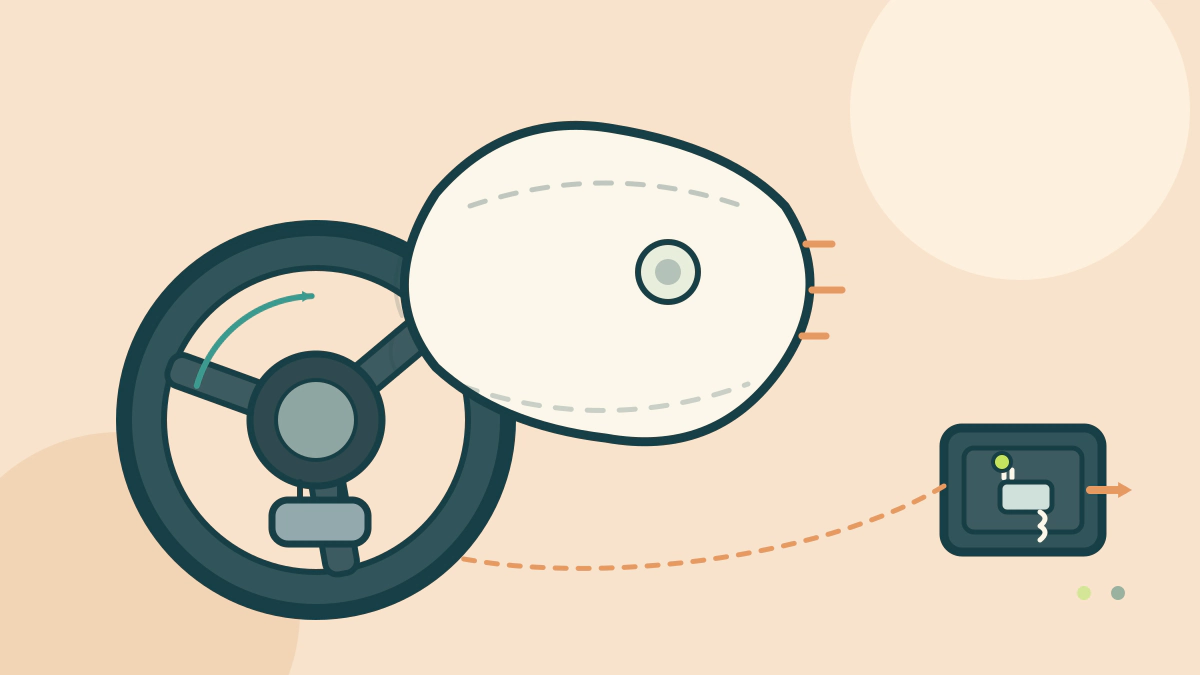
Follow an airbag from crash signal to inflation, see when frontal and side bags deploy, and learn why replacement and servicing belong to trained technicians.
What does an airbag do?
An airbag is a supplemental restraint that cushions the head and upper body in a moderate to severe crash, and it is designed to work with a seat belt rather than replace it. The National Highway Traffic Safety Administration describes frontal and side airbags as supplemental protection. A belt holds the occupant in place, and the bag softens the contact with the steering wheel, dashboard or door.
NHTSA warns that an airbag can injure or kill someone who is too close when it opens. Sit as far back as practical, and keep children under 13 in the back seat. The Car Safety hub covers the wider set of occupant-protection topics.
The sequence inside a crash
The NHTSA airbag page lays out the chain. In a moderate to severe crash, a signal goes from the airbag system’s electronic control unit to an inflator inside the airbag module. An igniter starts a chemical reaction that produces a gas, and the bag inflates in less than one twentieth of a second.
There is no second use. NHTSA says a deployed bag must be replaced at an authorized repair center before the vehicle is driven again.
When a frontal airbag deploys
Frontal airbags are generally designed to deploy in moderate to severe frontal or near-frontal crashes. NHTSA’s FAQ defines that as a crash equivalent to hitting a solid, fixed barrier at 8 to 14 mph or higher.
They do not deploy in every crash. A moderate impact may not need a bag if the occupant is belted, and the system may decide not to fire. An airbag that fails to deploy in an injury-producing crash should be reported to NHTSA.
Federal Motor Vehicle Safety Standard No. 208 sets the crash protection requirements. 49 CFR 571.208 requires passenger cars built on or after September 1, 1997 to have an inflatable restraint at the driver’s and right front passenger’s positions.
Side airbags work in less space
Side-impact airbags inflate even faster because there is less distance between the occupant and the striking object, which may be a door, another vehicle, a tree or a pole. The bag has to fill the gap between the occupant and the door trim. Seat covers can interfere with that path, as the side airbag seat cover guide explains.
Side airbags are not required in the same way as frontal bags. NHTSA says they are offered as standard or optional equipment on many new passenger vehicles. Frontal airbags have been standard since the late 1990s; the history of airbags explains how that changed.
Position, seat belts and children
NHTSA recommends keeping at least 10 inches between the airbag cover and the driver’s chest or the passenger’s chest. Move the seat back as far as it goes while still reaching the pedals comfortably.
A rear-facing child seat should never go in front of an active frontal airbag. NHTSA says children under 13 should ride in the back seat in the correct restraint. Some advanced systems can suppress the passenger bag for a small occupant or an empty seat, but that does not make the front seat safe for a rear-facing seat.
| Factor | What it changes |
|---|---|
| Crash severity | Frontal bags are designed for moderate to severe crashes, not every bump |
| Impact direction | Frontal and side systems respond to different crash geometry |
| Occupant position | Sitting too close raises the risk of injury from the bag itself |
| Seat belt use | The bag is supplemental; the belt does the primary restraining |
| Prior deployment | A used bag cannot fire twice and must be replaced |
| Replacement part | Counterfeit or substandard inflators may fail or throw debris |
Why servicing is professional work
Airbag work is not a DIY job. The inflator contains a chemical charge, and the module has to be diagnosed and tested after any repair. NHTSA says deployed bags must be replaced at an authorized repair center. Only authorized dealers and repair shops can install an airbag on-off switch, and only with an authorization letter from NHTSA.
There is a parts problem too. NHTSA has identified counterfeit airbags that may have been sold online to consumers or repair shops. Counterfeit bags have malfunctioned in ways that range from not deploying to throwing metal fragments. A 2024 NHTSA consumer alert warned about cheap replacement inflators linked to deaths and serious injuries. Genuine parts and a trained installer are the safe route. A warning light is another reason to seek service, as this airbag warning guide explains.
The Takata recall is still relevant
NHTSA says Takata airbags installed in tens of millions of US vehicles are subject to recall because a defect may cause them to explode. If you own a used car, check its recall status by vehicle identification number at NHTSA’s recall lookup rather than assuming a previous owner handled it.
Frequently asked questions
Do airbags replace seat belts?
No. NHTSA describes airbags as supplemental protection designed to work with seat belts. The belt holds the occupant in position and absorbs crash energy. An unbelted occupant can move into the bag while it is still opening.
Why did the airbag not deploy in my crash?
Deployment depends on crash severity, direction and system design. A moderate impact may not trigger a bag when the belt already provides protection. Some advanced systems suppress the passenger bag for a small occupant or an empty seat. Report a failed deployment in an injury-producing crash to NHTSA.
Can I replace an airbag myself?
No. NHTSA says deployed airbags must be replaced at an authorized repair center, and the inflator is a chemical device that needs proper handling. Counterfeit inflators are a documented danger, so use genuine parts and a trained technician.
Is my car affected by the Takata recall?
Possibly, even if you are not the original owner. NHTSA says the recall covers tens of millions of vehicles. Enter your vehicle identification number in NHTSA’s recall lookup to see whether an open recall applies. A dealer replaces the affected inflator for free.