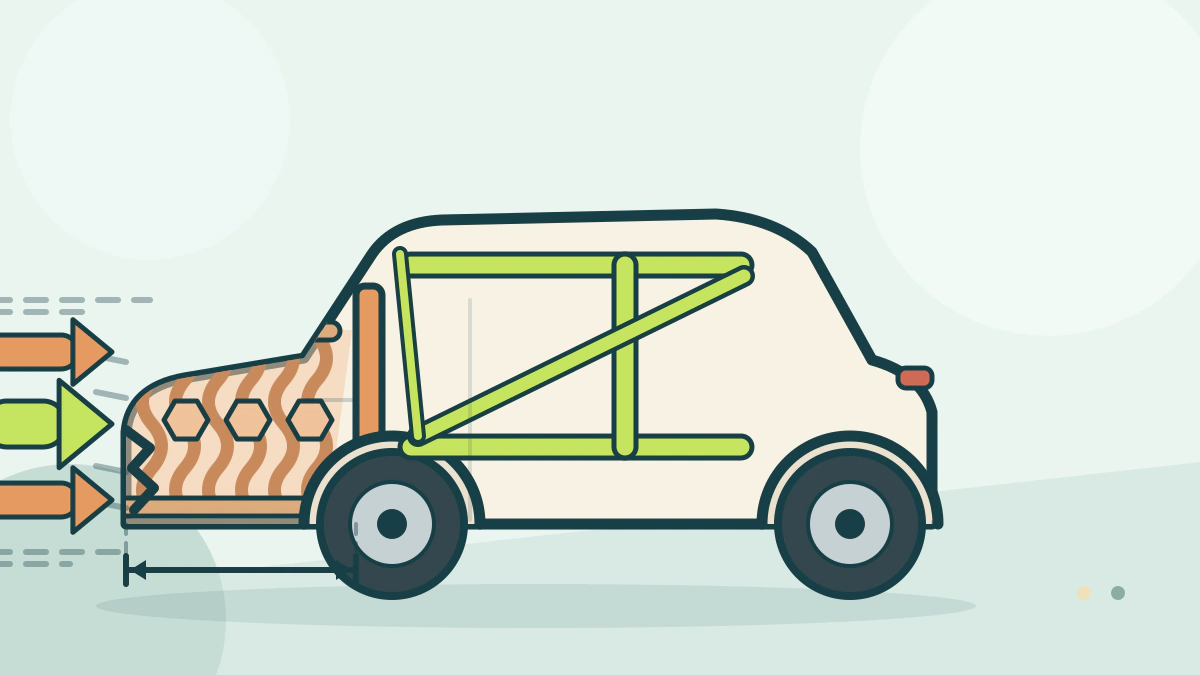
See how a car's crumple zones absorb crash energy, why the occupant compartment must stay strong, and where crumple zones stop helping.
What is a crumple zone?
A crumple zone is a section of a vehicle designed to crush in a crash and absorb energy before it reaches the occupants. IIHS describes the part of the car between the front bumper and the occupant compartment doing this work by crumpling.
The idea is simple. A crash turns motion into a sudden stop. A front end that crushes uses up energy and takes time, so less force reaches the people inside.
IIHS puts it directly on its vehicle size and weight page. The energy-absorbing structure absorbs energy from crashes by crumpling. A longer front end gives it more room to crush.
Crumple zone and safety cage have opposite jobs
A crumple zone is meant to bend. The occupant compartment, often called the safety cage, is meant to stay intact. IIHS lists a strong occupant compartment and crumple zones as separate parts of a crashworthy design on its shopping for safety page.
That split shows up in crash tests. IIHS measures intrusion into the occupant compartment at key locations; less intrusion means the cage held its shape.
| Part of the car | Job in a crash | What it protects against |
|---|---|---|
| Front crumple zone | Crushes and absorbs energy | Force reaching the cabin |
| Occupant compartment | Resists deformation | Cabin collapse |
| Seat belts | Hold occupants in position | Occupant movement |
| Air bags | Cushion the head and chest | Head and chest injury |
| Side structure | Resists a hit from the side | Intrusion into the seating area |
| Roof | Resists collapse in a rollover | Roof crush in a rollover |
The moderate overlap and small overlap test pages describe those intrusion and dummy measurements.
Why a longer front end helps in a frontal crash
A longer distance between the bumper and the cabin gives the structure more room to crush. IIHS says longer front ends offer better protection in frontal crashes for that reason.
That benefit is limited to frontal crashes. IIHS notes that frontal crashes account for more than half of passenger vehicle occupant deaths, which is why the front structure gets so much attention.
Weight matters too, but in a different way. In a crash between two vehicles, the heavier one pushes the lighter one backward. The people in the heavier vehicle face less force. That is why IIHS says ratings can only be compared among vehicles of similar weight.
Where crumple zones stop helping
A crumple zone is a frontal story. Side impact protection depends on door beams, pillars and side air bags. Rollover protection depends on a roof that resists collapse. IIHS lists those as separate elements of a crashworthy design.
IIHS’s published description of energy absorption focuses on the front. Do not assume a strong frontal result tells you how the rear of the car will behave.
A crumple zone also does nothing for an occupant who is not restrained. The belts and air bags manage the people.
Crumple zones work with seat belts and air bags
NHTSA calls air bags supplemental protection designed to work best with seat belts. They are not a substitute. Frontal air bags are generally designed to deploy in moderate to severe frontal crashes.
NHTSA also says an air bag can deploy only once and must be replaced before the vehicle is driven again. That matters after a crash. A crushed crumple zone and a used air bag both need attention before the car goes back on the road.
The federal baseline for frontal protection is FMVSS 208. It requires a belted barrier test at up to 30 mph, with an enhanced option tested at up to 35 mph. Consumer tests such as the IIHS 40 mph frontal tests go further.
What this means for repairs and shopping
A crumple zone that has already been crushed may not absorb energy the same way again. After a frontal crash, the front structure needs to be measured and repaired to the manufacturer’s specifications. A cosmetic repair that hides bent structure is not the same job.
That is why a post-crash inspection matters. See how to check for hidden damage after a crash. For a used car, the same warning signs apply, as described in how to check for hidden body repairs.
When you compare cars, read the individual frontal test results. A strong cage and a well-designed crush zone should both show up in the intrusion and injury measurements.
The parent hub is Car Safety and Recalls. For the difference between the two testing programs, see NHTSA vs IIHS crash testing.
Frequently asked questions
Are crumple zones meant to stay undamaged in a crash?
No. They are designed to deform. The crushing metal absorbs energy that would otherwise reach the occupant compartment. A front end that looks badly damaged may have done its job, while hidden structural damage still needs professional measurement.
Can a repaired crumple zone work as well as the original?
Only if the structure is restored to the manufacturer’s specifications. Bent rails or panels that are pulled straight and covered with filler may not absorb energy as designed. Ask for the invoice and have the structure checked.
Does a longer crumple zone always mean a safer car?
Not by itself. IIHS says longer front ends help in frontal crashes, but weight, the occupant compartment, restraints and the specific test also matter. Compare results within the same size and weight group.
Do air bags replace the need for seat belts?
No. NHTSA describes air bags as supplemental protection designed to work best with seat belts. Seat belts hold occupants in position and help keep them away from a deploying air bag.