Trace early electric cars from Morrison's 1890s wagon through the 1900 peak, the battery limits and the gasoline changes that ended the market.
Were early electric cars a real market or a niche?
They were a real market, and in 1900 they were roughly a third of the vehicles on US roads. The US Department of Energy calls that period the electric car’s heyday. Electric cars were quiet, easy to drive and did not emit exhaust, which made them attractive in cities (DOE).
That share did not last. By the late 1920s electric cars were all but extinct, according to the Smithsonian (NMAH). The story is about batteries, charging, roads and the economics of gasoline.
The first practical American electric car
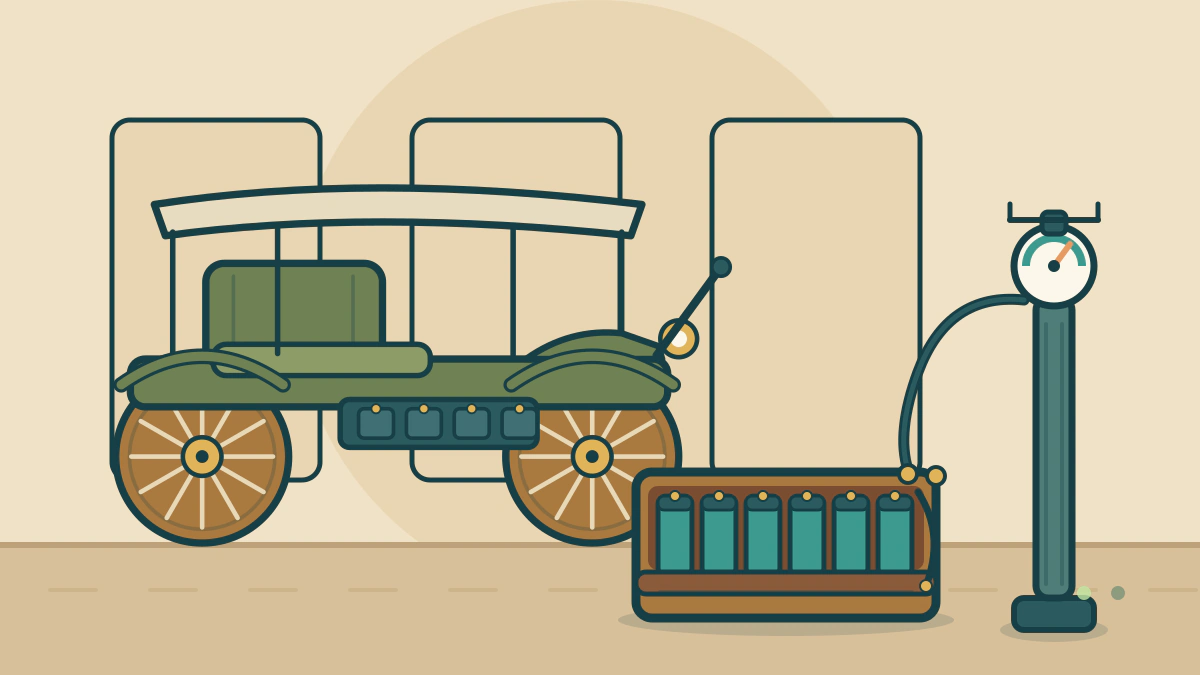
The Department of Energy says the first successful American electric car appeared around 1890. It was built by William Morrison, a chemist in Des Moines, Iowa. His six-passenger vehicle could reach about 14 mph and was little more than an electrified wagon (DOE).
The Library of Congress dates the same vehicle to 1891. It calls Morrison’s wagon “often considered the first practical electric vehicle in the United States” (LOC). The one-year difference is a useful warning: early automotive dates are often approximate.
Neither source names one inventor. DOE says the technology came from a series of battery and motor breakthroughs in several countries (DOE).
Who bought them, and why
Early electrics were urban cars. DOE says they were popular with city residents, especially women, because they were clean, quiet and simple to operate (DOE).
The Smithsonian’s collection records the same pattern. Physicians and affluent women bought electric cars because they were comfortable and easy to operate, and cities had power grids for recharging (NMAH).
Price kept the market narrow. The Smithsonian notes that electric cars were expensive and electricity rates were high (NMAH). The museum describes the buyers as wealthy urban owners.
The limits that defined the era
Range was the first limit. The Smithsonian says an electric car did not run very far between charges, and its lead-acid batteries needed frequent maintenance (NMAH).
Charging infrastructure was the second. DOE notes that few Americans outside cities had electricity, even in the 1920s (DOE). A car that charged at home worked in a city. It did not work on a farm or on a long trip.
Battery care was the third. The Smithsonian describes battery maintenance as complicated and hazardous, often left to a commercial garage (NMAH). That added cost to ownership.
A short chronology
| Year | Event | Source |
|---|---|---|
| c. 1890-1891 | Morrison builds a six-passenger electric wagon in Iowa | DOE; Library of Congress |
| 1897 | First 12 electric cabs operate in New York City | Library of Congress |
| 1900 | Electric cars are about one-third of US vehicles | DOE |
| 1904 | Columbia electric runabout built in Hartford, Connecticut | Smithsonian |
| 1912 | Electric starter arrives; gasoline car about $650, electric roadster about $1,750 | DOE |
| 1914-1935 | Electric car sales decline and the cars leave the market | Library of Congress |
The table mixes a national share with individual models, so read it as a timeline, not a sales series. The sources do not give a single consistent production count for every year.
What pushed gasoline ahead
Three changes did most of the work.
First, the Model T. Ford introduced it in 1908 and pushed gasoline cars toward mass-market prices. DOE compares a gasoline car at about $650 in 1912 with an electric roadster at about $1,750 (DOE). The production side of that shift is covered in how mass production changed the auto industry.
Second, the electric starter. DOE credits Charles Kettering with introducing it in 1912 (DOE). The Smithsonian says gasoline makers took two electric-car advantages, switch-on starting and electric lighting, and added them to their own cars (NMAH). By the late 1920s those features were standard. The electric car’s ease-of-use advantage was gone.
Third, fuel and roads. By the 1920s the US had better roads between cities, cheap Texas crude and a growing network of filling stations (DOE). Gasoline was portable energy. Electricity was not, outside the grid.
The Library of Congress dates the decline from 1914 to 1935, when the cars disappeared (LOC).
What the early electric era proves
The early market shows that electric drive is not new. It also shows that adoption depends on more than the motor. Batteries, charging access and the price of the competing fuel set the pace.
The decline was a system effect, not a single defeat. A cheaper car, a starter, cheap fuel and better roads arrived close together (DOE). Each one made the gasoline car a little more usable for the average buyer.
That pattern still matters. A modern EV is judged on range and charging, the same two variables as in 1900. For the modern version, see how long it takes to charge an electric car and what maintenance an electric car needs. The Automotive History hub covers the wider timeline, and electric car insurance explains how coverage differs today.
Frequently asked questions
Were electric cars popular in 1900?
Yes. DOE estimates they were around a third of vehicles on US roads. That share was concentrated in cities and among wealthier buyers.
Who invented the electric car?
No single person is responsible. DOE describes a series of battery and motor breakthroughs in several countries. Morrison’s wagon is often called the first practical American example, but DOE and the Library of Congress date it one year apart.
Why did early electric cars lose to gasoline?
Cheaper mass-produced gasoline cars, the 1912 electric starter, cheap fuel, better roads and limited rural electricity all pushed the same way. Electric cars kept some advantages, but not range or price.
Did early electric cars have enough range?
For city trips, often yes. The Smithsonian says range between charges was short, and early electrics were mainly city cars. For travel between cities, no, and charging outside cities was difficult.