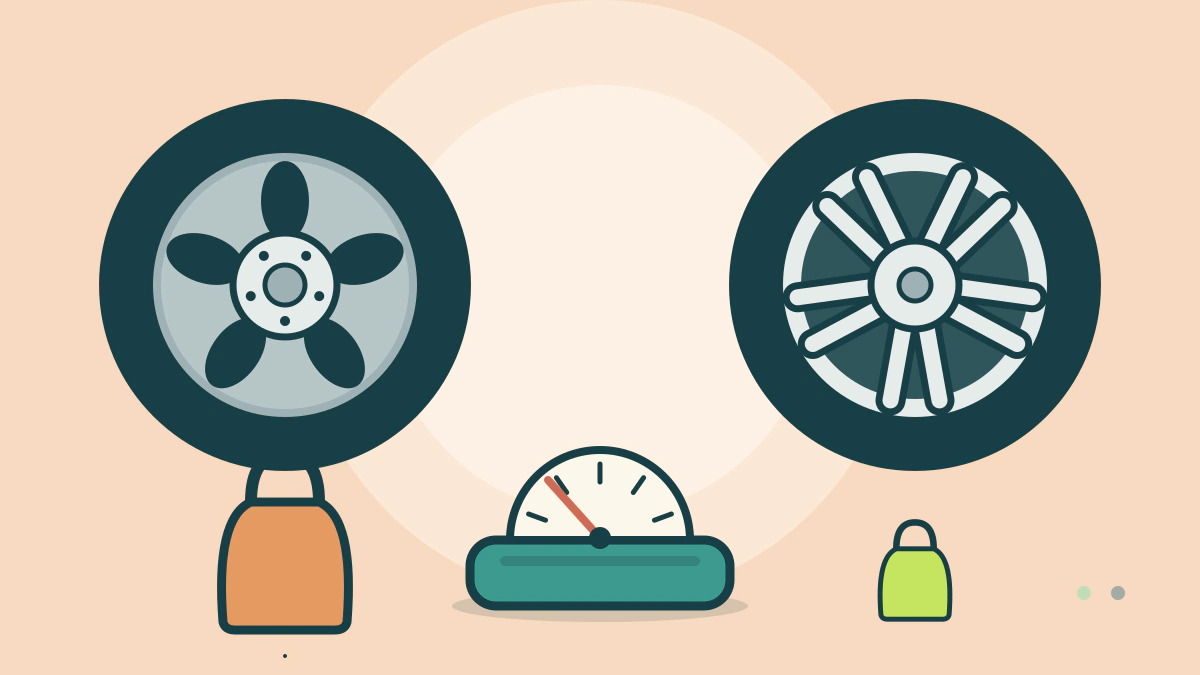
Compare steel and alloy wheels on weight, care, corrosion, TPMS and lug nut fit, using owner's manual statements and clearly labelled reasoning.
Which is better, steel or alloy wheels?
Neither is better for every car; the right wheel is the one your manufacturer supports for your model, in the correct size, offset, nut seat and sensor setup. Steel wheels and alloy wheels differ in material, finish and care. Those differences matter less than getting the fit right.
This guide compares the two types using what owner’s manuals actually say. Where a point is general reasoning instead of a manufacturer statement, the text says so. It does not quote prices, because they change by wheel, brand and retailer.
Weight and unsprung mass: what can be reasoned
The following is general engineering reasoning, not a measured result. The wheel, tire and brakes are “unsprung” weight: the springs do not carry it. In principle, a lighter wheel asks less of the suspension when it moves over bumps.
That does not mean every alloy wheel is lighter than every steel wheel. Weight depends on the exact design, size and width. A large, wide alloy wheel can weigh more than a small, plain steel one.
If weight matters to you, compare the listed weights of the two exact wheels you are considering. Do not assume a type is lighter. The tire is also part of the rotating mass, so a heavier tire can cancel out a lighter wheel.
Care, corrosion and repair: what manuals say
Corrosion and finish care are where manuals give concrete direction. The Kia 2026 K5 manual says its aluminum wheels carry a clear protective finish. It tells owners to avoid abrasive cleaners, polishing compound, solvents and wire brushes, and to avoid alkaline or acid detergents.
The same manual says to clean the wheels after driving on salted roads, because that helps prevent corrosion. It also says to avoid high-speed vehicle wash brushes on them.
The manuals reviewed for this guide do not give a repair standard for either wheel type. If a wheel is damaged or corroded, ask the wheel maker or a dealer whether it can be serviced or must be replaced. Our guide to what causes a bent wheel covers the damage side.
Manual statements that change with wheel type
| Topic | What the sources say | What to do |
|---|---|---|
| Finish care | Kia: aluminum wheels have a clear protective finish; no abrasive, solvent, acid or alkaline cleaners | Follow your own manual’s wheel cleaning section |
| Tire chains | Kia: do not use tire chains on aluminum wheels; if unavoidable, use wire chains | Check the chain advice for your wheel type |
| Balance weights | Kia: improper wheel weights can damage aluminum wheels; use approved weights | Tell the shop which wheels you have |
| TPMS sensors | Kia: a sensor sits inside each tire behind the valve stem; use TPMS-specific wheels | Confirm the new wheels accept sensors |
| Replacement wheels | Kia: new wheels must match the original in diameter, rim width and offset | Compare all three numbers |
TPMS and lug nut seat: check before you swap
Two details often get missed when changing wheel type. The first is the tire pressure monitoring system. NHTSA explains that a direct system uses sensors in the tires, while an indirect system uses wheel speed and other vehicle sensors. If your car has direct sensors, the new wheels and sensors must work together.
Kia says each wheel has a pressure sensor behind the valve stem and that TPMS-specific wheels must be used. The Kia manual also says to check the TPMS malfunction telltale after replacing tires or wheels, because replacement wheels can stop the system working properly.
The second detail is the lug nut. Kia says the same nuts must go back on, or replacements with metric threads and the same chamfer configuration. Hyundai’s CN7 manual says to install lug nuts with the smaller end closest to the wheel. Nut shape and wheel seat must match, so do not assume the nuts from one wheel fit another type.
Tightening torque is model-specific. Follow your manual, and see our guide on using a torque wrench correctly.
How to decide for your car
- Read the tires and wheels section of your owner’s manual for the supported wheel size.
- Read the tire and loading information label by the driver’s door. Our guide to the tire pressure placard versus the sidewall explains it.
- Match diameter, rim width and offset to the original, as Kia’s manual requires.
- Confirm TPMS sensor compatibility and the correct lug nuts.
- Ask the wheel maker or a dealer if you are unsure.
For more on this area, see Tires, Wheels and Brakes.
Frequently asked questions
Are alloy wheels always lighter than steel wheels?
No. Weight depends on the specific design, size and width. Compare the listed weight of the two exact wheels instead of assuming one type is lighter.
Can I put steel wheels on a car that came with alloy wheels?
Only if the size, offset, bolt pattern, nut seat and TPMS setup match what the manufacturer supports. Kia’s manual warns that wheels outside its specifications may fit poorly and cause unusual handling. Ask a dealer or the wheel maker first.
Do alloy wheels need special cleaning?
Many do. Kia’s manual says its aluminum wheels have a clear protective finish and warns against abrasive, solvent, acid and alkaline products. Read the wheel care section of your own manual.
Will my TPMS work with different wheels?
Not automatically. Kia says its TPMS sensors sit inside the tire behind the valve stem and that TPMS-specific wheels are required. Check the warning light after any wheel change and ask the installer about sensors.