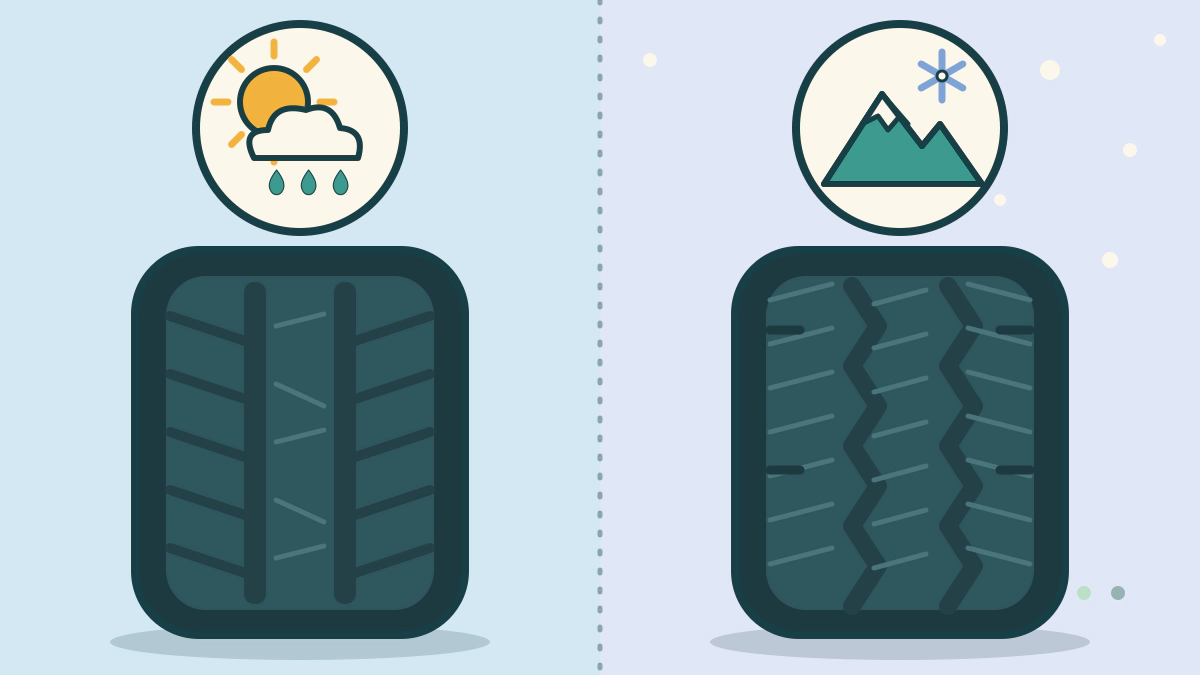
Learn how all-season and all-weather tires differ, what the M+S and three-peak mountain snowflake markings mean, and what the sources do and do not promise.
All-season vs all-weather tires: what the label really tells you
“All-weather” is a sales term rather than a government tire category, so the useful check is whether the sidewall carries the three-peak mountain snowflake symbol. An all-season tire without that symbol may still be sold for year-round use. The sources read for this guide do not define “all-weather” at all.
This guide explains the markings so you can compare a specific tire. It does not name brands or rank products. For a dedicated cold-weather tire, read our winter tires vs all-season tires guide. The wider topic lives in Tires, Wheels and Brakes.
What the all-season label promises
NHTSA’s tire buying guidance says all-season tires handle a variety of road conditions and have some mud and snow capability. It also says winter tires are more effective in deep snow. NHTSA does not list “all-weather” as a separate type.
The 2025 Ram 2500/3500 owner’s manual is more specific about marks. It says all-season tires carry an M+S, M&S, M/S or MS marking on the sidewall. It says snow tires carry a mountain and snowflake symbol. Summer tires, it adds, have neither mark.
What the snowflake symbol means
Transport Canada’s winter tire briefing explains the symbol. Manufacturers certify that a winter tire passes a traction test on medium packed snow. The tire must score at least 110 against a reference tire, which is 10 percent better. Passing lets the maker display the three-peak mountain and snowflake pictogram.
The same note says Canadian and US standards for this test are fully aligned. It also says no government minimum exists for winter tire performance on ice in Canada, the United States or the European Union. A snowflake symbol therefore speaks to packed snow, not to ice.
How the markings compare
| Marking on the sidewall | What the sources say it means |
|---|---|
| M+S, M&S, M/S or MS | Identifies an all-season tire in the Ram manual |
| Three-peak mountain snowflake | Tire passed the snow traction test (Transport Canada) |
| Both marks together | Each mark still carries its own meaning |
| No snow marking | Ram says summer tires lack both marks |
| “All-weather” wording | No official definition in the sources read |
An all-season-style tire that also carries the snowflake would meet both descriptions. Whether a seller calls that tire “all-weather” is the seller’s choice, not a rule.
Where the term shows up in law
Colorado’s traction law update shows how loosely the words are used. It names winter tires with the mountain-snowflake icon, all-weather rated tires and M+S tires as acceptable. It also asks for at least 3/16 inch of tread depth. That rule applies to Colorado’s traction law, not to every road.
Other states and provinces set their own rules. Transport Canada’s briefing says provinces and territories decide whether winter tires are required, and Quebec requires them province-wide in winter. Check your own state or province before a mountain trip.
What the sources do not promise
None of the pages read says an all-weather tire performs like a dedicated winter tire. Transport Canada’s winter tire page includes a video of a winter tire and an all-season tire braking on snow and ice. The video’s narration says the all-season setup needed more stopping distance on ice. The narration describes all-season tires, not an all-weather product.
The same page says all-season and summer tires begin to lose elasticity below 7 degrees Celsius, which reduces traction. It also says to install winter tires in sets of four. The Ram manual gives the same advice for all-season, summer and snow tires.
Tire design is always a compromise. FuelEconomy.gov notes that cutting rolling resistance must be balanced against traction, durability and noise. No source here ranks the two categories on fuel economy, so do not assume either one saves fuel.
Steps to choose between them
- Read your owner’s manual tire section for the approved size, load index and speed rating.
- Note how often you face snow or ice, not just cold rain.
- Look at the sidewall of any tire you are quoted for the M+S and snowflake marks.
- Ask the seller for the maker’s specification page for that exact tire.
- Confirm local winter tire or traction rules if you cross state or provincial lines.
Our guide to reading tire size numbers helps with step one. Check pressure monthly whichever type you choose, using the door label rather than the sidewall maximum.
Frequently asked questions
Is an all-weather tire the same as an all-season tire?
Not by definition. All-season is the older label, and NHTSA describes it as covering varied roads with some mud and snow ability. All-weather is a marketing term, and the mark worth checking is the snowflake symbol.
Does the snowflake symbol mean a tire grips on ice?
No. Transport Canada ties the symbol to a snow traction test on medium packed snow. It says no government minimum for ice performance exists in Canada, the United States or the European Union.
Can I mix all-weather tires with other tires?
The Ram manual says to use all-season, summer and snow tires only in sets of four. Transport Canada gives the same advice for winter tires. Check your own manual and ask a tire shop before mixing types.
Are all-weather tires legal for winter traction laws?
It depends on the rule. Colorado’s traction law accepts all-weather rated tires with enough tread depth, but other jurisdictions word their rules differently. Read the exact requirement from your state or provincial transport agency before you travel.