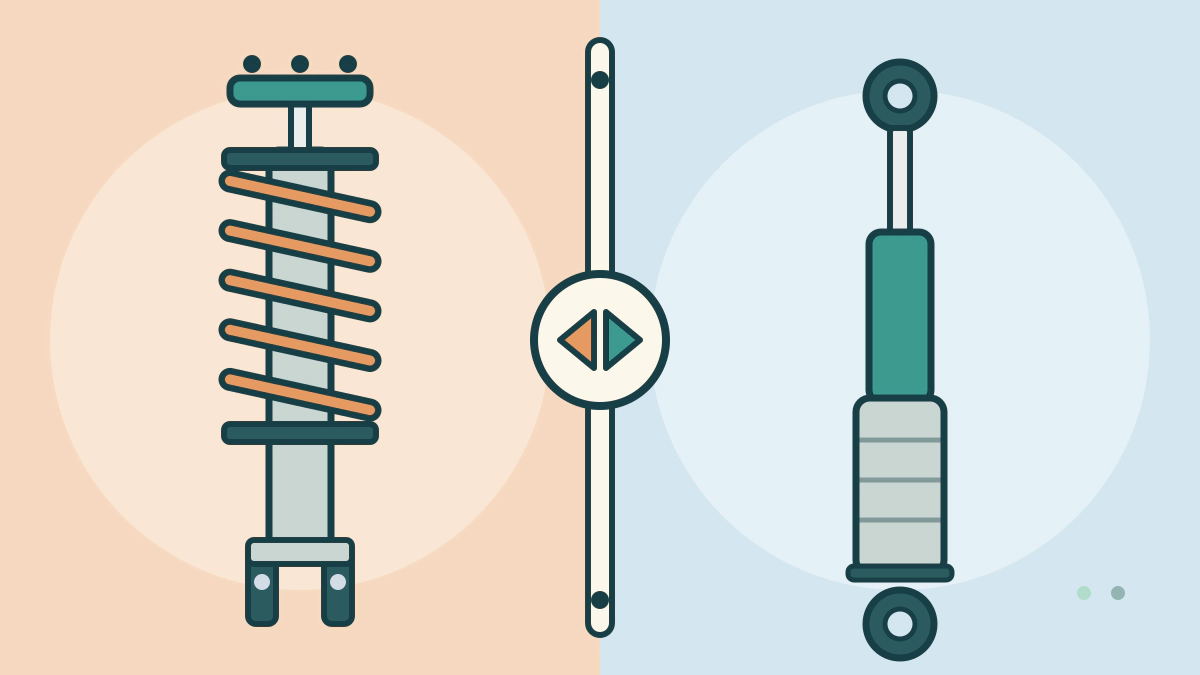
Compare a bad strut with a bad shock absorber using FTC, NHTSA and Pennsylvania inspection sources: what each does, what failure looks like and who names the part.
What is the difference between a bad strut and a bad shock?
A bad shock absorber mainly lets the car bounce and rock, while a bad or loose strut can also affect steering because it is a structural part of the suspension. The public sources treat the two together for ride symptoms. They separate them when a safety recall or a repair estimate names a specific part.
This guide uses consumer, state and federal sources. It does not describe how to tell the parts apart by sight, because none of those sources does. For the wider subject area, see Tires, Wheels and Brakes.
What a worn shock absorber does to the ride
Pennsylvania’s inspection rule gives a plain test for shock absorbers. Inspectors reject a vehicle that keeps rocking freely for more than three cycles after release, which the rule says indicates loss of shock absorber function.
The FTC describes the same job from the driver’s seat. It says worn shock absorbers or other suspension components can contribute to poor cornering. It also describes a loose shock absorber as one source of a random clunk.
So the shock’s role is controlling motion after the wheel meets a bump. When it fails, the symptoms are bounce, rocking, poorer cornering and noise.
Why a strut carries more responsibility
A strut is named differently in federal recall data. NHTSA files some recalls under a component called suspension, front, MacPherson strut. In recall 26V692, Hyundai reported that front strut assembly fasteners may not be tightened properly, which can result in a loss of vehicle steering control.
The remedy in that recall was to inspect and tighten the fasteners and perform a wheel alignment as necessary. That example covers certain 2026 Hyundai models only. It does show that a strut assembly is tied into steering and wheel position, not only ride comfort.
The sources read do not explain how a strut is built inside, so this guide does not either.
How failures compare in the sources
| Finding | Source | What it points to |
|---|---|---|
| Bounces twice or more after a hard push | FTC | Weak shocks, per the FTC test |
| Rocks more than three cycles after release | Pennsylvania rule | Loss of shock absorber function |
| Severe leakage, not slight dampness | Pennsylvania rule | A shock absorber that fails inspection |
| Broken shock mounting bolts or mounts | Pennsylvania rule | A mounting failure, not only a weak shock |
| Random clunk | FTC | A loose shock absorber or other suspension part |
| Loose strut assembly fasteners | NHTSA recall 26V692 | Possible loss of steering control |
How a shop tells which part your car has
No source read for this guide gives a visual rule. The parts differ by vehicle, and even the names differ. Tesla’s Model 3 service manual lists a front damper assembly and a separate rear damper in its suspension procedures. A recall for another model names a front strut.
The reliable route is the manufacturer’s service information for your exact model, which names each part. A recall listing for your vehicle can also name the component.
The FTC says a written estimate should identify the condition to be repaired, the parts needed and the labor charge. Ask that the part be named exactly as the service information names it, and for the position: front, rear, left or right.
Why the bounce test cannot separate the two
The FTC states that there is no hard and fast rule about when to replace shock absorbers or struts. Its test is to bounce the vehicle up and down hard at each wheel and let go. Weak shocks allow the vehicle to bounce twice or more.
That test finds a weak corner. It does not say whether the fault is a worn damper, a leak, a loose mount or a strut problem. A technician inspects the parts to learn that.
Note that the FTC’s “twice or more” and Pennsylvania’s “more than three cycles” are separate yardsticks. One is consumer advice. The other is a state inspection rejection rule.
What else to check before blaming the part
The FTC says springs do not normally wear out and do not need replacement unless one corner of the vehicle is lower than the others. It adds that overloading can damage springs.
The Car Care Council calls steering and suspension key safety-related systems and suggests checking them at least once a year, usually with a wheel alignment. Its symptom list includes pulling to one side, uneven tire wear, excessive noise, vibration or bouncing, and loss of control.
Our guide to why a car squeaks over bumps covers a related noise. For bounce itself, see what causes a car to bounce excessively.
Frequently asked questions
Do all cars have struts?
The sources show that naming varies. NHTSA has a front strut classification used in a recall, while Tesla’s Model 3 manual names dampers. Check the service information for your model rather than assuming.
Is a bad strut more dangerous than a bad shock?
The sources do not rank them. A NHTSA recall shows loose strut assembly fasteners can lead to loss of steering control. The Car Care Council also lists loss of control among suspension symptoms, so any suspension fault deserves a prompt inspection.
Can the bounce test tell me which part is bad?
No. The FTC test shows whether a corner bounces twice or more, which suggests weak shocks. A technician has to inspect the corner to identify the failed part.
Does a leaking shock absorber always fail inspection?
Not in Pennsylvania’s rule, which rejects severe leakage but not slight dampness. Other states have their own rules. Ask a technician to judge any wet shock against the manufacturer’s information.