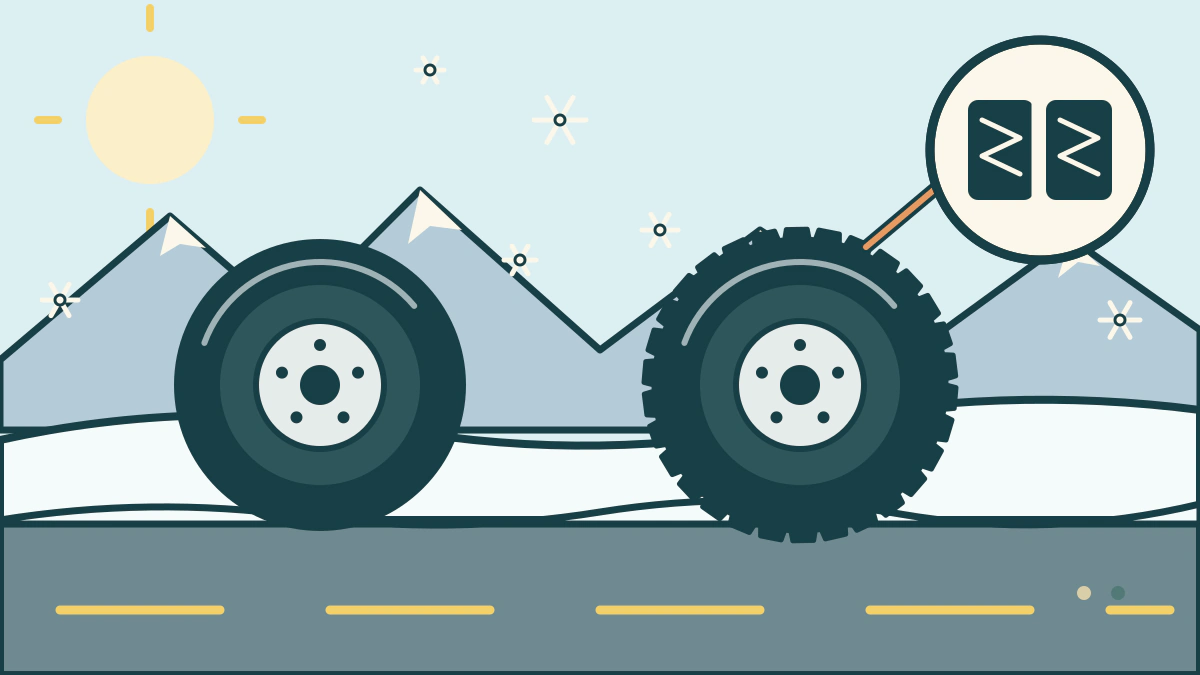
Compare winter and all-season tires using NHTSA, fueleconomy.gov and manual guidance: compounds, tread, M+S and snowflake markings, pressure and fitting rules.
Winter tires vs all-season tires: where the real difference shows up
Winter tires are more effective than all-season tires in deep snow, while all-season tires handle a variety of conditions with some mud and snow capability. That is how NHTSA’s tire buying guidance puts it. NHTSA adds that the right choice varies with where you live and the weather you usually drive in.
This guide is about the tires themselves. If you want to know which vehicle features help in winter, read our guide to comparing cars for winter driving. The wider topic sits in the Tires, Wheels and Brakes hub.
How the two types differ on paper
The sources agree on direction, but they do not give one universal test. Treat the table as a summary of what each source says.
| Feature | Winter tire | All-season tire |
|---|---|---|
| Snow performance | More effective in deep snow (NHTSA) | Some mud and snow capability (NHTSA) |
| Rubber | More flexible compounds for cold-weather traction, says a Canadian tire industry group | Not described in the sources read |
| Tread | Described as sophisticated tread designs | Not described in the sources read |
| Sidewall marks | Snowflake symbol (Canadian group); M+S can also appear (Kia) | M+S, mud and snow (Kia and Canadian group) |
The compound and tread claims come from the Tire and Rubber Association of Canada’s winter tire page. It is a trade group, so read it as an industry view rather than an independent test.
What M+S and the snowflake symbol tell you
Kia’s 2026 K5 owner’s manual says winter and all-weather tires are identified by the M+S (Mud and Snow) marking. The Canadian group says tires with the three-peak mountain snowflake symbol must meet minimum safety standards for winter driving in Canada. It says they must pass the ASTM F-1805 traction test on medium packed snow.
The sources read here include no US federal rule that defines the snowflake symbol, and NHTSA’s tire page does not discuss it. Washington State shows the two marks are separate. Its traction tire rule asks for a mud and snow marking or the mountain/snowflake symbol, plus at least 4/32 inch of tread and a relatively aggressive tread pattern. That rule applies to that state’s traction-device requirements, not to every road.
Also note that the federal grading rule, 49 CFR 575.104, excludes winter-type snow tires. Do not expect treadwear, traction and temperature grades on them.
Cold-weather rules that apply to every tire
Cold air lowers tire pressure. NHTSA’s winter driving tips say to fill each tire to the vehicle maker’s recommended pressure, found in the manual and on a label on the driver’s door frame. Do not use the number on the tire, which is the maximum the tire can hold.
FuelEconomy.gov adds that lower pressure in cold weather increases rolling resistance. It advises checking tire pressure regularly.
NHTSA also says to keep tread at least 2/32 of an inch deep on all tires. In its penny test, if you can see the top of Lincoln’s head, you need new tires. Our winter car maintenance checklist covers other cold-season checks.
Rules for fitting winter tires
Kia’s manual for the 2026 K5 gives specific instructions, and other makers may differ.
- Snow tires should match the original tires in size and load capacity.
- Fit them on all four wheels, or poor handling may result.
- Add 4 psi to the pressure on the door label, or go up to the sidewall maximum, whichever is less.
- Do not drive faster than 75 mph with snow tires fitted.
- Do not use summer tires below 45°F or on snow and ice.
Read your own manual before copying any of these numbers. The pressure and speed limits are that model’s figures, not a universal rule.
Frequently asked questions
Is the M+S marking the same as the snowflake symbol?
No. They are separate sidewall markings. Washington’s rule lists them as alternatives, and the Canadian group ties the snowflake symbol to a specific snow traction test. Check which marking your tire carries.
Do I need winter tires on all four wheels?
Kia’s 2026 K5 manual says snow tires should be on all four wheels, or poor handling may result. Other manuals may add their own rules. Ask a tire shop and check your owner’s manual before fitting only two.
What tire pressure should I use in winter?
Use the pressure on the driver’s door label or in the owner’s manual, not the sidewall maximum. NHTSA says pressure falls as the outside temperature drops. Check the pressure when the tires are cold.
How much tread should winter tires have?
NHTSA says tread should be at least 2/32 of an inch on all tires, and the penny test shows when that point is reached. Washington’s traction tire rule asks for 4/32 inch, but only for that state’s approved traction tires.