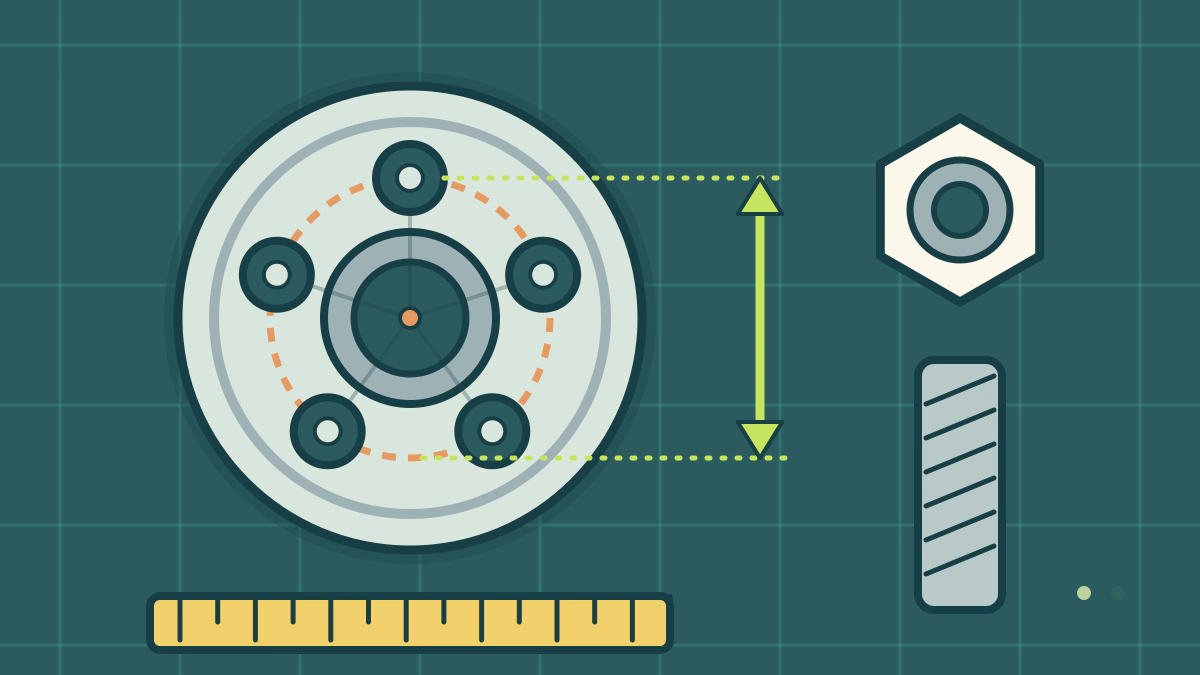
Learn how a wheel bolt pattern pairs lug count with circle diameter, how to check it with simple arithmetic, and why fitment needs more than a match.
What a wheel bolt pattern tells you
A wheel bolt pattern has two parts: how many studs or bolts hold the wheel, and the diameter of the circle that passes through their centers. Wheel makers call that circle measurement the pitch circle diameter, or PCD. Konig Wheels, a wheel maker, defines PCD as the diameter of the circle passing through the centre of all the studs, wheel bolts or wheel rim holes.
So a pattern code is just a lug count and a circle size. Listings often join the two numbers with an “x”, but check the unit a listing uses before you compare numbers. This guide gives no pattern for any vehicle, because those figures belong in your owner’s manual or the wheel maker’s fitment data. It sits in the Tires, Wheels and Brakes hub.
The arithmetic for measuring a pattern
Konig’s page gives a simple method. Measure the distance between two adjacent studs, from the centre of each hole. Call that distance S. Then divide S by a number that depends on the lug count.
| Lug count | PCD formula | Made-up example S | Result |
|---|---|---|---|
| 4 | S / 0.7071 | 70.71 | 100.0 |
| 5 | S / 0.5878 | 67.0 | about 114.0 |
| 6 | S / 0.5 | 62.5 | 125.0 |
These example distances are invented for practice, in the same unit as the answer. They are not the pattern of any real vehicle. Konig’s page also notes a shortcut for four lugs: measure from the centre of one stud to the centre of the stud directly opposite. That note is stated only for four-lug fitments, so use the adjacent-stud formula for five and six.
Why the formula changes with lug count
The divisors are not arbitrary. Studs sit evenly around the circle, so the straight-line gap between neighbors shrinks as the count rises on a circle of the same size. The formula simply reverses that relationship. This is reasoning from the arithmetic, not a claim from the maker, but it explains why you cannot use one divisor for every wheel.
Treat a measured value as a cross-check. A tape or caliper can be off by a little, and a small error changes the result. Confirm it against a published figure.
What else must match besides the pattern
Matching the pattern does not prove a wheel fits. Konig’s installation guidance says vehicles differ widely in stud length, stud size, thread pitch and hub size. It says the correct hardware can only be chosen once the installer or retailer knows exactly which vehicle you have.
Its page lists these checks:
- Lug seat style. Many aftermarket wheels use a conical seat, and a ball seat or flat washer style is not compatible with it.
- Hub fit. If a wheel is not hub-centric for your vehicle, Konig recommends hub-centric rings. It says the installer or retailer should confirm fit at purchase.
- Thread engagement. Konig warns that too few engaged threads can lead to wheel detachment.
- A test fit. Konig advises a test fit before mounting tires, to check brake and body clearance and that the wheel sits flush on the hub.
Offset matters as well. Our guide to what wheel offset means explains it.
Steps to confirm fitment safely
- Find the maker’s data. Check your owner’s manual and ask the vehicle maker or dealer for the wheel specification. Do not guess from memory or a friend’s car.
- Check the wheel’s maker. Ask the wheel maker or retailer to confirm the exact wheel for your exact vehicle.
- Measure as a cross-check. Use the formulas above and compare the result with what the maker states.
- Match the hardware. Konig says it is critical to use the correct lug nut or bolt, because improper hardware can cause a wheel to come loose.
- Check wheel specs. Kia’s 2026 K5 owner’s manual says replacement metal wheels should be equivalent to the factory units in diameter, rim width and offset. It also says wheels that do not meet its specifications may fit poorly and cause unusual handling.
Leave tightening and torque to your manual or a qualified shop, because those figures are model specific. For a comparison of wheel types, see our steel wheels versus alloy wheels guide.
Frequently asked questions
What does PCD stand for on a wheel?
PCD stands for pitch circle diameter. It is the diameter of the circle through the centres of the studs, bolts or bolt holes. It is half of the pattern code, with the lug count as the other half.
Can I use a wheel with a pattern that is close but not exact?
The sources read here give no tolerance for a close match, so do not assume one works. Ask the wheel maker or a qualified installer to confirm the wheel for your exact vehicle. A wrong fit can leave the wheel loose.
Does the same bolt pattern mean a wheel will fit?
No. Stud length, thread pitch, hub size, seat style and offset all matter too, and Konig stresses confirming fit by vehicle. A test fit before mounting tires can reveal clearance problems early.
Where do I find the correct size for my vehicle?
NHTSA says to check your owner’s manual or the Tire and Loading Information Label on the driver’s door edge or post for the correct tire size. For the wheel itself, use the manual or ask the vehicle maker for the specification.