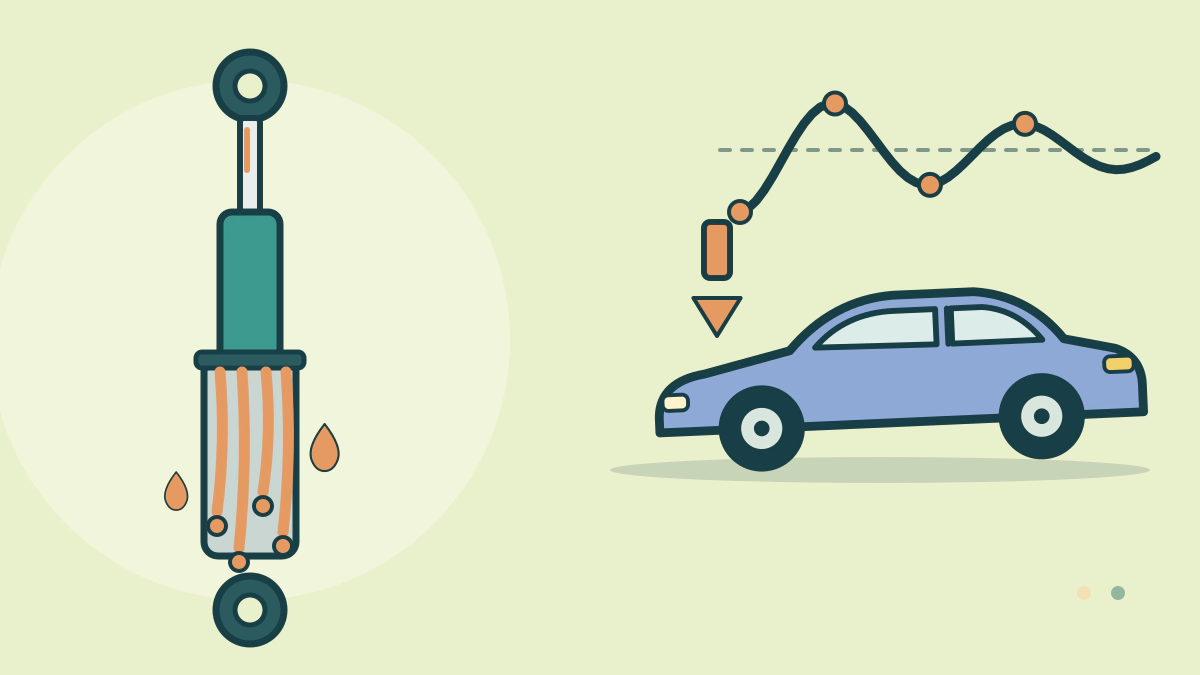
Learn the symptoms of worn shock absorbers, from leaks and rocking to clunks and tire wear, using FTC, Pennsylvania, Ford and Car Care Council sources.
What are the symptoms of worn shock absorbers?
Worn shock absorbers show up as fluid leaks, a car that keeps bouncing or rocking after a bump, poor cornering and a loose, clunking feel. Uneven tire wear can join the list, though several other faults cause it too.
This guide is a symptom checklist, not a repair guide. Which part is worn is a separate question. For the strut and shock comparison, read bad strut versus bad shock. For the wider subject, see Tires, Wheels and Brakes.
Symptoms you can see: leaks and broken mounts
Pennsylvania’s inspection rule gives the clearest visual standard. An inspector rejects a vehicle whose shock absorbers have severe leakage, not slight dampness. The same rule rejects shocks that are missing or have broken mounting bolts or mounts.
So a damp shock is not automatically a failed one, and a dripping one deserves a closer look. Other states set their own rules, and this guide gives no leak measurement.
Ford’s 2014 Escape manual lists a multi-point inspection that includes suspension components for leaks or damage. It is a good item to ask for at a routine visit.
Symptoms you can feel: bounce, rocking and cornering
The FTC says there is no hard and fast rule for replacing shocks. It offers a bounce test instead. Press down hard on the vehicle at each wheel, release, and count the bounces. Weak shocks allow two or more.
Pennsylvania uses a different yardstick. An inspector rejects a vehicle whose rocking continues for more than three cycles after release, which the rule treats as loss of shock function. The two figures are not interchangeable, since one is advice and the other is an inspection rule.
The FTC also says worn shocks or other suspension parts can contribute to poor cornering. The Car Care Council lists excessive noise, vibration or bouncing among the symptoms of steering and suspension trouble, along with a car that pulls and loss of control.
For the reasons behind a car that bounces, see what causes a car to bounce excessively.
Symptoms you can hear: the random clunk
The FTC describes a clunk as a random thumping sound. It names two sources: a loose shock absorber or other suspension component, and a loose exhaust pipe or muffler.
That means a clunk is a reason to inspect, not proof of a worn shock. Our guide to clunking noise over bumps covers the other candidates.
Symptoms on the tires: uneven wear
The Car Care Council lists uneven tire wear as a steering and suspension symptom. That does not make it a shock symptom by itself. NHTSA says irregular wear can come from underinflation or overloading, and Kia’s manual says correct alignment helps decrease tire wear.
The advice from NHTSA and Kia is practical. Rotate tires on schedule, and sooner if irregular wear appears. Kia’s manual gives 8,000 miles for its model, so check your own manual.
How the symptoms compare
| Symptom | What the sources say | Other possible causes |
|---|---|---|
| Severe fluid leak on a shock | Pennsylvania rejects severe leakage, not slight dampness | Needs a technician to judge |
| Bounces twice or more after pushing down | FTC: weak shocks | Not named, so a technician must inspect |
| Rocks more than three cycles | Pennsylvania: loss of shock function | Not named, so a technician must inspect |
| Poor cornering | FTC: worn shocks or other suspension parts | Improper tire inflation, per the FTC |
| Random clunk | FTC: loose shock or other suspension part | A loose exhaust pipe or muffler |
| Uneven tire wear | Car Care Council: steering and suspension symptom | Pressure, overloading, alignment |
Terms the public sources do not define
Drivers often mention nose dive when braking and cupped tire wear. The sources read for this guide do not use or define either term. This guide therefore draws no conclusion from them.
If a shop says your shocks cause one of those, ask what it measured or found on the vehicle. Ask for the finding in the manufacturer’s terms.
What to do once you notice symptoms
The Car Care Council says steering and suspension should be checked at least once a year, usually with a wheel alignment. Note when each symptom happens: over bumps, in turns or when braking.
If a shop recommends replacement, the FTC says a written estimate should identify the condition, the parts and the labor charge. It suggests a second opinion for expensive or complicated work.
Frequently asked questions
Is a damp shock absorber a failed one?
Not necessarily. Pennsylvania’s rule rejects severe leakage but not slight dampness. A technician should judge whether the amount of fluid on your shock is a problem.
How many times should a car bounce after the bounce test?
The FTC says weak shocks allow the vehicle to bounce twice or more. It is a rough consumer test, not a measurement. Have the car inspected if it keeps moving.
Can worn shocks cause uneven tire wear?
The sources do not say so directly. The Car Care Council lists uneven wear as a steering and suspension symptom, while NHTSA names underinflation and overloading. Get the pressure, alignment and suspension all checked.
Is there a mileage at which shocks must be replaced?
The FTC says there is no hard and fast rule. Check your owner’s manual and the symptoms above. Ford’s 2014 Escape manual lists a suspension leak and damage check in its multi-point inspection.