Learn what V2X means for vehicle communication, how V2V, V2I, V2P and V2N differ, and why the term is not the EV power shorthand V2L, V2H or V2G.
What does vehicle-to-everything mean?
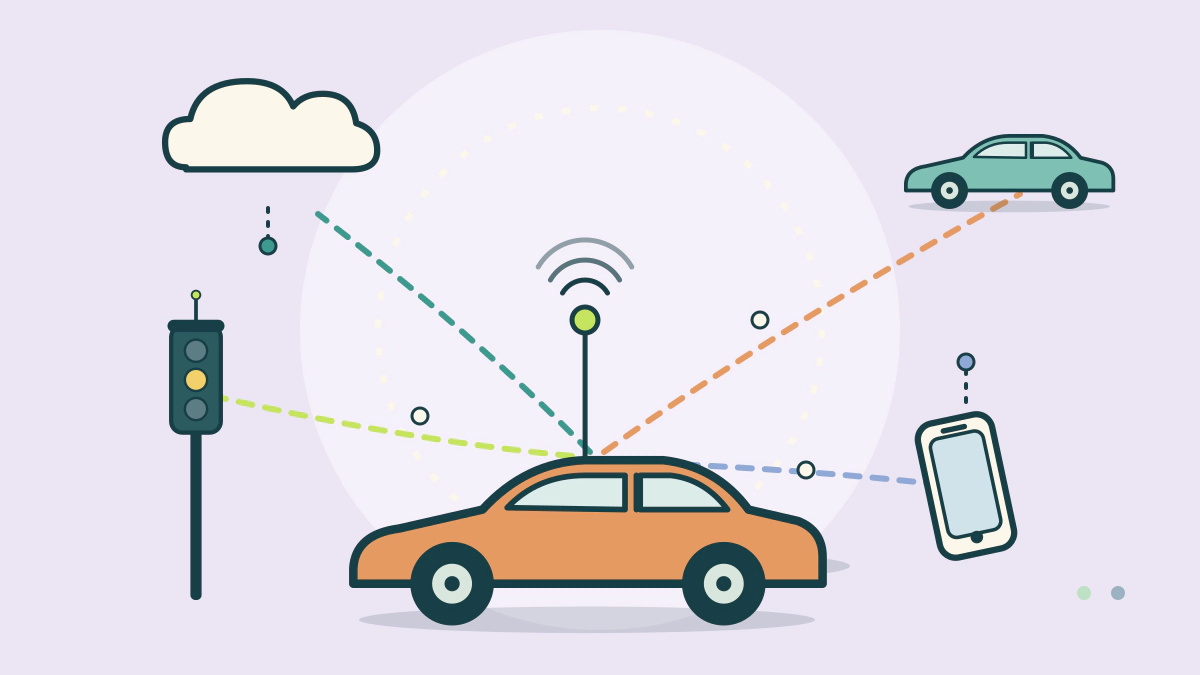
Vehicle-to-everything, or V2X, is wireless data exchange between a vehicle and other vehicles, roadside equipment, people’s devices or a network. It is a family of links, not one product.
USDOT’s ITS Joint Program Office says the goal is secure, interoperable connections among cars, roads and mobile devices. Its plan calls for devices from different makers to work together across the road system. [ITS JPO]
The acronym does not describe electric power. That matters because EV marketing uses a similar set of letters for something else.
The four links under the V2X umbrella
V2V, vehicle to vehicle, is a message from one vehicle to another. A hard-braking alert is the simple example. V2I, vehicle to infrastructure, connects a car to a roadside unit, a traffic signal or a traffic center. V2P, vehicle to pedestrian, reaches a person’s phone or a roadside beacon. V2N, vehicle to network, sends data through a mobile network or cloud service.
FHWA’s V2X Hub work shows the range. It describes communication among vehicles, infrastructure, pedestrians, cyclists and emergency services, including pedestrian messages sent from a phone. [FHWA]
The four labels describe who is talking, not which radio is used.
Direct messages and network messages
There are two delivery paths. A direct link is device to device. It is built for low latency and for awareness around corners or in fog. [ITS JPO]
The network path goes through a carrier or cloud service. It reaches farther, but it is not the path for a split-second crash warning. [ITS JPO] A car can use both: direct for the vehicle ahead, network for a closure many miles away.
The same letters appear in EV charging
This is the naming trap. In the EV world, V2L means vehicle-to-load, V2H means vehicle-to-home and V2G means vehicle-to-grid. All three describe electric power leaving the battery, not data entering the car.
| Term | Field | What it connects | What moves |
|---|---|---|---|
| V2V | Vehicle communication | Car to car | Safety and position data |
| V2I | Vehicle communication | Car to roadside equipment | Signal, lane and hazard data |
| V2P | Vehicle communication | Car to a person’s device | Crossing and presence data |
| V2N | Vehicle communication | Car to a network service | Longer-range alerts |
| V2L | EV charging | Car to a tool or appliance | AC electric power |
| V2G | EV charging | Car to the grid | Electric power for export |
V2H sits between the last two: it powers a building through fixed equipment. Our guide to V2L vs V2H vs V2G explains the hardware, permits and utility approvals.
A quick test is the surrounding words. Backup power, transfer switches and utility interconnection point to the charging terms. Radios, latency, roadside units and signal timing point to communication.
The radio rules behind C-V2X
US V2X safety messages use 5.895 to 5.925 GHz. [ITS JPO] FCC rules divide the hardware. Roadside units sit in part 90, subpart M. On-board units fall under part 95, subpart L. [Part 90] [Part 95]
C-V2X means cellular vehicle-to-everything. The FCC’s rule defines it as cellular radio techniques that move data between roadside and on-board units, or between on-board units, for traffic flow, safety and other ITS uses. [Part 90]
The technology transition has a date. A 2024 FCC order took effect on February 11, 2025. It lets existing DSRC licenses run only until December 14, 2026. [Federal Register] C-V2X is the version with a future in the band.
What is deployed today
The main federal deployment effort is the V2X Accelerator Program. USDOT awarded cooperative agreements worth $60 million in fall 2024 to sites in Arizona, Texas and Utah. [Accelerator]
The schedule is specific. Phase 1 allows up to 18 months to design, build and test. Phase 2 runs at least 12 months of operation and evaluation. Each site must then operate for at least five years without extra federal funds. [Accelerator]
Those are three named sites, not a national network. NHTSA’s published statement also says no final decision had been made on the proposed V2V mandate. [NHTSA]
What V2X can and cannot do for a driver
A warning only helps if the other vehicle or the roadside unit is equipped. A message also has to be trusted. USDOT’s security system issues certificates and can revoke privileges when a device misbehaves. [Spectrum]
V2X does not drive the car. It can warn a driver or feed an assistance system. The driver still has to watch the road. For how warnings travel, see how cars exchange road-hazard information. For signals, see smart traffic lights and connected cars. For assistance versus automation, read driver assistance vs self-driving. The Future Mobility and Innovation hub has the wider section.
Frequently asked questions
Is V2X the same as self-driving?
No. V2X is a communication link. It can warn a driver or feed an assistance system, but it does not steer, brake or accelerate the car.
Does V2X need a cellular subscription?
Not for direct V2V and V2I messages. Network V2X alerts do depend on a mobile network and a service provider.
Is V2X the same as V2L?
No. V2L is vehicle-to-load electric power for tools or appliances. V2X here means vehicle-to-everything data communication. The acronyms overlap but the systems do not.
Is C-V2X the same as DSRC?
No. DSRC on-board units must meet IEEE 802.11p, while C-V2X uses cellular radio techniques. The FCC is ending DSRC use of the band by December 14, 2026.