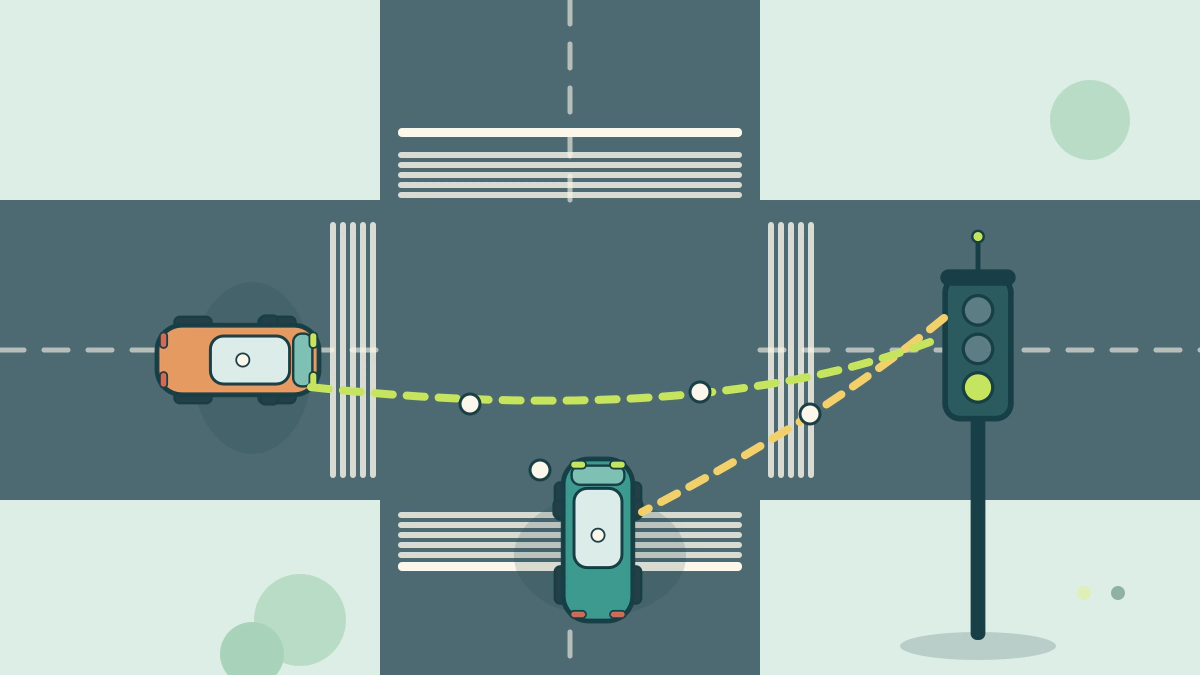
Learn how adaptive signals and connected cars share red, yellow and green timing, and what signal priority and preemption can and cannot do.
Do smart traffic lights really respond to cars?
Yes, but “smart” describes the control software, not one gadget: adaptive signals use sensor and vehicle data to change timing, while connected cars can also receive signal status and ask for priority. FHWA says conventional signals run pre-programmed daily schedules, and adaptive signal control adjusts the timing of red, yellow and green lights as traffic changes. [FHWA]
A connected car does not take over the intersection. It can receive information and, in some systems, request extra green time.
What adaptive signal control changes
FHWA explains the loop: sensors collect data, the system evaluates it, and timing updates follow every few minutes. It says adaptive control improves travel time by more than 10 percent on average, and by 50 percent or more where signal timing is badly outdated. [FHWA]
That gain comes from redistribution, not from faster lights. Green time moves to the approaches that need it. FHWA also says outdated signal timing accounts for more than 10 percent of all traffic delay and congestion on major routes. [FHWA]
Intersections are a sensible target. FHWA says roughly one-quarter of US traffic fatalities and about one-half of traffic injuries each year are attributed to intersections. [FHWA]
What the car can receive from the signal
The most important message is SPaT. It states the current color and the time remaining in that phase. SPaT stands for signal phase and timing. The phase is the current green, yellow or red interval; the timing is how long it will last. A companion MAP message describes the intersection geometry and lanes. The MAP message supplies the lane geometry that turns a phase number into a path the car can follow.
USDOT lists several connected applications that use those messages:
| Application | What the signal shares | What the car does |
|---|---|---|
| Red Light Violation Warning | SPaT and MAP | Warns a driver who is likely to run the light |
| Traffic Signal Optimal Speed Advisory | Current phase and time remaining | Suggests a speed to reach green smoothly |
| Intelligent Traffic Signal System | Phase, priority and pedestrian calls | Coordinates priority across approaches |
| Signal Priority | Vehicle type and requested approach | Extends green for transit, freight or snowplows |
| Emergency Vehicle Preemption | Emergency vehicle approach | Changes timing to clear the path |
| Mobile Accessible Pedestrian Signal | Pedestrian call from a phone | Gives audio cues for crossing |
USDOT describes each of these as a V2I use case. [Mobility] [Safety]
Priority is not the same as preemption
Signal priority gives a little extra green time. Preemption interrupts the normal cycle so an emergency vehicle can pass. USDOT lists Emergency Vehicle Preemption separately from Signal Priority, and the distinction matters for how a city configures its controller. [Mobility] [Safety]
A bus running late may get a few seconds. A fire engine gets the whole intersection.
The hardware behind the curb
A connected intersection needs a roadside unit, a map of the lanes and a secure credential for each device. FCC rules license roadside units under 47 CFR part 90, subpart M, in the 5.895 to 5.925 GHz band. On-board units are covered by part 95, subpart L. [Part 90] [Part 95]
A city also needs a controller that accepts the request and a backhaul link to its traffic management center. A city has to confirm that its controllers support the messages before it plans a deployment.
What can go wrong
The first limit is the fleet. A signal can broadcast all day, but only an equipped car can use the message. A pedestrian without a phone gets no V2P warning.
The second limit is the map. SPaT is only useful if the MAP file matches the actual lanes and crosswalks.
The third is trust. USDOT’s security system issues certificates and can revoke message privileges when a device misbehaves. [Spectrum]
The fourth is authority. Traffic signals belong to state and local agencies, so deployment is a local decision, not a federal switch. FHWA’s role is research, guidance and encouragement. [FHWA]
For the wider network, see vehicle-to-everything communication explained and how cars exchange road-hazard information. For the boundary between assistance and automation, read driver assistance vs self-driving. For the wider section, visit Future Mobility and Innovation.
Frequently asked questions
Are smart traffic lights the same as connected traffic lights?
Not exactly. An adaptive signal adjusts timing from sensor data. A connected signal also broadcasts SPaT and MAP and can accept priority requests.
Can my car request a green light?
Only if the car, the signal controller and the local agency support signal priority or preemption. Passenger cars normally do not get priority.
Do smart signals reduce crashes?
FHWA reports travel-time and congestion benefits for adaptive control. It does not claim a crash reduction for every installation, and safety effects depend on the location.
Will smart signals work without connected cars?
Yes. Adaptive control can run on sensors such as cameras and radar. Connected messages add another input and enable in-car warnings.