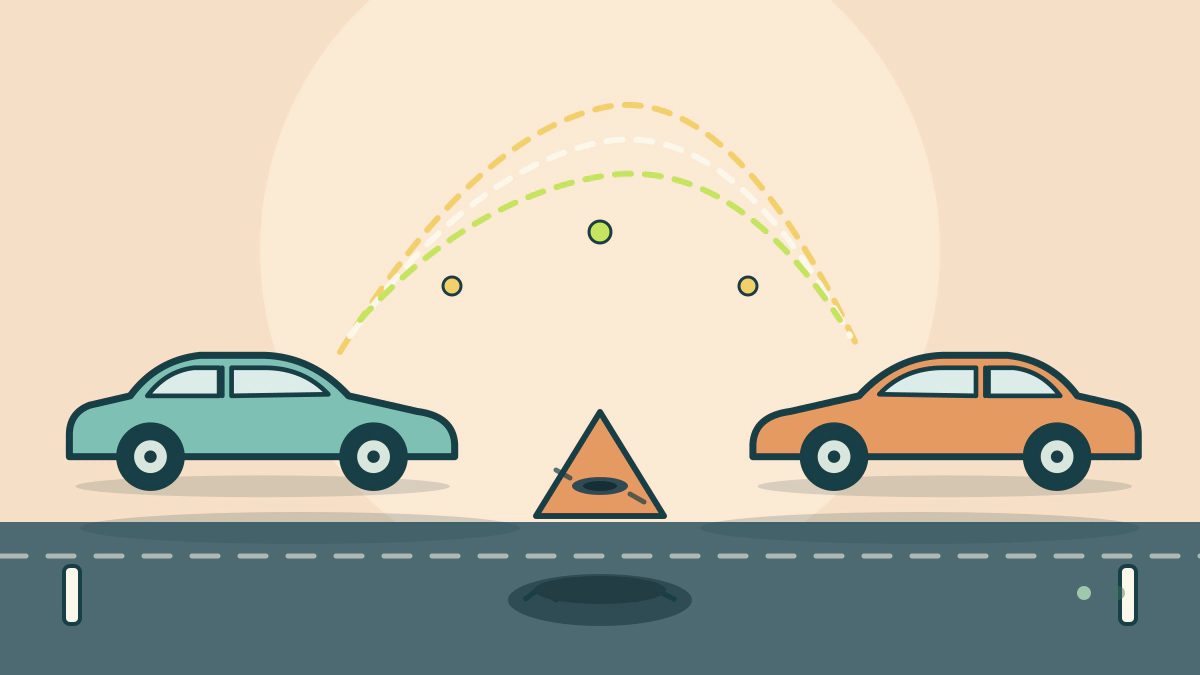
Learn how connected cars share braking, queue, weather and work-zone warnings through direct short-range messages and longer-range networks.
How do cars exchange road-hazard information?
Cars exchange hazard information by broadcasting short, structured safety messages to nearby vehicles and roadside units, and by receiving longer-range alerts through mobile networks. USDOT’s ITS Joint Program Office calls this vehicle-to-everything, or V2X. It describes direct messages that carry relative speed, position and other data from one device to another. The same page says direct V2X gives 360-degree awareness around corners and in dense fog, where eyes and cameras cannot see. [ITS JPO]
The split matters. A direct message is for a crash risk that is seconds away. A network alert is for a hazard that is miles ahead.
What a basic safety message contains
The core message is the Basic Safety Message, or BSM. USDOT’s Safety Pilot Model Deployment describes it plainly. Vehicles used DSRC to send BSMs with speed, location and direction at 10 messages per second. [Safety Pilot]
That rate explains why the system can track a hard stop. Ten position reports per second let a receiving car estimate closing speed and time to collision. The message is not a video and does not carry a driver’s name. USDOT says V2X messages do not identify the driver or vehicle, and controls exist to prevent tracking and tampering. [ITS JPO]
A BSM is also not a map. It is one snapshot from one vehicle, repeated.
Four paths a hazard warning can take
| Path | Who sends | Common hazard | Main limit |
|---|---|---|---|
| V2V, vehicle to vehicle | Nearby cars and trucks | Hard braking, forward collision, blind spot | Both vehicles need compatible equipment |
| V2I, vehicle to infrastructure | Roadside unit or traffic center | Red light, curve speed, work zone, queue | Roadside equipment must be installed |
| V2N, vehicle to network | Mobile network and cloud service | Weather, closures, distant incidents | Needs cellular coverage and a service |
| V2P, vehicle to pedestrian | Phone or beacon carried by a person | Pedestrian in a crosswalk, cyclist ahead | The person must carry a compatible device |
USDOT’s safety list includes Emergency Electronic Brake Lights Warning, Forward Collision Warning and Blind Spot Warning as V2V uses. It lists Curve Speed Warning, Red Light Violation Warning and Work Zone Worker Advisories as V2I uses. [Safety applications]
The mobility list adds Queue Warning, Road Weather Advisories and Incident and Road Closure Advisories. Those are the long-range cases where a network path makes more sense. [Mobility applications]
From a hard stop to a warning on the dashboard
The chain has four steps. A car detects an event, such as heavy braking or a stability control intervention. It broadcasts a message. A nearby car receives the message and checks whether it is genuine. Its system then decides whether to warn the driver, and how urgently.
Latency is the design target. USDOT says direct V2X suits safety applications that need low latency. Network V2X suits information that travels longer distances. [ITS JPO]
GPS is a weak point. USDOT’s LTE-V2X test program says loss of GPS access affects both radio performance and V2V safety application performance. [LTE-V2X] A car that cannot place itself accurately cannot describe a hazard’s location well.
Why the radio rules matter to the warning
V2X safety messages in the United States use the 5.895 to 5.925 GHz band. FCC rules divide the hardware. Roadside units are licensed under 47 CFR part 90, subpart M. On-board units fall under part 95, subpart L. [Part 90] [Part 95]
The rules are mid-transition. The FCC says DSRC stations must stop operating in that band by December 14, 2026, and no new DSRC station licenses were issued after February 11, 2025. [Part 90] C-V2X is the cellular version that remains.
That transition is one reason a used car’s window sticker is a poor guide to what it can receive. Hardware, software and local roadside equipment all have to line up.
What a hazard warning cannot promise
A warning only helps if the other vehicle is equipped and the message is trusted. USDOT’s security system issues certificates that prove a device is a trusted actor, and misbehavior detection can revoke message privileges. [Spectrum]
Coverage is uneven. The federal V2X Accelerator Program is a set of three deployment sites, not a national network. [Accelerator]
NHTSA has not issued a final rule requiring V2V in new cars. Its published statement says no final decision had been made on the proposed rulemaking. [NHTSA]
Automatic crash notification is a separate feature. NHTSA says it contacts emergency responders after an airbag deployment or sudden deceleration and provides the location. [NHTSA] That is a network service, not a peer-to-peer hazard message.
The driver still has to look. For how assistance features differ from automation, see driver assistance vs self-driving. For the in-car network that carries sensor data, see CAN bus. For the wider system, read vehicle-to-everything communication explained and visit Future Mobility and Innovation.
Frequently asked questions
Do all new cars exchange hazard warnings?
No. V2X hardware is not universal, and NHTSA has not finalized a rule requiring it. Some cars offer warnings from cameras and radar only.
Does V2X identify my car to other drivers?
USDOT says V2X messages do not identify the driver or vehicle, and technical controls exist to prevent tracking. Security certificates authenticate the device, not its owner.
Can a hazard warning work without cell service?
Direct V2V and V2I messages can, as long as the vehicles and roadside units are equipped. Network alerts need cellular coverage.
Is automatic crash notification the same as V2V?
No. Automatic crash notification calls emergency responders after a crash. V2V sends safety messages between vehicles before a crash.