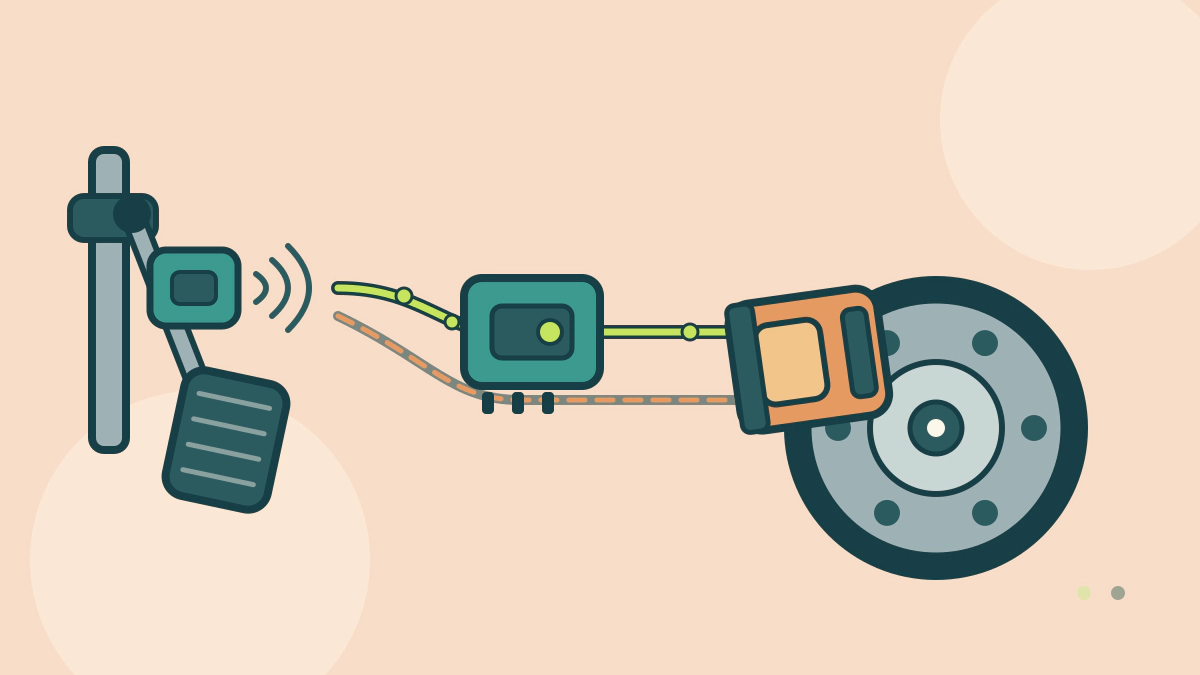
Understand how brake-by-wire sends pedal input electrically, what FMVSS 135 requires, and how redundancy and service differ from a conventional brake system.
What is brake-by-wire?
Brake-by-wire is a braking system that sends the driver’s pedal input electrically to a control module instead of applying hydraulic pressure through a direct mechanical link. NHTSA’s functional safety report uses that description and treats brake-by-wire as distinct from a conventional hydraulic system.
The name covers more than one layout. In some systems the pedal is connected to a sensor and a motor or pump builds pressure at the wheels. In others the pedal still moves hydraulic fluid, but valves and a computer decide how much pressure reaches each wheel. A car with an electric parking brake or regenerative braking is not automatically brake-by-wire.
What FMVSS 135 requires
FMVSS No. 135 is the federal standard for light vehicle brake systems. The regulation applies to passenger cars from September 1, 2000 and to other light vehicles up to 3,500 kg GVWR from September 1, 2002. It requires a service brake on all wheels and a parking brake held by mechanical means.
The standard defines a brake power unit as a device that supplies the energy to actuate the brakes, with the driver only modulating that energy. It defines a backup system as a part that automatically supplies energy if the primary source fails. It also requires a warning indicator when the electric power source for electrically actuated brakes fails or falls below the manufacturer’s specified level.
| FMVSS 135 item | What it requires | What it means for a by-wire car |
|---|---|---|
| Service brake | Acts on all wheels | Foundation brakes still do the stopping |
| Split system | One failure must not impair the other subsystem | Two circuits or equivalent redundancy |
| Power unit failure | A distance limit still applies | A fallback mode is tested, not assumed |
| Electrically actuated brakes | 10 stops from 100 km/h or lower Vmax, at least two within 70 m | Performance is checked with a depleted battery |
| Warning | Driver is warned of electric or control-circuit failure | The brake warning light is a real signal |
NHTSA’s test procedure sets a 168 m limit from 100 km/h with one unit inoperative.
How the pedal and the brakes communicate
A by-wire system reads pedal position with one or more sensors. A control module interprets the request, then commands a pump, motor or valve block. The module can also accept requests from stability control or blend in regenerative braking.
FMVSS 135 defines a regenerative braking system as an electrical system that recovers or dissipates kinetic energy by using the propulsion motor as a retarder. When that system is part of the service brake, the standard says ABS must control it. That blending is where an EV pedal can feel different from a purely hydraulic one.
Toyota’s 2025 RAV4 Hybrid owner’s manual describes its Electronically Controlled Brake System as a system that generates braking force corresponding to the brake operation. The same manual lists expected sounds: a sound from the engine compartment when the pedal is pressed, a motor sound when the driver’s door opens, and a sound after the hybrid system stops.
That applies to that Toyota system, not every design.
What happens when the electronics fail
The Toyota manual gives a plain description of the fallback. If the electronically controlled brake system does not operate, braking is still possible, but the pedal must be pressed more firmly and the stopping distance increases. The manual also says the brake system has two or more individual hydraulic systems, so if one fails the other still operates. It directs the driver to have the brakes fixed immediately.
FMVSS 135 builds a floor under that behavior. It defines a split service brake system so that one failure does not impair the other subsystem.
NHTSA’s report also notes that manufacturers use redundancy, plausibility checks and driver warnings to meet functional safety goals. Those are design techniques, not a promise that every system behaves alike.
What by-wire changes for service and repair
Some by-wire systems still use hydraulic fluid at the calipers, but the pedal may not create pressure directly. A soft pedal can point to a sensor, a control module, a pump or a hydraulic fault, and the warning light may be the first clue.
Fluid service and component replacement should follow the manufacturer’s procedure. The procedure may call for a scan tool to cycle valves or enter a service mode. Do not assume a conventional bleed sequence applies. The owner’s manual gives the warnings and fluid specification; service information gives the procedure.
For DIY work, fluid checks and pad inspection may be reasonable where the manual allows them. Actuator, module or pressure-bleeding work belongs with a qualified technician who has the specified equipment. Brake pedal feel and brake noise guides cover symptoms, not by-wire service steps.
Questions to ask before buying a by-wire car
- Does the owner’s manual describe a mechanical or hydraulic fallback?
- Which warning lights and messages indicate a brake fault?
- Is the parking brake separate and mechanically held?
More context on vehicle systems is in Future Mobility and Innovation.
Frequently asked questions
Is brake-by-wire the same as an electric parking brake?
No. An electric parking brake applies the parking brake with a motor, but the service brakes may still be conventional. FMVSS 135 allows an electrically applied parking brake only if mechanical means hold it engaged.
Do brake-by-wire cars still have brake fluid?
Many do, because the calipers are still hydraulic. What changes is how the pressure is created and controlled. Some systems use fluid under pressure from a pump rather than from the pedal directly.
Can a by-wire car stop if the electrical system fails?
FMVSS 135 requires a tested fallback and a warning, and the Toyota manual describes braking with a firmer pedal when its system is inoperative. Read the owner’s manual for the specific car.
Is brake-by-wire less reliable than a conventional system?
Not from the design alone. Reliability depends on the specific hardware, its redundancy and its diagnostics. The federal standard tests failure modes, but it does not rank one design above another.