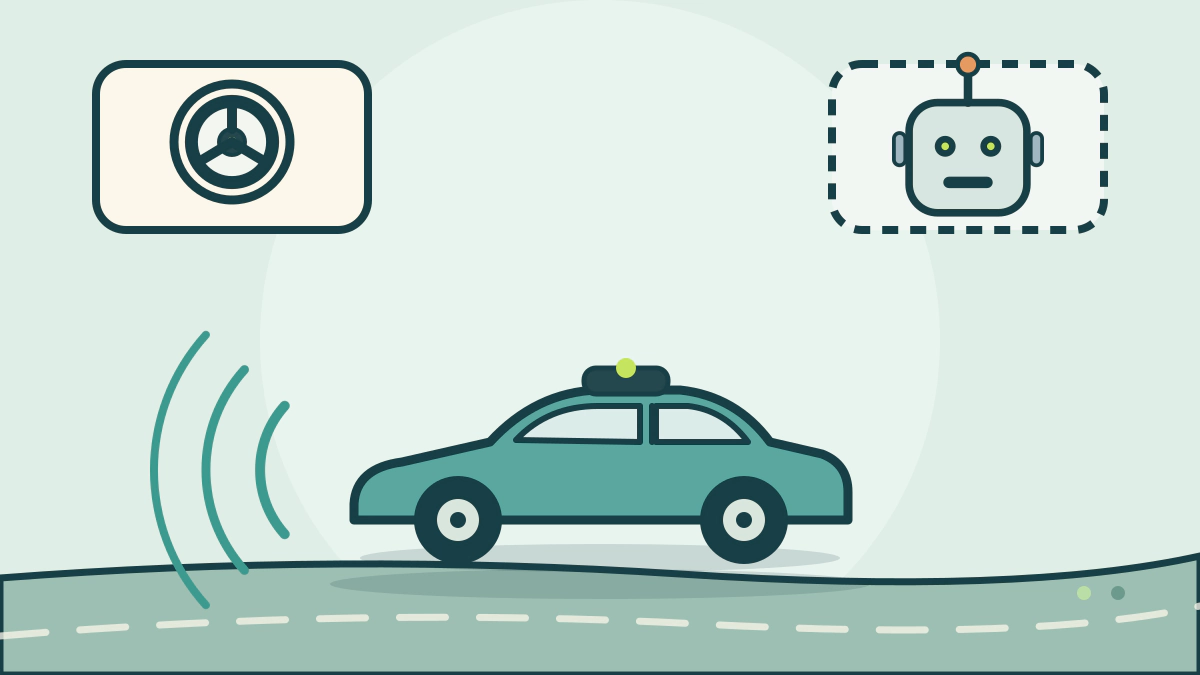
Learn what separates driver assistance from self-driving using NHTSA guidance and SAE's 2026 level definitions, including who must watch the road.
What actually separates driver assistance from self-driving?
Driver assistance supports a person who stays responsible for the driving task; self-driving means the system performs the whole task within its limits, and no new US car does that today. That distinction comes from NHTSA and SAE, not from a marketing name.
NHTSA’s automated vehicle page is blunt: no vehicle currently for sale is fully automated or self-driving, and every vehicle for sale in the United States requires the driver’s full attention. Even the highest level of automation available to consumers requires full engagement.
So a car can have impressive assistance and still be nowhere near self-driving. The question is who watches the road and who takes over at a limit.
Who is responsible at each level
SAE’s J3016 taxonomy, revised in September 2026, defines six levels. The current wording calls Levels 1 and 2 driver support and Levels 3 through 5 automated driving.
| Level | What the system does | Driver role | For sale to consumers in the US |
|---|---|---|---|
| Level 0 | No driving automation | Full control | Yes, most vehicles |
| Level 1 | Support for steering OR speed | Continual supervision and intervention | Yes |
| Level 2 | Support for steering AND speed | Continual supervision and intervention | Yes, widely available |
| Level 3 | Automated driving under defined conditions | Human driving needed after an alert or malfunction | Not available to consumers per NHTSA |
| Level 4 | Automated driving under defined conditions | Human driving not needed to mitigate risk inside those conditions | Not available to consumers per NHTSA |
| Level 5 | Automated driving in all conditions humans can drive | Human driving not needed | Not available to consumers per NHTSA |
The levels describe a feature that is engaged, not the whole car. An SUV with automatic emergency braking and lane keeping can still be Level 0 or 1 in normal driving, because those systems intervene briefly rather than drive continuously. SAE excludes active safety systems and warning-only features from the taxonomy.
Why “hands-free” is not “self-driving”
Ford’s BlueCruise page states the feature “is not safety equipment and it is not self-driving.” It requires eyes on the road, and a driver-facing camera tracks gaze and head position. It works on prequalified divided highways Ford calls Blue Zones, listed as more than 130,000 miles of North American roads.
By SAE’s wording, support for both steering and speed with continual supervision is Level 2 driver support. Hands-free describes your hands, not the system’s responsibility.
Waymo’s technology page makes a similar contrast. It says many companies promote “self-driving” features that still require a human paying full attention and ready to take over.
What NHTSA says is available today
NHTSA separates advanced driver assistance systems from automated driving systems. Its crash-reporting page defines Level 2 as partial automation that assists an attentive driver, who must monitor the environment and be ready to steer, brake and accelerate. It defines an ADS as Levels 3 through 5, which aim to perform the entire driving task within a defined operating domain without driver involvement.
That second category is what NHTSA says is not for sale to consumers. The automated vehicle page notes that states permit a limited number of self-driving vehicles for testing, research and pilot programs, monitored through the Standing General Order.
A driverless taxi and a showroom car are different products: the taxi operates under specific conditions and oversight.
Where the confusion starts
NHTSA’s driver assistance page says manufacturers use different names for similar technologies, which is why it publishes its own explanations. It separates systems that warn from systems that act and tells buyers to review the owner’s manual.
Names change by trim. A name that sounds autonomous may describe adaptive cruise control, lane centering or a traffic-jam assist for slow traffic. None removes the driver’s duty to monitor. If a salesperson calls a system self-driving and the manual does not, believe the manual.
What would have to change before a car counts as self-driving
A Level 3 system would handle the whole task in defined conditions but still call on a human after an alert or a detectable malfunction. A Level 4 system would not need a human to mitigate risk inside its conditions, the category robotaxi services occupy. Level 5 would remove the condition limits.
NHTSA’s page also lists unresolved policy questions, including liability and insurance, that it says policymakers are working through.
Until then, the test is simple: if the system disengages, who is expected to be looking at the road? If the answer is you, it is assistance.
For the sensors behind these features, see ADAS camera calibration after windshield replacement. Before accepting a demo, read what to ask during a new car test drive. Related advances are covered in the Future Mobility and Innovation hub.
Frequently asked questions
Is adaptive cruise control self-driving?
No. Adaptive cruise control adjusts speed to keep a set distance from the vehicle ahead, but the driver still steers, monitors traffic and brakes when needed. It is a support feature, not a replacement for the driver.
Does hands-free mean I can look away from the road?
No. Ford’s BlueCruise page requires eyes on the road and says a driver-facing camera tracks gaze and head position. A hands-free system can still demand full attention and ask you to take over outside its operating area.
Can I buy a Level 3 car in the US today?
NHTSA says no vehicle currently for sale is fully automated or self-driving, and it describes automated driving systems as Levels 3 through 5. States permit limited testing, but that is not a showroom product you can buy and use anywhere.
Is a driverless taxi the same as a self-driving car I can buy?
No. A driverless taxi is a service that operates within a mapped area and under specific oversight, with no human driver performing the task. A car you buy may have similar sensors, but its features still require a licensed driver to supervise.