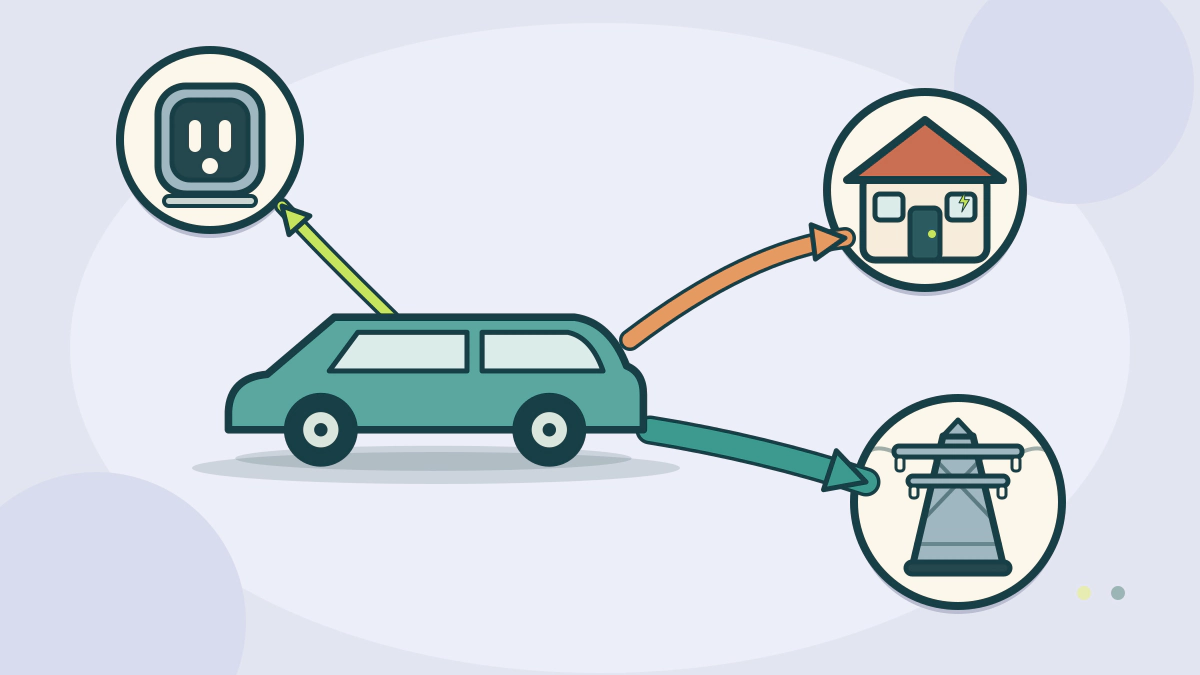
Compare V2L, V2H and V2G by what each one powers, the equipment and approvals each needs, and who can use each mode today.
Which of the three modes fits your job?
V2L runs a tool or appliance from the vehicle’s own outlet, V2H runs a house or building circuit through fixed equipment, and V2G sends power to the grid through a utility process. All three draw on the same battery. They differ in what they energize, what hardware is needed and who must approve the flow.
DOE’s Federal Energy Management Program defines a bidirectional EV as one that can take energy from charging equipment and give energy to an external load when the equipment supports the same flow. [DOE FEMP]
What each mode powers
| Question | V2L | V2H | V2G |
|---|---|---|---|
| What it powers | One appliance or tool, plugged into the car or an adapter | A home’s circuits, often a chosen set of backed-up loads | The local distribution grid |
| Equipment | Built-in AC outlet or a connector that uses the charge port | Bidirectional charger plus a transfer switch or gateway | Bidirectional charger, net meter and utility-approved controls |
| Approval | None for an isolated load | Electrical permit, and utility review where the site can export | Interconnection agreement signed before any export |
| Who can use it today | Buyers of a model that offers the feature | Owners of a supported vehicle, charger and transfer set | Mostly fleets, pilots and managed programs |
AFDC draws the same lines. It calls V2L an individual load off board the vehicle and V2B a whole building of loads. V2B needs a disconnect switch and safety-certified bidirectional equipment so power is not fed back to the grid. V2G goes further and needs close utility involvement plus a net meter. [AFDC]
V2L is limited by the outlet, not the battery
V2L is the version most drivers meet first. AFDC says V2L is most common at remote worksites without grid access, where it powers tools, and campers use it for small comforts. [AFDC] Its limits are electrical, not just battery capacity.
Kia’s 2026 US owner’s manual shows how those limits work. The high-voltage battery supplies AC power through a V2L connector in the charging port or an indoor outlet. The driver sets a discharge limit as a percentage, and the supply stops when the battery reaches it. The manual lists appliances above 16 A as a possible cause of an overheating shutdown. [Kia manual]
The manual adds that some appliances may not run normally on inverter AC power. Failures caused by modifying the V2L connector are not covered by the warranty.
V2L never touches the home’s panel, so it is not home backup.
V2H needs a fixed transfer point
V2H energizes a house. That requires disconnecting the home from the utility first, otherwise power can travel backward onto lines that crews treat as dead.
Ford’s system shows a real installation. The F-150 Lightning needs the 80-amp Ford Charge Station Pro and the Home Integration System, which Ford sells through Sunrun. Ford says the pair can supply up to 9.6 kW to the home during an outage, and that it may not cover larger homes or homes with high power demand. Ford lists the feature for 2022 through 2025 Lightning models. [Ford]
The pairing is the point. The truck, the wall charger and the transfer equipment must all appear on the supported list.
V2G adds a utility process on top
V2G sends power into the grid, so it moves from a building product to an interconnection case. DOE’s 2025 assessment says V2X can serve a home, a building, a facility or the grid, and that feeding the grid needs more control and coordination than feeding an isolated home. [DOE VGI]
Utility tariffs govern the connection. PG&E’s Electric Generation Interconnection page says storage devices are treated as generators for Rule 21 purposes, and that export customers apply through the Rule 21 Export process. [PG&E]
Equipment standards sit underneath. PNNL’s standards review says SAE J3072 sets requirements for V2G over AC connections with an inverter onboard the vehicle, and references IEEE 1547-2018 for interconnection behavior. ISO 15118-20 defines the messages that support bidirectional power transfer. [PNNL]
Why availability differs by vehicle, equipment and utility
Availability depends on three separate lists. The vehicle must support the mode. The charger and transfer equipment must support it and be installed to code. The utility must accept the connection, and for export, have a process that covers the site.
State and utility rules vary, and no national rule requires a utility to accept power exported from a customer’s vehicle. Export approval is a local decision made under a tariff or a program. A system that discharges only during an outage avoids the export question, but it still needs transfer equipment and a permitted installation.
The practical split is simple. V2L needs only the car. V2H needs a supported pair and an electrician. V2G needs a utility.
For the underlying technology, read bidirectional EV charging explained. For station authentication, see what Plug and Charge is. Before you buy wall equipment, see how to choose a home EV charger. For charging stops on a trip, read preparing an EV for a long road trip. The EV Charging hub lists the rest.
Frequently asked questions
Can a V2L outlet run a refrigerator during an outage?
Yes, if the refrigerator’s draw stays under the vehicle’s outlet limit and you accept the cutoff. V2L is an isolated load, not a home circuit. It cannot energize house wiring.
Do I need a transfer switch for V2H?
Yes. The home must be disconnected from the utility before the vehicle energizes its circuits. Ford’s system uses a Home Integration System for that job. A bidirectional charger by itself does not provide the break.
Can any electric car send power to the grid?
No. The vehicle, the bidirectional charger and the utility’s interconnection process must all support export. Many cars offer only V2L, and many utilities have no retail V2G program.
Is V2G the same as V2H?
No. V2H supplies a home, often during an outage, and can avoid export. V2G sends power to the grid and needs an interconnection agreement.