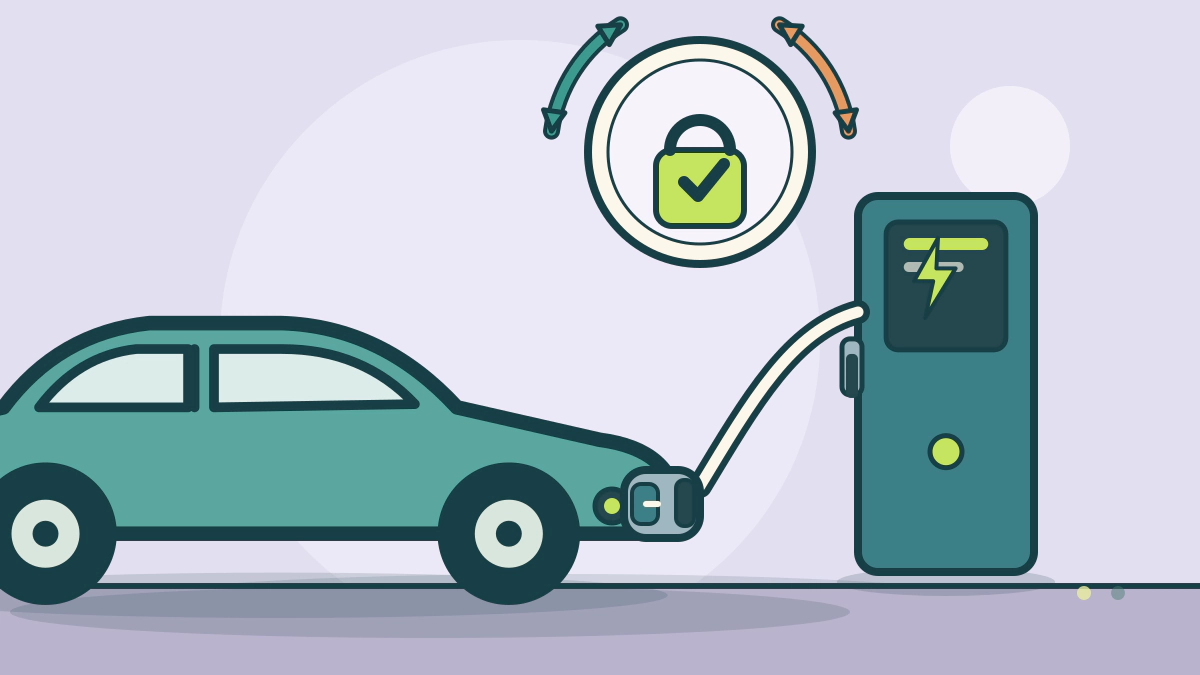
Plug and Charge lets an eligible EV authenticate and pay automatically when connected, using ISO 15118 certificates instead of an app, card or screen.
What does Plug and Charge mean?
Plug and Charge is automatic authentication and payment at a charging station: the car and charger identify each other when the cable is connected, so the session can start without an app, card or screen step. The Joint Office describes it as secure automatic authentication as soon as a driver plugs in. [Joint Office]
Three things must line up: an eligible vehicle, a supporting charger, and an active account or contract tied to the car.
What happens in the first moments
The charger reads a digital credential from the vehicle and matches it to the driver’s billing arrangement. The Joint Office says the SAE EVPKI framework uses a Certificate Trust List to enable secure, automated authentication at the start of the transaction. [Joint Office]
The ChargeX testing program describes Plug and Charge tests using valid and expired EV contract certificates, with a fallback to external authentication when the certificate fails. [ChargeX]
In everyday terms, the car carries proof of an account. The station verifies it, starts the session, and bills the account.
Where ISO 15118 fits
ISO 15118 is the high-level communication standard between an EV and a charger. The Joint Office lists ISO 15118-2 among the protocols it works on, alongside public key infrastructure for Universal Plug and Charge. [Joint Office]
Plug and Charge is one authentication method under that standard. The other is External Identification Means, or EIM, covering a credit card, RFID card or app. The ChargeX test plan lists both authentication types for ISO 15118-2. [ChargeX]
The EV-ChART reporting guidance used by states and charging networks defines the payment method “plug_charge” as payment via ISO 15118 Plug and Charge. [EV-ChART]
The distinction explains why support is uneven: car, charger and back-end systems all need the same certificate framework.
Plug and Charge versus an app, a card or RFID
| Method | What you do at the station | What must be set up first | Where it works |
|---|---|---|---|
| Plug and Charge | Plug in | Eligible car, enrolled account, supporting charger | Participating networks |
| Mobile app | Open the app, pick the charger, start | Account with that network and a connection | That network’s stations |
| Credit or debit card | Tap or insert at the reader | Nothing beyond a payment card | Stations with a working reader |
| RFID or membership card | Tap the card | Membership or plan | That network’s stations |
ChargeX groups card, RFID and app methods as EIM authentication, separate from Plug and Charge. [ChargeX]
Ford’s charging support page shows both styles in one account. Plug and Charge starts automatically at Electrify America or Tesla Supercharger locations, while “Pay for Charging” asks the driver to select the location and charger in the Ford app. [Ford]
Why availability varies by car and network
Plug and Charge existed inside individual networks before it worked across them. The Joint Office says automakers and charging networks used proprietary authentication and authorization solutions, and sometimes offered Plug and Charge only within their own network. [Joint Office]
The framework announced in December 2024 is meant to change that. SAE ITC and the Joint Office described a common EVPKI framework, with testing through 2025 and the goal of plugging any car into any public station. [Joint Office]
Until that is universal, check the specific pairing. Electrify America says all of its chargers are Plug and Charge capable, but not all vehicles are, and it publishes an eligibility list by brand and model year. [Electrify America]
Ford says its Plug and Charge works at Electrify America or Tesla Supercharger locations and requires an active BlueOval Charge Network account. [Ford]
Setting it up and troubleshooting the start
Setup usually happens once, in the maker’s app. Electrify America describes enrolling in a plan and activating Plug and Charge in its app. [Electrify America] Ford says the driver toggles Plug and Charge in the Ford app, and that the setting will not change while the vehicle is plugged in. [Ford]
If a session does not start, Ford’s checklist is a useful model: confirm the account is active, the feature is enabled, the card on file is valid, and the station is inside the network. If those fail, use the app payment option or follow the station’s instructions. [Ford]
Plug and Charge removes a step, not the account. A lapsed card or inactive plan can still stop the session.
What Plug and Charge does not do
- It does not make charging free. The session is billed to the account or contract.
- It does not guarantee a charge at every station. The vehicle and charger must both support it.
- It is not wireless charging. The cable still carries the power; only the authentication step is automatic.
The Joint Office also presents the certificate framework as a security improvement for the charging ecosystem. [Joint Office]
For the physical connection, see EV charging adapters. For charging rates, see what an EV charging curve is. The EV Charging hub covers connectors, levels and home equipment.
Frequently asked questions
Do all electric cars support Plug and Charge?
No. Support depends on the vehicle, its software and the maker’s enrollment process. Electrify America publishes an eligibility list because not every EV can use the feature.
Is Plug and Charge the same as wireless charging?
No. Plug and Charge is automatic authentication and billing after a cable is connected. Wireless or inductive charging transfers power without a cable, which is a different technology.
Does Plug and Charge work with a charging adapter?
It can, if the adapter and station are approved for the car. Ford says that with its Fast Charging Adapter at a Tesla Supercharger, Plug and Charge can start the session automatically. Outside the approved combination, do not assume it will work.
Is Plug and Charge free?
No. It removes the payment step, not the charge itself. The session is billed to the account or plan tied to the car, and network prices and membership terms still apply.