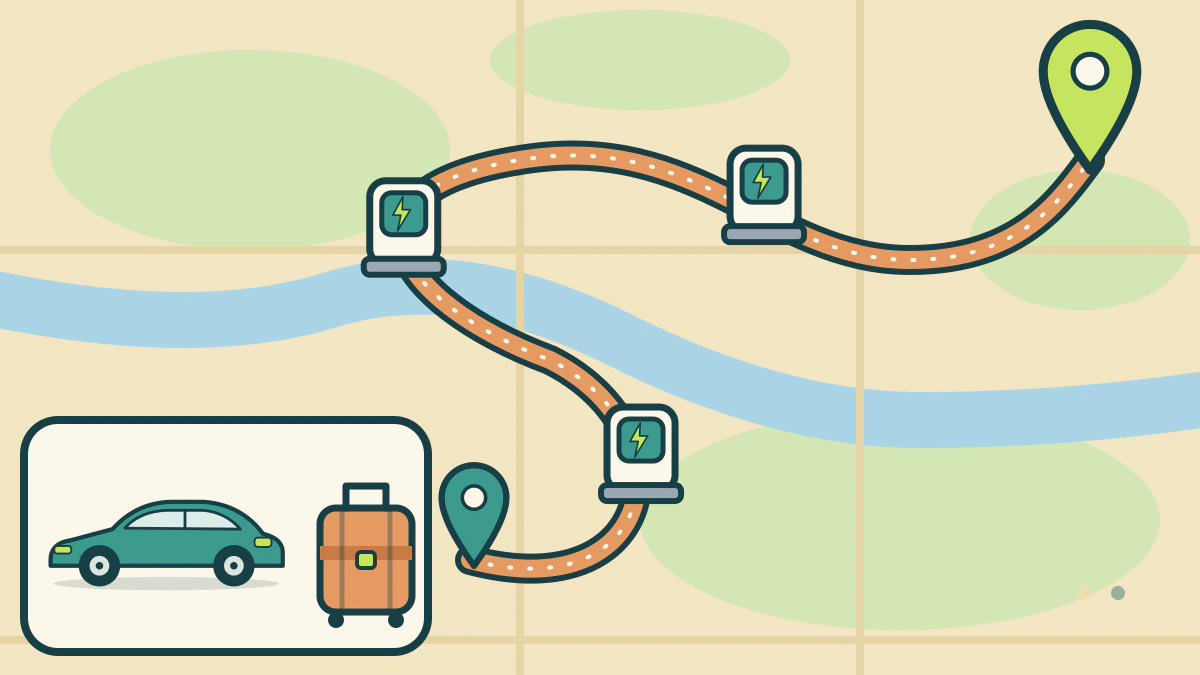
Turn EPA label range into a trip budget, map chargers with the AFDC Station Locator, check plug types and adapters, and plan each charging stop.
How do you prepare an EV for a long road trip?
Plan the trip around charging stops, not the label range: map chargers on your route, confirm the plug fits your car, and keep a range margin for speed, load and weather. Preparation takes less effort than it sounds, because most of it happens at the planning stage.
This guide is for owners who already have an EV. If you are still choosing between powertrains, read electric SUV vs hybrid SUV for road trips. For more ownership topics, see Electric and Hybrid Vehicles.
Turn the label range into a trip budget
The EPA label shows range from a full battery in combined city and highway driving, according to FuelEconomy.gov. That is a comparison figure, not a promise.
EPA explains that lab range is adjusted for real-world factors such as air conditioning, cold and aggressive driving. The most common method uses a factor of 0.7. Even then, your own speed, load and weather can push results lower.
| Factor | What the sources say |
|---|---|
| Label range | Combined city and highway range from a full charge, adjusted by EPA |
| Speed and load | The LEAF manual lists speed, vehicle load and accessory use as range factors |
| Cold | FuelEconomy.gov reports about 41% lower EV range at 20 degrees F with the heater on |
| Heat | AAA found 17% lower range at 95 degrees F with air conditioning |
| Climate use | FuelEconomy.gov says accessories such as heating and cooling affect EVs more than conventional vehicles |
The cold and heat figures come from a 2019 AAA study of five vehicles, so treat them as warnings. For winter detail, read EV ownership in cold climates.
A simple habit helps. Look at the energy use your car reports on a recent highway drive at your usual speed. Plan each leg from that, not from the label.
Map chargers with the AFDC Station Locator
DOE’s Station Locator lets you search by location or map a route, and AFDC says you can find stations along a route. Its Advanced Filters can also show private and planned stations.
Use the tool this way:
- Map the route and list the public charging stops that fit your car’s plug.
- Choose a primary and a backup stop on each leg.
- Note that AFDC defines a charging port as serving only one vehicle at a time.
- Use “Report a change” on a station page if you find wrong details.
The LEAF manual is blunt about the risk. It says public stations may not be available where you wish to drive, so trip planning is important.
Check plugs, cables and adapters
AFDC names several connector types, including CCS and CHAdeMO. Its page says a CCS port on a vehicle can accept Level 1, Level 2 or DC fast charging.
The Joint Office of Energy and Transportation says the industry is moving toward the SAE J3400 connector. During the transition, EVs may need an adapter to reach more chargers. It calls adapters inconvenient and less efficient than a direct connection.
Its safety advice is specific:
- Use only adapters provided by your vehicle’s manufacturer for your specific vehicle.
- Use them as instructed.
- Not all adapters work with all vehicles or chargers.
If your maker supplies an adapter for your car, pack it. Do not buy a generic one because a forum suggests it.
Plan each charging stop
At a stop, charge for the next leg, not necessarily to 100%. The 2023 Chevrolet Bolt EUV manual says a target charge level lets you set only as much range as you need at a public pay station. Read why DC fast charging slows near full to see why that often saves time.
The LEAF manual adds two cautions. Quick-charge time depends on battery temperature and the charger. It also suggests avoiding extended highway driving with multiple quick charges.
FuelEconomy.gov says preconditioning while plugged in can extend electric range. Start the trip with the cabin already comfortable, if your car supports it.
At overnight stops, check the voltage. The label’s charge time assumes 240 volt service, and FuelEconomy.gov says a lower voltage means longer charging times.
What to check before you leave home
- Read the trip and range pages of your owner’s manual. FuelEconomy.gov says tips can vary by model.
- Check tire pressure. The LEAF manual lists correct tire pressure and alignment among range habits.
- Remove cargo you do not need. The same manual lists unnecessary cargo.
- Charge fully at home only if your first leg needs it.
- Save your route in the Station Locator and in your car’s navigation.
Frequently asked questions
Is the EPA range enough to plan a long trip?
It is a starting point. EPA adjusts lab results for real-world factors, but speed, load, weather and accessory use still change what you get. Plan from your own highway energy use, and keep a reserve at every stop.
Do I need an adapter for public fast chargers?
It depends on your car’s plug and the station’s connectors. The Joint Office says EVs may need an adapter during the J3400 transition. It advises using only the adapter your vehicle’s manufacturer provides.
How do I find chargers along my route?
Use the AFDC Station Locator, which can search by location and map a route. Check each station’s connector types and choose a backup. Your car’s own navigation may also list chargers.
Should I charge to 100% before leaving?
Only if the first leg needs it. Charge to what the next leg requires, plus a margin, then top up on the road. Fast charging often slows near full, so a shorter stop can be quicker overall.