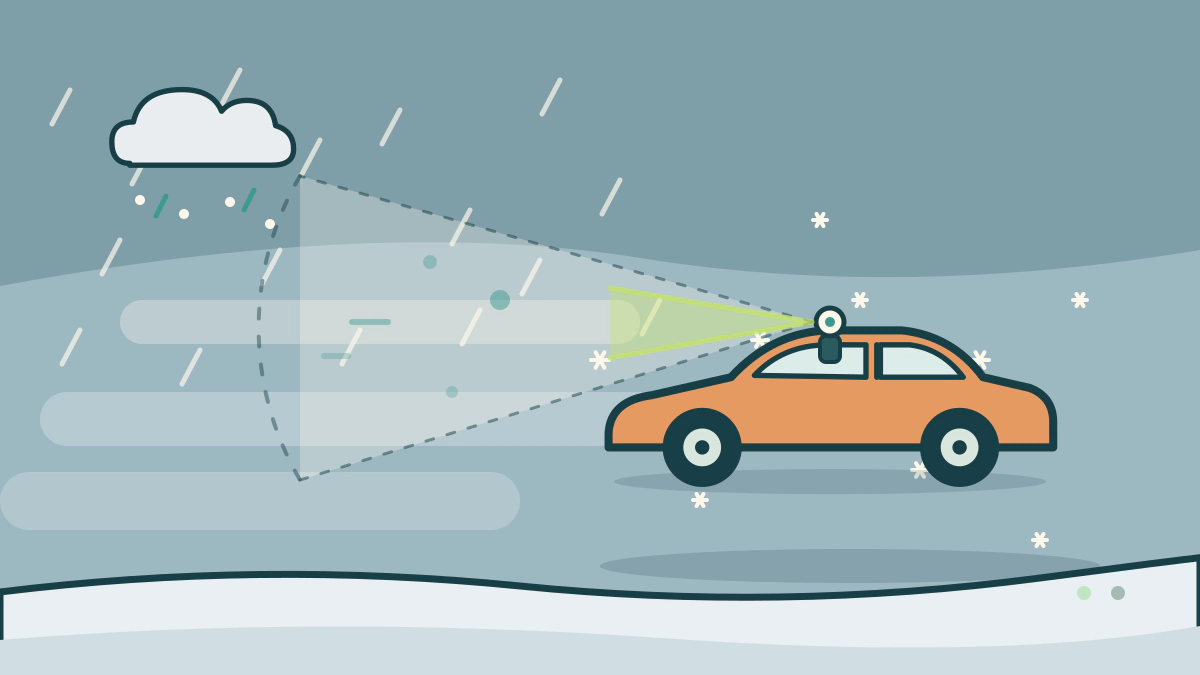
Learn how rain, snow, fog and road spray degrade cameras, radar and lidar, and why automated systems set weather limits and stop when they are exceeded.
Why is bad weather so hard for an autonomous car?
Bad weather weakens the data from cameras, radar and lidar and reduces the grip available to steer and brake. A system validated on a dry day can be operating outside the conditions it was designed for.
The USDOT report uses an operational design domain, or ODD, to describe where and when a system is meant to work. Weather belongs in that description. NHTSA says no fully automated vehicle is for sale today, and every vehicle on sale still needs the driver’s full attention. [NHTSA] [Report]
FHWA says about 12 percent of US motor vehicle crashes, roughly 745,000 a year, occur in bad weather. More than 77 percent of those happen in rain or mist. [FHWA]
What rain does to sensors and to grip
Rain causes two different problems. It cuts visibility and pavement friction, and it can leave water standing on the road. FHWA lists reduced visibility, lower friction and lane obstruction as precipitation effects. [FHWA]
In USDOT field tests, falling rain sometimes looked like an object, so cars braked hard. In other runs, rain hid the vehicle ahead, so a car sped up. [Field test]
Wet pavement alone was less disruptive. In most runs, cars still found the lane lines and steered back. [Field test]
Why snow and ice are harder than rain
Ice on the sensor covers ended the test. Every vehicle with ice on its sensors failed, because radar and vision were blocked. [Field test] A layer about 0.25 inch thick was enough to disable the system completely. [Report]
Snow on the ground is a separate problem. One vehicle could not find the lane line under a small amount of snow. The cars also disagreed about how much confidence they needed to stay engaged. [Field test]
Slush matters for radar. Light snow gave no trouble, but modest slush on part of a heated radar sensor could affect adaptive cruise control. [Field test]
Fog, spray and what each sensor can see
Fog limits a camera much as it limits a human eye, according to USDOT’s report. [Report]
Spray is the overlooked case. In wet and muddy conditions, spray can cover sensors. The report says that can make a vehicle see objects that are not there or miss objects that are. [Report]
| Sensor | Main job | Weather failure seen in the tests |
|---|---|---|
| Camera | Lane lines, signs and objects | Fog, spray, droplets, low sun and snow cover |
| Radar | Distance and speed of other vehicles | Slush or ice on the cover; cannot read lane markings |
| Lidar | A 3D view of the surroundings | Rain, snow and fog; snowflakes can look like obstacles |
Radar uses longer waves than lidar, so it travels better through precipitation. Its resolution is coarser, and it cannot sense lane markings. [Report] Lidar struggles in bad weather, and a water-filled pothole can look like an obstacle. [Report]
Why the road surface matters as much as the sky
A car can perceive a hazard and still fail to stop. FHWA lists lower pavement friction as an effect of rain, snow and ice. [FHWA] The USDOT report adds that snow, ice and even water in a pothole make it harder to locate the traveled way. [Report]
That is one reason a weather limit is about more than windshield wipers.
What is not publicly verified
The report is direct about the gap. It says the weather limits of automated vehicles are not well understood. It also found no clear guidelines for deciding whether a trip under automation should begin or continue. [Report]
Developers do not publish detailed sensor performance for every model in every condition. The field test used five Level 2 production vehicles, not a robotaxi fleet. A claim that a system works in rain needs detail: which rain, at what speed, and what the car does at the limit.
The tested drivers had to avoid over-trusting the automation and stay ready to take over. [Report]
What this means for a driver
The same limits apply to lane keeping, adaptive cruise control and automatic emergency braking on a car you own. NHTSA says lane departure warning uses a camera to watch lane markings, and forward collision warning uses sensors to detect the vehicle ahead, as described on its driver assistance page. [NHTSA] Read the owner’s manual for the weather conditions it names. Keep the camera and radar covers clear of snow, ice and mud.
A driverless service may stop in weather because it has left its ODD, not because it broke. For the boundary between assistance and automation, see driver assistance vs self-driving. The SAE levels guide explains the scale. The driverless car requirements guide covers the sensor and fallback chain. Connected weather alerts are another input; see how cars exchange road-hazard information. More context sits in the Future Mobility and Innovation hub.
Frequently asked questions
Can self-driving cars drive in rain?
Some automated systems are tested in rain, and USDOT’s field tests show both phantom braking and missed vehicles. No consumer car is fully self-driving. Check the operator’s stated conditions rather than assuming a general yes.
Does fog affect radar?
Radar travels through fog better than a camera does. Fog still limits cameras and lidar, and visibility can fall below the range a system was validated for. The result depends on the whole sensor set.
Why does ice stop these systems?
Ice blocks the covers that protect radar and camera sensors. In the USDOT tests, every vehicle with ice on its sensors failed to work properly. Keeping those covers clear matters on a car with driver assistance.
Do all automated cars handle weather the same way?
No. The five test vehicles reacted differently to the same rain, snow and ice. Each developer sets its own operating domain and validates its own hardware and software.