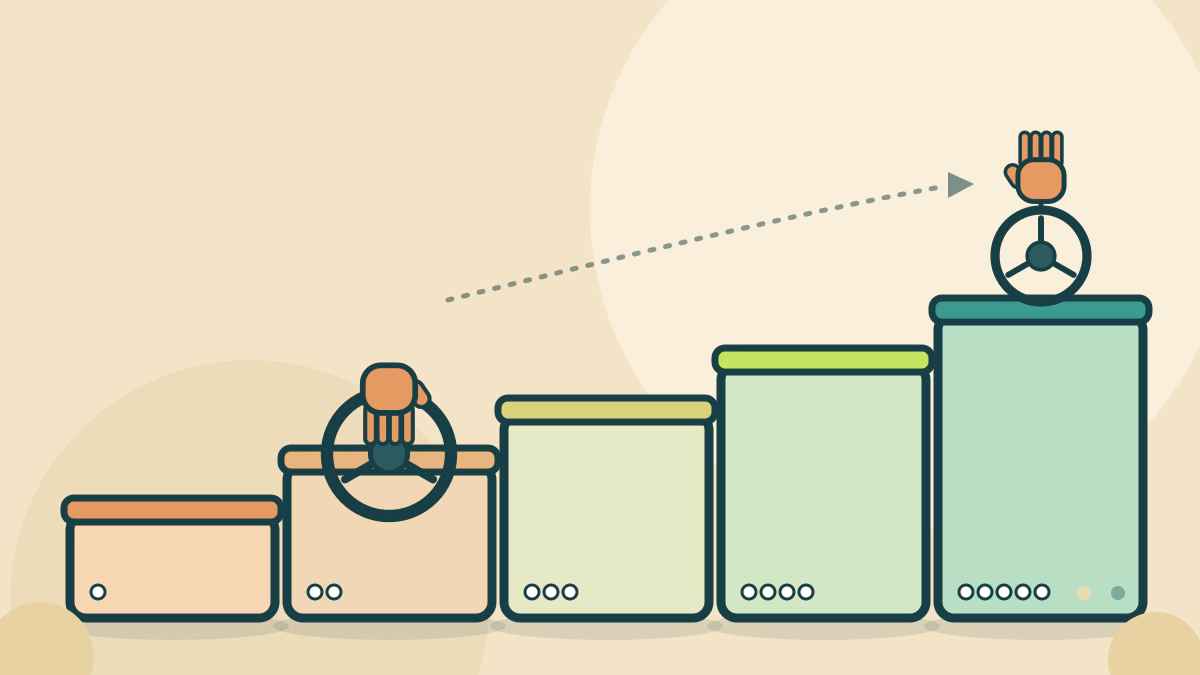
Learn what the six SAE levels mean, who must supervise at each step, and which example features show the difference between assistance and automated driving.
What do the SAE levels actually measure?
The SAE levels describe how much of the driving task one engaged feature performs and who must handle the rest. They are not a safety score and they do not by themselves make a car self-driving.
SAE International publishes the taxonomy as J3016. It defines six levels, from Level 0 (no driving automation) to Level 5 (full driving automation).
A level belongs to the feature that is switched on at that moment, not to the vehicle’s nameplate. One car can offer features at different levels. NHTSA’s automated vehicle page adds a practical warning: no vehicle for sale in the United States is fully automated, and every one requires the driver’s full attention.
The six levels and who does what
A level is a job description for the feature and for the person in the driver’s seat.
| SAE level | Name | Steering and speed | Who must supervise or take over | Example from SAE’s chart |
|---|---|---|---|---|
| 0 | No driving automation | Neither | You do everything; features only warn or assist briefly | Automatic emergency braking, blind spot warning, lane departure warning |
| 1 | Driver assistance | One of the two | You supervise and handle the rest | Lane centering OR adaptive cruise control |
| 2 | Partial driving automation | Both at once | You supervise constantly and intervene | Lane centering AND adaptive cruise control together |
| 3 | Conditional driving automation | The system drives within limits | You must drive when the feature requests | Traffic jam chauffeur |
| 4 | High driving automation | The system drives within limits | No human takeover is needed inside those limits | Local driverless taxi; pedals may be absent |
| 5 | Full driving automation | The system drives everywhere | No human driver is needed | Same as Level 4, in all conditions |
The examples come from SAE’s levels chart, not from brand names.
Why one car can show different levels
Level 1 and Level 2 use the same building blocks. Lane centering steers. Adaptive cruise control handles speed. Either one alone is Level 1 support. Switch on both at the same time and the feature controls steering and speed, which is Level 2. The driver still supervises.
SAE’s scope note adds a useful boundary. Active safety systems such as electronic stability control and automatic emergency braking, along with warning-only features, intervene briefly rather than drive continuously. The chart still places those brief interventions at Level 0 because the person remains responsible for the driving task.
Where Level 2 ends and Level 3 begins
At Level 2, the person in the driver’s seat must constantly supervise the support feature and steer, brake or accelerate as needed. Feet off the pedals do not change that duty.
Level 3 is different. The feature performs the whole driving task inside limited conditions, and the person does not supervise continuously. The catch is the request to intervene: when the feature asks, the person must drive. SAE’s chart uses a traffic jam chauffeur as its example, a feature that handles a slow queue but can hand control back.
What separates Level 3 from Level 4
Level 4 also drives inside limits, but it does not need a person to take over inside those limits. SAE’s chart shows a local driverless taxi and notes that pedals and a steering wheel may or may not be installed.
Level 5 removes the condition limits. The chart describes it as the same as Level 4 but able to drive everywhere in all conditions.
What the levels do not tell you
A level does not rate crash safety, insurance cost or reliability. It does not prove the feature works in rain, at night or through a work zone. Those limits belong to the operational design domain, which SAE defines separately from the level.
A level also does not prove a car is for sale. NHTSA says states permit a limited number of automated vehicles for testing, research and pilot programs. A driverless taxi inside a mapped service area is a different product from a showroom car with driver assistance.
How to use the levels when you shop
Start with the feature name in the owner’s manual, then ask who watches the road while it is on. If you must supervise, the feature is driver support. If it drives the whole task but may ask you to take over, it is Level 3. If it never asks inside its area, it is Level 4.
Ignore names that imply autonomy without that answer. For the camera work behind lane keeping, see ADAS camera calibration after windshield replacement. For the service model, see how robotaxis work. The driver assistance vs self-driving guide covers the wider distinction, and the Future Mobility and Innovation hub collects related explainers.
Frequently asked questions
Is Level 2 self-driving?
No. Level 2 provides steering and speed support at the same time, but the driver must supervise constantly and intervene when needed. Hands off the wheel or feet off the pedals do not transfer responsibility to the car.
What is the difference between Level 3 and Level 4?
A Level 3 feature drives the whole task inside limited conditions but can ask the person to take over. A Level 4 feature does not need a human takeover inside its conditions, so it may operate without pedals or a steering wheel. Neither level works everywhere.
Does a higher SAE level mean a safer car?
No. The levels describe who performs the driving task, not crash-test results, reliability or real-world safety records. The level says nothing about how well a car protects its occupants.
Can I buy a Level 5 car today?
No. NHTSA says no vehicle currently for sale in the United States is fully automated, and states allow only limited testing and pilot programs. Level 5 describes full driving automation in all conditions, which is not a showroom product.