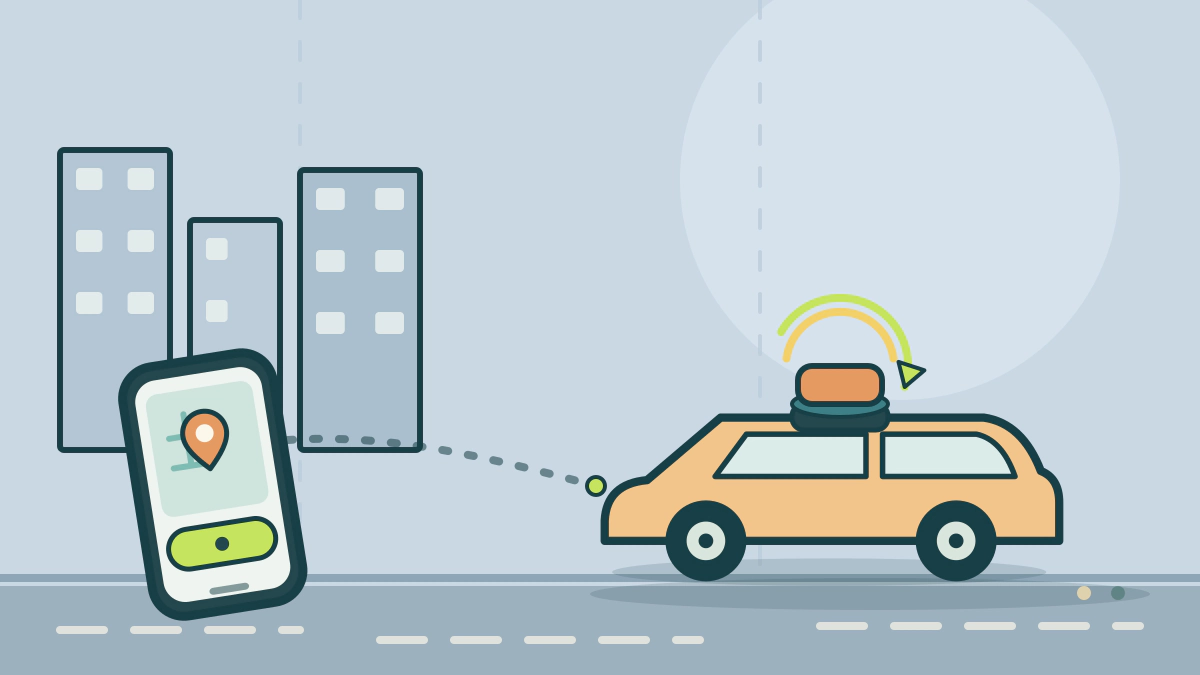
Follow a robotaxi from app request to drop-off, see the sensors and maps behind it, and learn how US regulators oversee driverless services.
How does a robotaxi work without a driver?
A robotaxi performs the whole driving task inside a mapped service area, is requested through an app, and carries passengers with no human operating the controls. The service supplies the driver.
NHTSA calls this an automated driving system, or ADS, a term its crash-reporting page defines as SAE Levels 3 through 5. Its automated vehicle page says a fully automated vehicle controls all aspects of driving without human intervention, and that such vehicles are not for sale to consumers.
A robotaxi is a service product, not a car you buy. You do not own the vehicle, choose its route or supervise its driving.
From app request to drop-off
Waymo publishes the steps on its ride page. A rider downloads the app, creates an account and enters a destination. The app selects pickup and drop-off spots. Up to four passengers can ride, and the rider unlocks the door with the app. The passenger presses “Start Ride” and can follow the route on a screen.
Waymo says the service is available to the public 24 hours a day. The page lists cities serving riders and a separate “Up Next” list, which is not active service. Riders do not need to know how to drive.
The sensor and map stack behind the trip
Waymo’s technology page describes four main parts. Lidar sends laser pulses and measures return time to build a 3D picture. Cameras provide a 360-degree view, with 29 cameras listed on its Jaguar I-PACE vehicles. Radar measures distance and speed and is described as effective in rain, fog and snow. An onboard computer combines the data, identifies objects and plans a route.
Before operating in a new area, Waymo maps lane markers, stop signs, curbs and crosswalks, then matches that map with live sensor data to locate the vehicle.
Redundancy is part of the design: a secondary computer, backup collision detection, redundant steering and braking, and independent power sources. These allow a safe stop if a primary component fails.
Why the service area is part of the product
SAE’s J3016 taxonomy describes Level 4 as automated driving under defined conditions, with human driving not needed to mitigate risk. That fits the driverless taxi model: the operator decides where the area begins and ends.
The area reflects mapping, road rules, weather and validated conditions. A trip can still be unavailable if the destination falls outside it.
On November 8, 2026, Waymo’s site listed public service in Atlanta, Austin, Dallas, Denver, Houston, Las Vegas, Los Angeles, Miami, Nashville, Orlando, Phoenix, San Antonio, San Diego, the San Francisco Bay Area and Tampa. Zoox’s site lists Las Vegas and San Francisco, and its Where to Ride page names additional cities. Lists change, and a city name does not guarantee neighborhood coverage.
Who oversees a robotaxi in the US
The Department of Transportation’s AV page sets out the roles.
| Body | What it covers for automated vehicles |
|---|---|
| NHTSA | Safety oversight of automated driving systems as motor vehicle equipment, guidance and standards |
| Federal Motor Carrier Safety Administration | Commercial trucks and buses equipped with automated driving systems |
| Federal Highway Administration | Standards for signs, markings and signals, plus truck size and weight rules |
NHTSA’s automated vehicle page says states currently permit a limited number of self-driving vehicles for testing, research and pilot programs, monitored through the Standing General Order. That is a different pathway from certifying a car for sale.
What crash reports can and cannot tell you
The Standing General Order requires named manufacturers, developers and operators to report certain crashes. For an ADS, a report is required if the system was in use within 30 seconds of a crash involving a fatality, a vulnerable road user being struck, an air bag deployment, a tow-away or transport to a hospital.
The third amended order took effect in June 2025. It requires the most severe reports within five days and less severe reports monthly.
NHTSA warns that the data is not normalized by miles traveled or fleet size, and operators do not submit exposure figures. The agency says the summary data should not be assumed to be statistically representative. A higher count can reflect better telemetry rather than worse safety.
For recalls on ordinary cars, see how to check car recalls by VIN. The Car Safety and Recalls hub covers crash testing and defects, and the Future Mobility and Innovation hub covers the wider technology.
Frequently asked questions
Is there a driver in the front seat of a robotaxi?
In a driverless service, no. Waymo describes passengers sitting in the back and not needing to know how to drive.
Can a robotaxi drive anywhere in a city?
Usually not. Service is limited to areas the operator has mapped and been permitted to serve, and the app may restrict pickup and drop-off points within them. A destination outside the area can make a trip unavailable.
Are robotaxi crashes reported to the government?
Yes, for operators named in NHTSA’s Standing General Order. They must report certain crashes involving an automated driving system, some within five days. NHTSA publishes summary data but warns it is not adjusted for miles or fleet size.
Is a robotaxi the same as a self-driving car I can buy?
No. A robotaxi is a service vehicle operating inside a defined area under an operator’s permit and oversight. NHTSA says no fully automated vehicle is currently available for consumers to buy, so a showroom car with driver assistance is a different product.