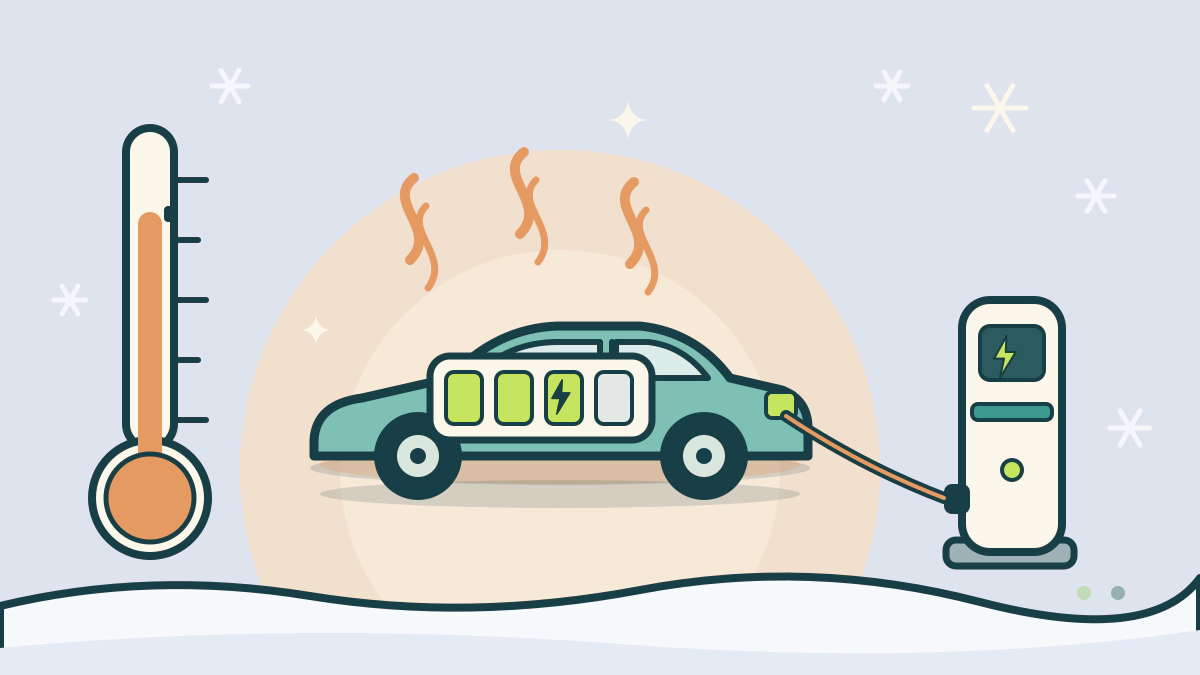
Learn what EV battery preconditioning does, how it differs from cabin preheating, when cars run it, and what the routine costs in driving range.
What is EV battery preconditioning?
Battery preconditioning is the car managing the high-voltage pack’s temperature toward the range where it charges and performs best, usually before a DC fast charge or a scheduled departure. It is a routine run by the vehicle, not a separate fuel or driving mode.
Manufacturer manuals describe the behavior. The Kia EV6 owner’s manual says the Battery conditioning mode is efficient in winter when the high-voltage battery is cold, and raises the pack to an adequate level to improve driving and DC charging performance.
Names differ by brand. The Hyundai IONIQ 5 owner’s manual also uses Battery conditioning mode, while other makers say preconditioning, battery heating or winter mode. Menu labels vary by model year and trim, so read your own manual.
Why a cold pack charges more slowly
A cold battery cannot accept the same power as a warm one. The Kia manual ties the feature directly to charging time: set a DC charging station as the destination, and the mode raises battery temperature so the pack is closer to an adequate level when you arrive.
That helps explain a common winter surprise. The same car can take power slowly at a powerful public charger in January and quickly in June, even though the charger has not changed. Pack temperature is one of several limits, alongside state of charge and the vehicle’s own charging curve. For the wider picture, see why DC fast charging slows near full and why EV battery packs need thermal management.
The three routines owners often confuse
Preconditioning is often used as a catch-all word. The functions are related but not identical.
| Routine | What it conditions | How it usually starts | Source |
|---|---|---|---|
| Battery conditioning for DC charging | The high-voltage pack | Mode switched on and a DC charger set as the navigation destination | Kia EV6 manual |
| Departure-time preparation | The pack on equipped cars, plus the cabin | A scheduled time in the EV menu or a connected app | Hyundai IONIQ 5 manual |
| Cabin preheat or precool | The cabin only | Remote start or app command, ideally while plugged in | FuelEconomy.gov |
Cabin preheating is the routine most owners already know. FuelEconomy.gov says pre-heating or pre-cooling the cabin while the car is plugged in can extend electric range, and its cold-weather page repeats the advice for plug-in and electric vehicles. The Hyundai manual makes a related point for scheduled departures: with the cable connected, the cabin reaches the target temperature at departure time without reducing the high-voltage battery’s charge level.
That does not prove the pack itself was warmed; cabin climate and pack conditioning can share a screen and still be separate jobs.
What preconditioning costs in energy
Both manuals warn about the trade-off. Kia says driving distance may be reduced because energy is needed to raise battery temperature. Hyundai makes the same point and adds a limit: the mode is not operated to protect driving distance when the battery level is low.
So the feature is not free range. If you precondition before a fast charge, the energy spent can be offset by a shorter stop. If you precondition on a mild day with no charging planned, you may simply leave with less range than the dashboard showed the night before.
For the charge-level side of planning, see should you charge your EV to 100 percent.
When preconditioning is worth switching on
The manual descriptions point to a few sensible cases:
- Before a DC fast charge in cold weather, especially the first stop of a trip.
- Before a regular morning departure, when the car is plugged in and the cabin or pack can draw from the outlet.
- After a cold night, when the pack is likely near ambient temperature.
- Not on short drives in mild weather, where the energy cost buys little.
Use the vehicle’s own indicator or menu status rather than guessing.
Does every EV have battery preconditioning?
No. Kia notes that the mode is available on vehicles equipped with a battery heater. A car without that hardware may still offer cabin preheating, but it cannot warm the pack the same way.
What preconditioning cannot do
It cannot make a slow charger fast. Station power, connector compatibility, state of charge and the car’s charging curve still set the ceiling. It also does not replace winter tires or a realistic trip plan. For cold-weather ownership habits beyond the battery, read EV ownership in cold climates.
The practical rule is simple: precondition when the next stop or departure justifies the energy, and leave it off when it does not. The EV Charging hub has more on charging behavior and planning.
Frequently asked questions
Is preconditioning the same as warming the cabin?
No. Cabin preheating warms the interior, while battery preconditioning warms the pack. Some cars run both from one departure schedule, but the manual will say which systems are included.
Does preconditioning use battery charge?
Yes, raising pack temperature takes energy. Kia and Hyundai both say driving distance may fall, although the energy can pay off by shortening a DC fast-charging stop.
Can I precondition without a charger connected?
It depends on the car. Some models allow battery conditioning while driving or unplugged, while scheduled departure climate may require the cable. Check the conditions in your manual.
Does preconditioning prevent winter range loss?
No. It can improve charging speed and cold performance, but the cabin heater, cold battery chemistry and driving conditions still reduce range. Treat it as one tool, not a cure.