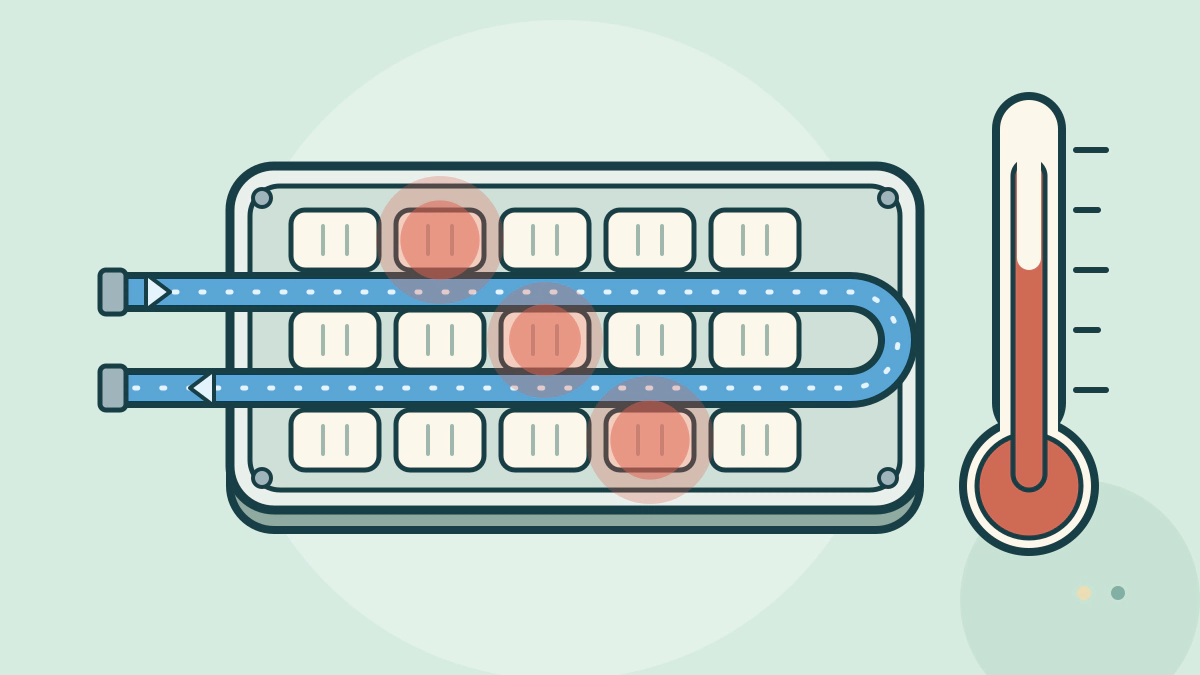
Learn why lithium-ion EV packs need heating and cooling, what temperature does to life, power and safety, and what two owner's manuals say about it.
Why do EV battery packs need thermal management?
Temperature changes how long a lithium-ion pack lasts, how much power it can deliver and how safely it runs, so EVs actively heat and cool the pack. The National Laboratory of the Rockies (NLR, formerly NREL) says temperature and temperature uniformity both affect the performance, lifespan and safety of vehicle batteries.
The same NLR page says lithium-ion packs are more sensitive to overheating and sharp temperature spikes than older nickel-metal hydride packs. For the wider topic, see Electric and Hybrid Vehicles.
What heat and cold do to a pack
NLR describes opposite problems at the two ends of the temperature range. The table summarizes its statements.
| Condition | What NLR reports |
|---|---|
| High temperature | Diminishes battery life and raises replacement costs |
| Low temperature | Decreases battery power and capacity, which affects range and performance |
| Extreme overheating | Can create safety hazards, including fires, in extreme instances |
| Uneven temperatures | Temperature differences across the pack also affect life and performance |
NLR gives one illustration. Without proper thermal management, an electric-drive vehicle battery can last more than 10 years in a temperate climate such as Minnesota. In a hot climate such as Arizona, it may last only 7 years. Treat that as a general analysis, not a prediction for any one car.
NLR also says optimized thermal management can raise battery power by more than 10%. An NREL presentation concludes a thermal management system is worth its added cost and complexity.
How packs are heated and cooled
Designs vary. DOE’s Alternative Fuels Data Center says some automotive battery systems use liquid coolant to keep safe operating temperatures. It says these systems may need regular checks and sends owners to the dealer or owner’s manual.
AFDC also lists a thermal system among the main EV parts. It keeps the motor, power electronics and other components in a proper operating range.
The 2023 Chevrolet Bolt EUV manual gives a concrete example:
- It says the battery cells are kept within a normal range during driving and charging.
- If the pack runs warm, the air conditioning compressor cools the battery coolant.
- If the pack runs cold, a high voltage heater warms the coolant.
- Coolant does not need regular checking unless a leak is suspected. It must be replaced at the maintenance schedule interval, and only a qualified technician should service it.
The 2023 Nissan LEAF manual describes a different feature set: a battery temperature gauge and, on equipped models, a Li-ion battery warmer. Do not assume one car’s hardware applies to another.
What the car does when the pack is too hot or cold
The LEAF manual shows how pack temperature reaches the driver. Its gauge has a normal zone, and the manual says to reduce speed if the reading nears the red end.
If the reading goes past the normal range, power to the motor can be reduced. Regenerative braking is also reduced when the battery is too hot or too cold. The manual says this protects the battery from damage.
Charging is affected too. Quick charging may take longer if the pack is too hot or too cold. Near the red zone, power is limited. In the red zone, quick charging is not allowed.
For the charge-level side of slow charging, read why DC fast charging slows near full.
Where preconditioning fits
NREL’s 2014 fact sheet says preconditioning is preheating or precooling the cabin while the vehicle is plugged in. It says this can extend driving range and battery life.
The same sheet says NREL was testing combined cooling loops. The aim was to precondition the power electronics, motor and battery as well as the cabin. That is research, not a feature every car has.
The manuals show what owners are told today:
- The Bolt EUV manual says to use remote start to heat or cool the cabin while plugged in. It warns against using remote start when the vehicle is low on energy.
- The LEAF manual lists pre-heating or pre-cooling the cabin while charging among its habits for maximizing range.
Neither passage promises that the battery itself is conditioned, so check your own manual.
Owner habits the manuals support
The LEAF manual lists habits for battery life. Its list includes:
- Avoid exposing the vehicle to extreme ambient temperatures for long periods.
- Park in cool places, out of direct sunlight.
- Avoid sustained high battery temperatures, such as extended highway driving with several quick charges.
- Let the battery cool after use before charging.
For the longer view on wear, read what causes EV battery degradation. AFDC says EV batteries are designed for long life but will eventually wear out, so thermal management slows wear and does not stop it.
Frequently asked questions
Do all EV battery packs use liquid cooling?
Not necessarily. AFDC says only some systems use liquid coolant, and the Bolt EUV manual describes a liquid loop. Other models use different hardware, so check the cooling section of your own manual.
Does thermal management use range?
It can. The LEAF manual says that on 40 kWh models driving range is reduced if the battery warmer operates while driving. It also says the battery needs more time to charge while the warmer runs.
Can parking in sun or deep cold hurt the pack?
The LEAF manual advises against long exposure to extreme ambient temperatures. It says to avoid storing the vehicle below -13 degrees F for more than seven days. Other makers may differ.
Does good thermal management stop battery degradation?
No. It improves life and power, according to NLR, but all batteries age. If your car shows a temperature warning, have the thermal system diagnosed rather than ignoring it.