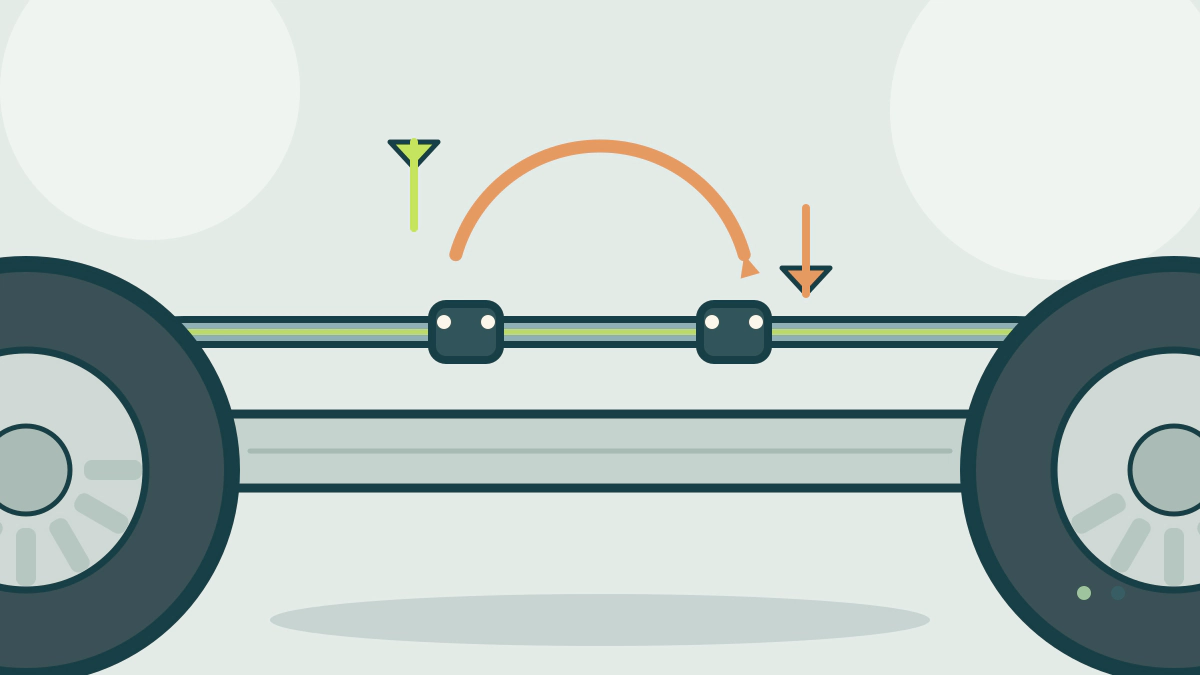
A sway bar links the left and right sides of a suspension and resists body roll in corners. See how front and rear bars differ and what they trade away.
What does a sway bar do?
A sway bar connects the left and right sides of a suspension and resists body roll when the car corners. Toyota’s parts listing describes a front stabilizer bar as connecting the left and right front sides of the suspension to help control body movement (Toyota Parts).
Honda says front and rear stabilizer bars improve turn-in response while reducing body roll during cornering (Honda Civic Si). Sway bar, anti-roll bar and stabilizer bar all name the same part in US usage.
How the bar is mounted
A sway bar spans the axle. Its middle is attached to the body or subframe through bushings, and its ends are connected to the suspension through links. Honda says its bars are bonded to their mounting bushings and use low-friction connecting links (Honda Civic Si).
When the body leans in a turn, one side of the suspension compresses more than the other. That moves one end of the bar relative to the other and twists the bar. The bar’s resistance to that twist is what limits body roll. This is why a bar can reduce lean without changing the spring rate that holds up the car’s weight.
Front and rear bars do different jobs
Both ends of the car can have a bar, but they are not duplicates. Honda says both bars improve turn-in and reduce body roll on the Civic Si. On the Odyssey, Honda credits the rear bar with controlling body roll so the springs and dampers can be tuned for ride comfort (Honda Odyssey).
That second point is the useful one for a daily driver. A bar lets the maker control lean without making the springs so stiff that the ride suffers. The bar and the springs work as a pair.
| Vehicle | Front bar | Rear bar | What the maker says |
|---|---|---|---|
| 2018 Honda Odyssey | 26.0 mm or 26.5 mm | 20.0 mm | Rear bar helps control roll and allows comfort tuning |
| 2017 Honda Civic Si | 27.0 mm tubular | 18.0 mm solid | Both bars improve turn-in and reduce body roll |
| 2006 Acura RSX | 25.4 mm | 21.0 mm | Bars reduce body roll during cornering |
The diameters come from the Honda releases for the Odyssey, Civic Si and RSX. They are not a ranking. Bar stiffness also depends on material, wall thickness, arm length and mounting points, so a larger diameter alone does not prove a stiffer bar.
Why a bar trades wheel travel for roll control
A fixed bar couples the two sides. That helps on pavement, but it can hurt when one wheel needs to move independently. Toyota’s Kinetic Dynamic Suspension System on the Land Cruiser adjusts the lean resistance of the stabilizer bars. Off-road, it reduces that resistance to help minimize wheel lift. On pavement, it lets the bars work conventionally and Toyota says body lean can drop by as much as 50 percent (Toyota Land Cruiser).
Toyota’s Stabilizer Disconnect Mechanism makes the same trade-off in simpler terms. It combines the stability of a sway bar on pavement with more wheel travel off-road, where the bar can be disconnected (Toyota SDM). A standard bar cannot do both at once.
What a sway bar does not fix
A sway bar is not a load-bearing spring. It does not carry the car’s weight or set the ride height. It also cannot repair worn dampers, sagging springs or worn bushings. If the body rolls more than it used to, inspect the whole suspension rather than assuming the bar is the problem.
The bar is only as good as its links and bushings. Honda’s description makes those the wear points: the bar is bonded to its bushings and connected through links. A broken link leaves that end of the bar ineffective.
Should you change the bars?
Honda treats bar rate as part of a package. On the Civic Si, the front bar is 7 percent stiffer and the rear bar 26 percent stiffer than the base Civic, alongside stiffer springs and dampers (Honda Civic Si). That is a matched change, not a bigger bar bolted onto an otherwise stock car.
If you are modifying a street car, treat a bar change as a handling change, not a cosmetic one. It can alter how the front and rear of the car share grip. Use a matched kit, keep the stock parts, and check the rules for any competition class. For lifted trucks, see suspension lift versus body lift and off-road suspension lift trade-offs.
This article sits in the Automotive Mechanical Systems hub.
Frequently asked questions
Are sway bars and anti-roll bars the same thing?
Yes. Sway bar, anti-roll bar and stabilizer bar are different names for the same suspension part. The name varies by region and by manufacturer.
Do sway bars make the ride stiffer?
They resist body roll, and they also tie the two sides of the suspension together. Over a one-wheel bump that can feel firmer. A rear bar can also let a maker use softer springs for ride comfort, so the total effect depends on the tune.
Do I need a bigger rear sway bar?
Not automatically. A larger rear bar changes handling balance and is only one part of the suspension package. Honda changes front and rear rates together with springs and dampers on the Civic Si.
Can a sway bar wear out?
The bar itself is a spring and usually lasts. Its bushings and end links wear or break, and then the bar cannot do its job. Inspect those parts using the owner’s manual and the maker’s service information.