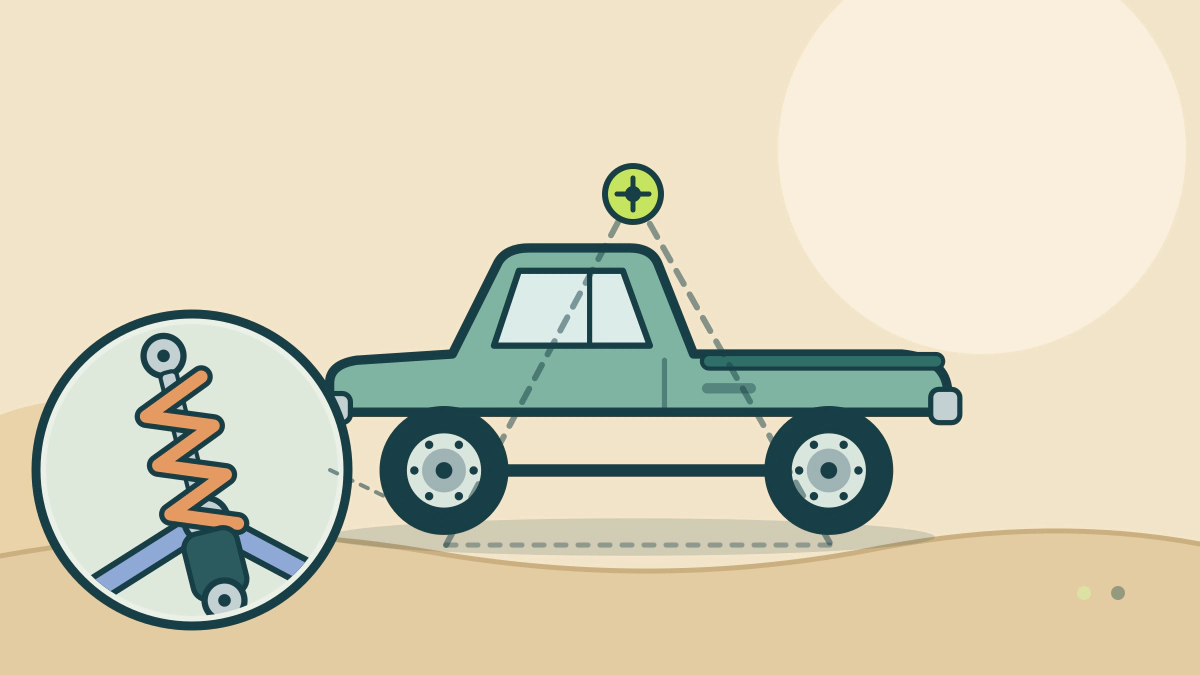
A suspension lift adds clearance, tire room and articulation, but it also raises the center of gravity and changes steering, braking and inspection needs.
What does a suspension lift add, and what does it cost?
A suspension lift raises the frame and body farther from the axles, creating room for taller tires and more suspension travel, but it also raises the center of gravity and changes steering, braking and alignment angles. It is worth it only when the trail needs that clearance.
A lift can use taller springs, spacers, lift blocks or replacement struts and control arms. Each method moves the chassis differently and changes a different set of parts. The Off Roading and Towing hub covers the related trail systems.
Clearance and tire room are the real gains
The first gain is distance between the vehicle’s lowest parts and the ground. A taller suspension lets the body clear rocks, ruts and ledges that would otherwise hit the frame, differentials or bumpers.
A lift also makes room for larger tires without rubbing at full steering lock or compression. Tire diameter raises the axle and differential too, so it adds clearance a suspension lift alone cannot.
Longer springs and matching shocks can add suspension travel, keeping more tires on uneven ground. A lift does not create traction. Tires, four-wheel drive and traction devices do that work.
| Change | What it can improve | What it can cost |
|---|---|---|
| Frame-to-axle distance | Ruts, ledges and obstacle clearance | Higher center of gravity |
| Tire clearance | Larger tires and more axle clearance | Speedometer and gearing changes |
| Suspension travel | Wheel contact on uneven ground | More strain on CV joints and driveshafts |
| Steering geometry | Nothing by itself; it must be corrected | Altered camber, caster, toe and bump steer |
| Brake hose routing | Nothing by itself; it must be checked | Taut lines at full droop or full lock |
The comparison with a body lift is in Suspension Lift vs Body Lift for Trucks. A body lift leaves the axles and alignment alone. A suspension lift changes both.
The stability margin changes with height
NHTSA’s rollover resistance rating uses the Static Stability Factor, a laboratory measure of how top-heavy a vehicle is, plus a severe maneuver. The rating applies to the stock vehicle, not to a lifted one.
Jeep’s 2024 Wrangler manual says utility vehicles have a significantly higher rollover rate than other vehicles, tied to higher ground clearance and center of gravity. It warns against sharp turns and abrupt maneuvers, and says a rollover can cause severe or fatal injury. It also warns that any modification could seriously affect roadworthiness and safety.
Height affects other road users too. IIHS found pickups in 2017-22 were a little less than twice as likely as cars to result in a fatality in the other vehicle. For pickups above 4,000 pounds, each 500 pounds added about seven crash-partner deaths per million vehicle years while reducing driver deaths by one. A lift does not add that weight, but heavier wheels, tires and armor do.
Steering, alignment and braking after the install
Raising the frame changes camber, caster and toe, and the steering linkage may sit at a new angle. The truck needs an alignment to the manufacturer’s specifications.
Larger tires change brake and steering leverage and alter speedometer and odometer readings unless recalibrated. Brake hoses, ABS wires and breather lines can become tight at full droop or full lock.
Utah’s inspection manual lists what inspectors check on a lifted vehicle: fenders and mud flaps, frame height by GVWR, body lift, stacked blocks, brake hoses, headlight aim and height, and shortened, lengthened or welded steering and suspension parts. It rejects braking or steering changes that may impair safe operation.
Utah caps frame height at 24 inches under 4,500 pounds GVWR, 26 inches up to 7,500 pounds and 28 inches above that. It rejects a body floor more than three inches above the frame, front axle blocks, stacked rear blocks and wheel spacers. Other states differ.
Washington requires a modified vehicle to complete a slalom at 25 mph and keep at least 30 percent of gross weight on any axle. Check your own state’s manual.
Legal limits, towing and warranty
A lift does not raise the manufacturer’s tow or payload rating. Those figures were set for the stock vehicle. Read Lifted Truck Towing: What Changes? and the door-jamb ratings, not the kit advertising. The difference is explained in Towing Capacity vs Payload Capacity.
Jeep’s manual says its warranties do not cover non-manufacturer parts or repairs caused by changes that do not comply with its specifications. A kit maker’s warranty is separate.
Matching the lift to your driving
The useful question is how much clearance your trails need, what tire size you need and whether the truck stays predictable on pavement.
A small lift with matched shocks, corrected alignment and proper hose routing is easier to live with than a tall appearance kit. If the truck mostly carries passengers on pavement, the stability, noise, wear and inspection costs buy little.
Frequently asked questions
Does a suspension lift improve off-road traction?
Not directly. A lift creates clearance and room for larger tires and more suspension travel, while traction comes from the tires, the drive system and how the vehicle is driven.
Will a lift make a truck more likely to roll over?
Raising the center of gravity reduces the stability margin in turns, lane changes and crosswinds. NHTSA’s rating is calculated for the stock vehicle, and Jeep’s manual warns that higher-center-of-gravity utility vehicles roll over more easily.
Is a suspension lift legal on public roads?
It depends on the state. Utah caps frame height by GVWR and rejects front axle blocks, stacked blocks and wheel spacers, while Washington requires a stability maneuver and limits body lifts.
Does a lift void the warranty?
It depends on the warranty terms and on what failed. Jeep’s manual says non-manufacturer parts and changes that do not comply with its specifications are not covered. Keep the kit paperwork and inspection records.