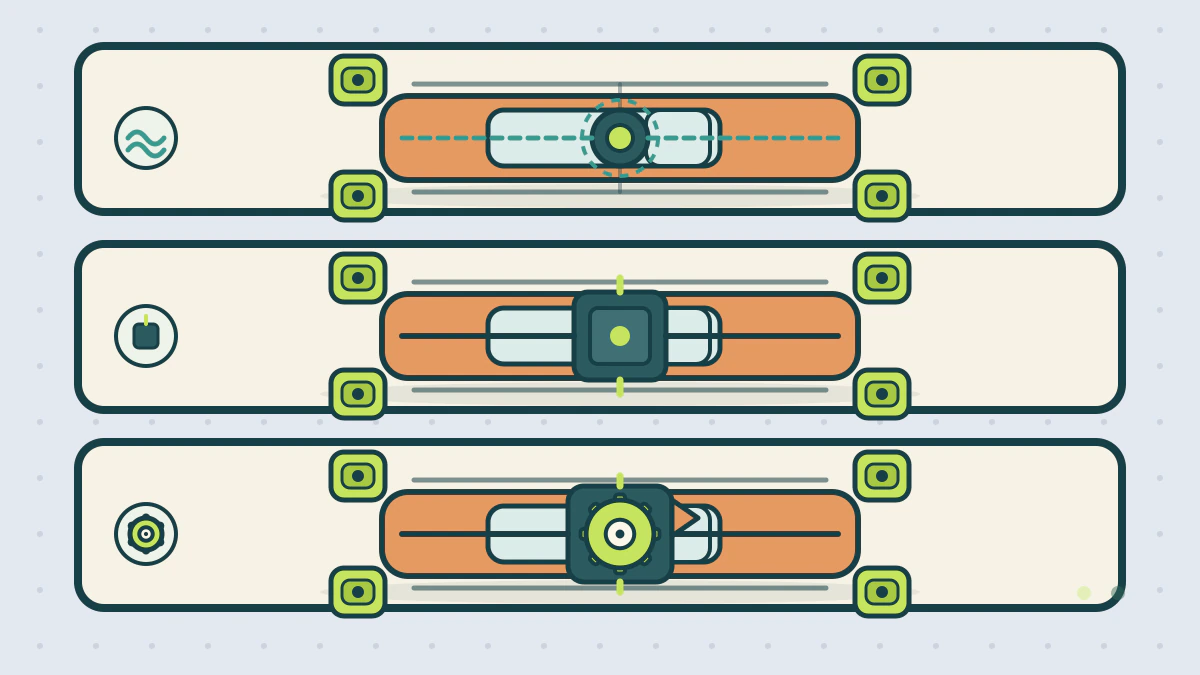
AWD sends torque to both axles automatically, 4WD adds driver-selected modes and 4WD low adds a second gear reduction for slow, heavy off-road work.
Is AWD the same as 4WD or 4WD low?
No. AWD describes a vehicle that can send torque to both axles automatically, 4WD usually adds driver-selected modes, and 4WD low adds a second gear reduction for slow, heavy work. The labels describe behavior, not a guarantee of grip.
A 2025 Ford F-150 owner’s manual shows the distinction inside one vehicle. Its four-wheel-drive auto mode provides electronically controlled power to both axles “as required” for varying on-road conditions (F-150 4WD auto). Its four-wheel-drive low mode provides locked power to both axles with additional gearing for torque multiplication, and the manual limits that mode to off-road use such as deep sand, steep slopes or pulling heavy objects (F-150 4WD low).
The three systems at a glance
| System | Who selects it | Typical use | Main limitation |
|---|---|---|---|
| AWD | The vehicle, automatically | Rain, snow, gravel, varying on-road grip | Often no low range; limits vary by model |
| 4WD high | The driver | Deep snow, sand, mud, loose surfaces | Not for dry pavement |
| 4WD auto | The vehicle, within a 4WD setting | Patchy slippery roads | Not a substitute for tires |
| 4WD low | The driver, at very low speed | Steep grades, deep sand, pulling | Off-road only; low speed |
AWD is a broad category. The Ford auto mode is one example of an on-demand approach; other vehicles may calibrate the split differently.
What 4WD low actually adds
Low range adds a gear reduction, which the Ford manual describes as additional gearing for increased torque multiplication. The engine turns at a usable speed while the wheels turn slowly, so the vehicle can produce more torque at the wheels.
That helps on a steep climb, in deep sand or when pulling a heavy load at walking pace. It does not increase tire grip. If the tires cannot hold the surface, more torque only spins them faster.
Shifting procedure is manufacturer-specific. The 2020 F-150 owner’s manual supplement requires the vehicle to be at 3 mph or less and the transmission in neutral before shifting to or from 4L. It also warns that 4L should not engage above that speed and that 4H and 4L are only for consistently slippery or loose surfaces (2020 F-150 supplement).
Why 4H and 4L are not for dry pavement
A part-time system locks the front and rear driveshafts. On a high-grip surface, the tires cannot slip enough to relieve the difference in wheel speed during a turn. The result is binding, noise, extra tire wear and possible damage to driveline parts.
Ford states that using 4H or 4L on dry, hard-surfaced roads can produce excessive noise, increase tire wear and damage drive components. The 2025 manual repeats that 4L is for off-road conditions only.
Because the automatic mode varies how much power reaches the front axle, it can be used on pavement where a locked part-time mode cannot.
Four-wheel drive does not shorten stopping distance
Traction under power and traction under braking are different problems. Ford’s manual is direct: a four-wheel-drive vehicle may accelerate better than a two-wheel-drive vehicle in snow and ice, but it cannot stop any faster because braking occurs at all four wheels.
Tires, speed and following distance still decide whether the vehicle stops. All-wheel drive versus four-wheel drive covers the hardware split; what AWD means covers the general term.
A taller vehicle also carries a rollover penalty. Ford warns that utility and four-wheel-drive vehicles have a higher center of gravity and handle differently from passenger cars, so sharp turns and excess speed raise the risk of loss of control. NHTSA rates rollover resistance using a static stability factor that measures how top-heavy a vehicle is, and those ratings can be compared across classes (NHTSA).
Matching the mode to the trip
Use two-wheel drive on dry pavement. Use 4A or an equivalent automatic mode when the surface is patchy and the vehicle allows it. Use 4H only when the surface is consistently loose or slippery. Use 4L when the route is slow, steep or heavy and the manual permits it.
Check the owner’s manual for the exact sequence, speed limit and instrument messages. Do not shift on the move beyond the permitted speed, and do not leave a part-time system engaged when the tires reach high-grip pavement.
For the driving side of the same decision, see how to approach steep off-road hills. The Off Roading and Towing hub collects the related guides.
Frequently asked questions
Is AWD better than 4WD?
Neither is universally better. AWD usually works automatically and suits varying road grip; 4WD usually gives the driver selectable modes and may include low range for slow, difficult terrain.
When should I use 4WD low?
Use it for slow, heavy work such as steep grades, deep sand or pulling, when the manufacturer permits it. It is not a high-speed mode and it does not create traction.
Can I drive in 4H on a wet highway?
Follow the manual. Ford permits 4A on varying on-road surfaces but restricts 4H to consistently slippery or loose surfaces and prohibits it on dry pavement.
Does 4WD help me stop on snow?
No. It can help acceleration, but braking uses all four wheels on any vehicle, so stopping distance still depends on tires, speed and surface.