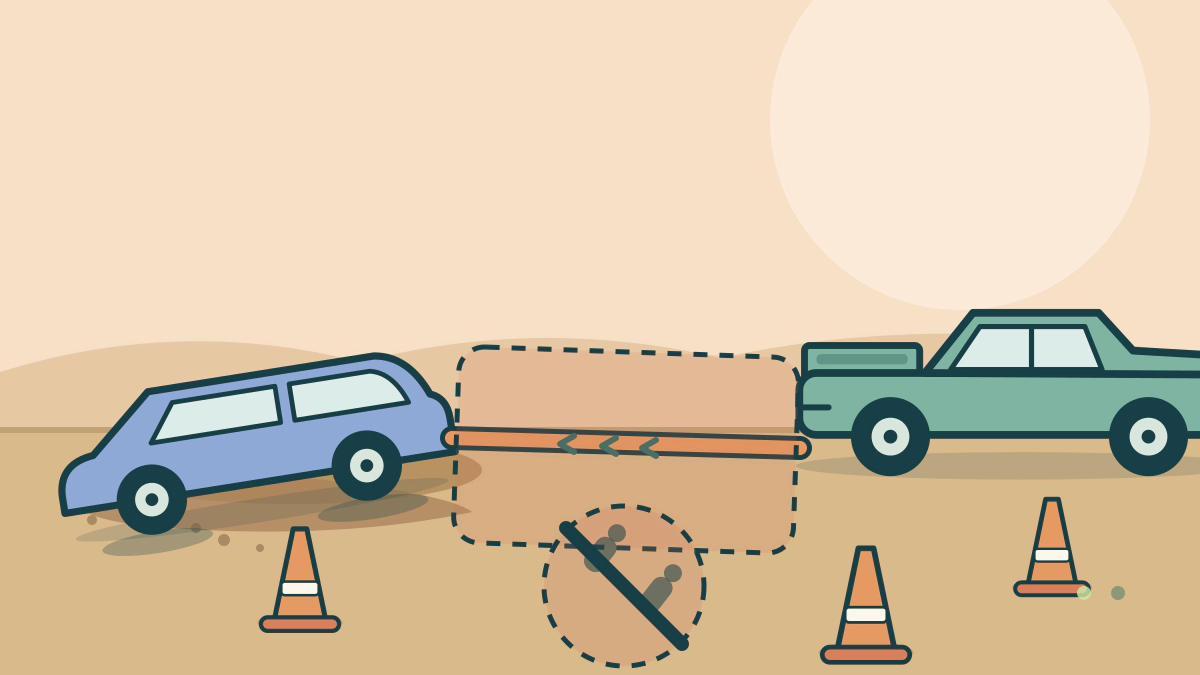
Unsafe recovery usually starts with an unrated attachment point, a strap or rope under load, or people standing in the line of a pull.
What makes a recovery unsafe?
Unsafe recovery usually comes from three choices: attaching to an unrated point, standing in the line of a loaded strap or rope, and using speed or stretch instead of traction. Any one can turn a stuck vehicle into an injury.
Warn’s Basic Guide to Winching says every winching situation has the potential for personal injury, and its warnings describe serious injury or death. A loaded rope or strap stores energy that goes somewhere when a part fails.
Attaching to a part that was never rated for a pull
A tow hook bolted to the frame is an attachment point. A cosmetic hook, bracket, tie-down or bumper trim can look similar and may not be rated for a recovery load. Warn describes frame-mounted tow hooks as the attachment point for winch lines, straps and chains. Check the owner’s manual before trusting one.
Never wrap a winch rope back onto itself. Use a choker chain or tree trunk protector around the anchor so the rope is not bent sharply.
Jeep’s 2024 Wrangler manual prohibits two common habits. Never attach a recovery strap to the winch hook to lengthen a pull, and never tow a vehicle with the recovery strap attached directly to the winch hook. The hook and its mounting were not designed for that combined load.
Standing in the line of a loaded rope
Warn says to declare where spectators should not stand, keep others away and stand clear of the rope and load. Never step over a winch rope under tension, and never touch the rope or hook while someone else is at the control switch.
Keep hands clear of the fairlead too. It is a pinch zone when the rope moves.
Bystanders are part of the plan, not spectators. Warn’s warnings state that failure to follow its precautions could lead to serious injury or death. Set the no-people zone before the first pull, and stop if someone walks into it.
Using stretch, speed or shock to force a stuck vehicle
A recovery strap is meant to stretch and snatch, not to winch. Warn says never use one in a winching operation, because stored energy can release like a rubber band if the rigging fails. Jeep also prohibits bungee and kinetic straps that develop high force when stretched.
Avoid shock loads. Take up slack intermittently with the winch control, and never use the vehicle to pull a load on the winch rope. A sudden combined load can break the rope.
Spinning tires carry their own hazard. Jeep warns that excessive wheel speed can fail an axle or tire and that a tire could explode and injure someone. Do not spin wheels faster than 30 mph or longer than 30 seconds continuously, and keep everyone away from a spinning wheel.
Skipping the inspection, damper and rope wraps
Inspect the rope, hook and slings before every pull. Replace frayed, kinked or damaged rope immediately. Put the damper on the rope midway between the winch and anchor before tension, so it can absorb energy if the rope snaps.
Keep at least 5 wraps of steel rope or 10 wraps of synthetic rope on the drum. Warn says fewer wraps let the rope come loose; Jeep gives the same 10-wrap minimum for its synthetic rope. Never shift the winch clutch while the rope is under load, in tension or moving.
Recovering alone without a plan or a way to call
The National Park Service’s Mojave guidance says people have died after underestimating the risks, using an unsuitable vehicle or lacking a satellite communication device.
It says to turn around when the road gets worse and to stay with the vehicle. Walking out has killed people. A satellite messenger and a filed return plan are recovery equipment, not luxuries.
| Unsafe practice | What can go wrong | Safer approach |
|---|---|---|
| Strap on the winch hook | Hook takes a load it was not rated for | Use a rated recovery point |
| Standing near a loaded rope | A failed line can strike people | Set and hold a no-people zone |
| Kinetic strap in a winch pull | Stored stretch releases with force | Use the winch rope and rated rigging |
| Spinning tires near helpers | Tire or axle failure can injure someone | Keep everyone away |
| Too few rope wraps | Rope pulls loose from the drum | 5 steel or 10 synthetic wraps |
Warn says the operator’s decisions determine the outcome. Stop when the anchor is uncertain, the rope is damaged or people will not stay clear. If the pull needs more force or a different angle, reset the rigging or call a professional service.
The hill approach guide covers the driving decisions that keep a vehicle out of a bad recovery, and the Off Roading and Towing hub covers the rest of the systems. The recovery equipment guide covers what to carry.
Frequently asked questions
Is it safe to stand behind a vehicle during a recovery?
No. Warn’s guide says to declare where spectators should not stand and to keep others away from the rope and load while winching. A failed line can travel through the area around the vehicle.
Can I use a recovery strap as a winch line?
No. Warn says a recovery strap is designed to stretch and must never be used in a winching operation. Jeep’s manual also prohibits attaching a recovery strap to the winch hook to extend a pull.
Why does a winch rope need a damper?
Warn says the damper is placed over the rope midway between the winch and the anchor before tension is applied, to absorb energy if the rope snaps. It does not make a damaged rope safe.
What should I do if a recovery starts to go wrong?
Stop the pull, keep everyone clear of the line and reset the rigging. If the anchor, rope or vehicle position is uncertain, do not add power; call a trained recovery service.