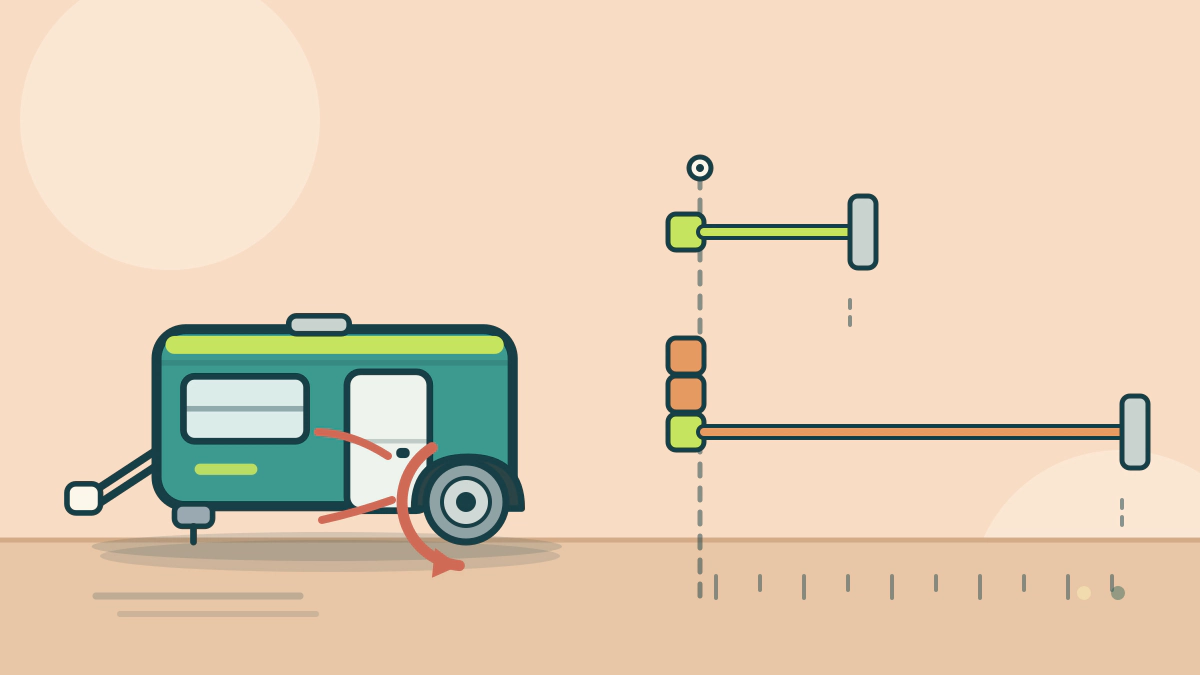
Trailer weight adds energy to every stop. See how trailer brakes, controller settings, tongue load and long grades change braking on a loaded combination.
Does a heavier trailer really need more room to stop?
Yes. A loaded trailer adds mass to every stop, and the brakes have to turn that extra motion into heat. Chevrolet’s 2026 Trailering Guide says braking with a trailer requires extra distance, so leave ample room to stop.
The energy in a moving combination depends on total weight and speed, and speed raises it far faster than weight does. Adding trailer weight lifts the energy the brakes must absorb at any given speed. Brakes absorb it as heat, stop after stop.
A tow vehicle’s brakes were engineered for the vehicle itself. With a trailer attached, its own brakes, the hitch setup and the driver’s gap decide how the added mass is controlled.
The federal brake test stops at the vehicle
FMVSS 135 is the federal standard for light-vehicle service brakes. It applies to passenger cars and, at a gross vehicle weight rating of 3,500 kilograms (7,716 pounds) or less, to multipurpose passenger vehicles, trucks and buses.
The test loads the vehicle to its GVWR and runs the stops on a surface built to a specified peak friction coefficient. No trailer is attached at any point.
So a published trailer rating is not a certified stopping distance for the combination. It says the vehicle can pull that weight when properly equipped. The standard shows the tow vehicle’s brakes work at its own GVWR, not that the pair does.
Trailer brakes are the first dividing line
Chevrolet’s guide says trailer brakes are required above a 2,000-pound trailer weight on Silverado, Suburban and Tahoe, and above 1,500 pounds on all its other models.
Two systems dominate. Electric brakes use a controller in the tow vehicle that senses braking and applies the trailer brakes. Surge brakes are self-contained hydraulics on the trailer, activated when the coupler pushes on the hitch ball as the combination slows.
An electric system also needs a working breakaway switch, which Chevrolet’s checklist says to test. It applies the trailer brakes if the trailer separates.
The Colorado trailering guide shows how an integrated controller ties trailer braking into the vehicle’s stability system.
State law can set a different trigger
State rules do not have to match a manufacturer’s number. The Wisconsin DMV says trailer brakes are required if the trailer and load exceed 3,000 pounds, or if the trailer’s gross weight exceeds the empty weight of the towing vehicle. It cites Wis. Stat. 348.10(4).
Michigan reads differently. MCL 257.705 lets a trailer under 3,000 pounds gross run without brakes only if it weighs no more than 40 percent of the tow vehicle, among other conditions.
So a trailer can be legal in one state and not in the next, and a light trailer can still need brakes behind a light tow vehicle.
Tongue load changes how the combination behaves
GM’s guide puts conventional tongue weight at 10 to 15 percent of loaded trailer weight. It also suggests placing about 60 percent of the load over the front half of the trailer when the axles sit at the center.
That is not only a comfort rule. The guide warns that loads too far forward or too far back can create sway at highway speed and during heavy braking. A weight-distributing hitch exists because tongue load sits behind the rear axle; spring bars shift some of it forward onto the front axle and rearward onto the trailer axles.
Too little tongue weight invites instability. Too much consumes rear axle capacity and payload before the trailer is fully loaded. The tongue weight guide covers measurement, and the payload comparison explains why the downward force counts against the vehicle.
Heat, grades and speed decide the last part
On a long descent, Chevrolet’s guide says to reduce speed and shift to a lower gear before the grade begins. Vehicles with grade braking can use the engine and transmission to hold speed. It also says to crest a hill no faster than the speed you want to descend, with firm, steady pedal pressure rather than hard jabs.
The reason is heat. A heavy combination asks the brakes to convert a lot of energy into heat over several minutes. Once they overheat, they fade and stopping gets worse.
The Off Roading and Towing hub covers the surrounding decisions, from ratings to hitches.
What changes as trailer weight rises
| Change | Effect on braking | Where to confirm it |
|---|---|---|
| Trailer gains 500 pounds | More energy per stop and more heat in the brakes | Trailer weight at a scale, not the brochure |
| Tongue weight moves rearward | Less load on the front axle, more chance of sway | Tongue scale and hitch setup |
| Electric brakes added | Trailer shares the stopping work | Controller manual and low-speed test |
| Long descent added | Heat builds and brakes can fade | Downshift before the grade |
Frequently asked questions
Does a trailer take longer to stop even with its own brakes?
Usually yes. The trailer’s brakes help, but the combination still carries more mass and energy than the tow vehicle alone. Chevrolet’s guide tells drivers to allow extra distance with a trailer attached.
Do I need brakes on a small utility trailer?
It depends on the trailer’s weight, the tow vehicle and the state. A manufacturer may set a threshold such as 1,500 or 2,000 pounds, while a state may use 3,000 pounds or a ratio to the tow vehicle’s weight.
Should I downshift before a long downhill with a trailer?
Chevrolet’s guide says to reduce speed and select a lower gear before the descent starts. Waiting until the brakes are already hot removes the engine braking that could have helped.
How do I check trailer brakes before a trip?
Chevrolet’s checklist says to test electric trailer brakes by applying them with the controller while moving slowly. It also says to confirm the breakaway switch is connected and working.