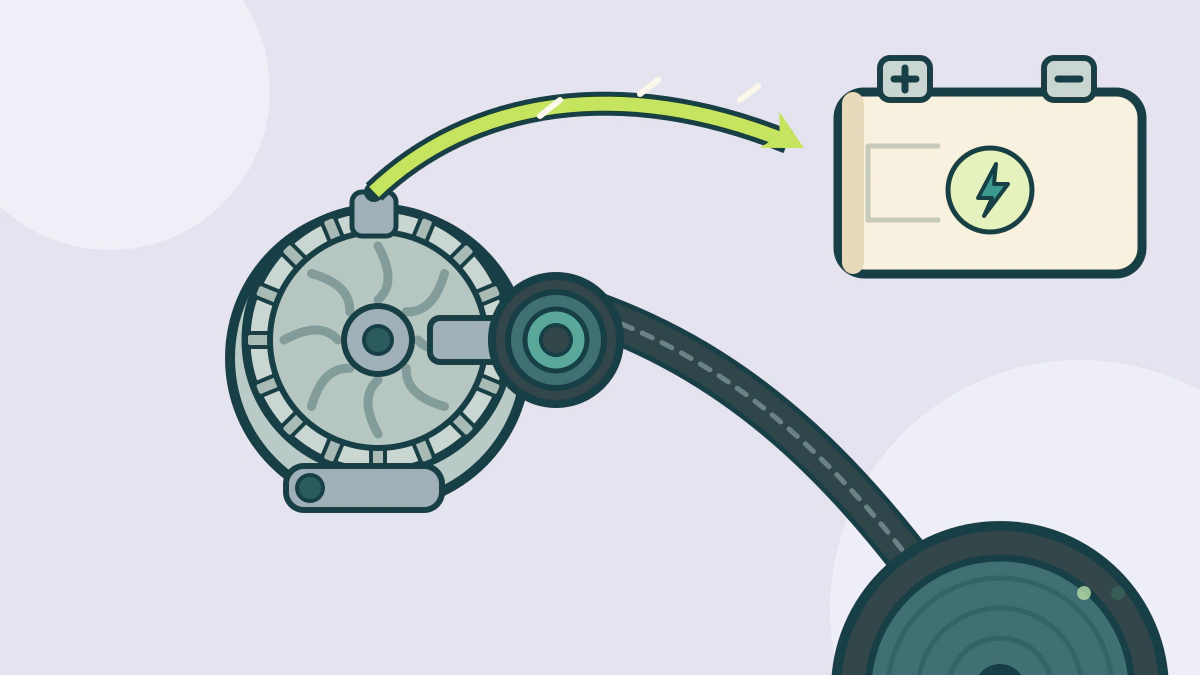
Follow the charging path from the engine-driven rotor to the battery: three-phase alternating current, diode rectification and regulator control explained.
How does an alternator charge the battery?
The alternator is a belt-driven generator. The engine turns its rotor, the rotor’s magnetic field induces alternating current in the stator, a rectifier converts that current to direct current, and a regulator holds the output within the manufacturer’s range so the battery can be recharged. The same output runs the vehicle’s electrical loads while the engine is running.
DENSO describes the alternator, belt and regulator as a system that converts mechanical power into electrical energy. During normal driving, that energy recharges the battery. When electrical demand is higher than the alternator’s output, the battery supplies the difference.
From engine rotation to alternating current
A rotating magnet near a coil induces a voltage. In an alternator, the rotor is the moving magnetic field and the stator is the stationary set of coils. As the rotor turns inside the stator, its north and south poles pass the stator coils in sequence, and current is induced in them.
DENSO’s technical manual explains that the output is three-phase alternating current. Three stator coils are spaced around the circle, and their outputs rise and fall in a repeating sequence. DENSO says the three-phase design offers significant advantages over single-phase output.
Why the current is rectified
A battery cannot be charged with alternating current that reverses direction. The alternator uses a rectifier, made of diodes, to convert the alternating current into direct current. In a three-phase alternator, DENSO uses six diodes for full-wave rectification.
The diodes allow current to leave the stator in one direction and return through the load. The result is a direct-current output that can charge the battery and run the electrical system.
How the regulator controls the output
The voltage generated by the alternator rises as rotor speed rises. If that voltage went straight to the battery and lamps, high engine speed could overcharge the battery or damage electrical equipment. The regulator prevents that by varying the current in the rotor’s field coil.
When output voltage approaches the specified value, the regulator reduces field current. When voltage falls, it increases field current. DENSO says the IC regulator is the most common type. The specified voltage range is set by the manufacturer, so use the service information for the exact vehicle rather than a generic number.
Where the charging current goes
| Stage | What happens | Main part |
|---|---|---|
| Engine turns the belt | Mechanical power reaches the alternator pulley | Belt and pulley |
| Rotor turns | A moving magnetic field cuts the stator coils | Rotor and stator |
| Alternating current is produced | Three-phase output leaves the stator | Stator windings |
| Current is rectified | Diodes convert alternating current to direct current | Rectifier |
| Output is regulated | Field current is adjusted to hold voltage | Regulator |
| Battery and loads are supplied | Charging current flows to the battery and electrical system | Cables and terminals |
The battery does not sit outside the circuit. It supplies power when the alternator’s output is below demand, and it receives current when output is above demand. That is why a weak battery and a weak alternator can produce similar symptoms.
What the charging warning means
The 2024 Mazda CX-5 owner’s manual says a charging system warning light while driving indicates a malfunction of the alternator or of the charging system. It tells the driver to pull off the road and consult an authorized dealer. It also warns that the engine could stop unexpectedly if driving continues.
That wording matters. The light does not say “replace the alternator.” A loose or worn belt, a bad connection, a blown fuse, a faulty battery or a wiring fault can all affect charging. The guide to failing alternator symptoms covers the warning signs, and the battery warning light guide explains what to do at the roadside.
What maintenance the charging system needs
The owner’s manual gives the belt inspection interval and the battery service schedule. Check the belt for the condition the manual describes, and follow the manual’s battery inspection steps and terminal warnings.
If the battery is old, have it tested before condemning the alternator. The battery life guide explains why age, heat and cycling matter, and a multimeter test can show the battery’s resting state. The Automotive Mechanical Systems hub covers the surrounding charging and engine systems.
Frequently asked questions
Does the alternator charge the battery at idle?
It can, but the output at idle depends on the alternator design, pulley ratio, electrical load and regulator strategy. Do not assume a fixed charging rate; the manufacturer’s service information gives the test conditions.
How long does it take to recharge a flat battery?
There is no single answer. Battery size, depth of discharge, alternator output, electrical load and temperature all affect charging time. Short trips with many electrical loads may not restore a deeply discharged battery.
Can a car keep running if the alternator fails?
Only until the battery’s stored energy is used. The Mazda manual warns that the engine could stop unexpectedly when the charging system warning is ignored, so the safe response is to stop and arrange service.
Why does the charging warning light come on?
The light indicates a fault in the alternator or charging system. It can be caused by the alternator, the belt, the wiring, the battery or the control circuit, so testing is needed before parts are replaced.