See what the battery warning light signals, what two owner's manuals tell drivers to do and how to handle the first minutes safely.
What the battery warning light means while you drive
A battery light that comes on while driving reports a fault in the charging system, so treat it as an urgent warning rather than a sign of an old battery. Both manuals below describe it as a malfunction.
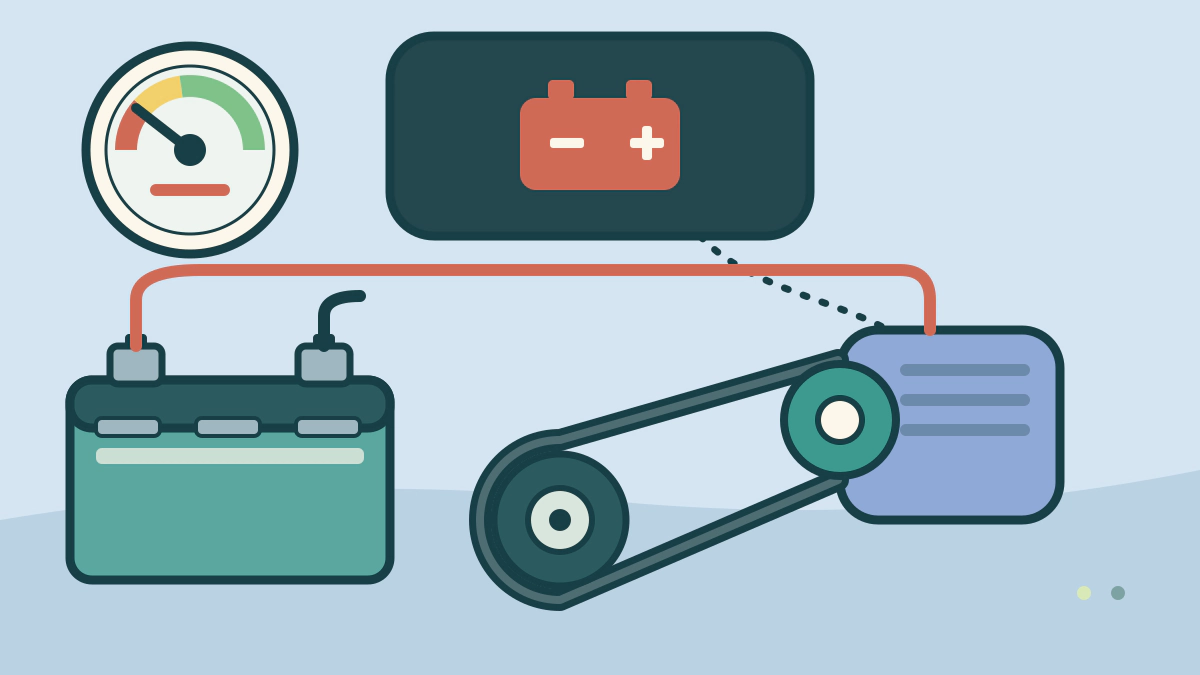
The Car Care Council explains the parts. The alternator produces current to replace what the starter used and to support electrical loads while the engine runs. A belt carries power from the engine to the alternator pulley.
If charging stops, the battery alone supplies the car’s electrical systems. The manuals read here give no time or distance for how long that lasts, so none is offered.
Some lamps light briefly at start-up as a check. Ford’s 2014 Escape manual says to consult the matching lamp entry if any lamp stays on after the engine starts.
What two owner’s manuals tell the driver to do
The wording differs by manufacturer, and so do the instructions.
| Manual | What it says about the charging warning |
|---|---|
| Toyota 2021 Tacoma, page 484 | Malfunction in the charging system. Immediately stop the vehicle in a safe place and contact the dealer. Continuing to drive may be dangerous. |
| Ford 2014 Escape, page 85 | If the light comes on while driving, it indicates a malfunction. Switch off all unnecessary electrical equipment and have the system checked by the dealer immediately. |
Neither manual says to keep driving as usual. Toyota’s manual is the stricter of the two.
Newer models, hybrids and electric vehicles may word this differently. Your own manual’s warning-light page is the authority for your vehicle.
The first minutes, step by step
Use these steps unless your manual says otherwise.
- Stay calm and find a safe place to stop. Use turn signals and move out of traffic when it is safe.
- Reduce electrical load, as Ford directs. Keep the lights you need to see and be seen.
- Read the warning-light page in the owner’s manual for your vehicle.
- If your manual says to stop, as Toyota’s does, stop and arrange a tow or roadside help.
Know what happens if the engine stops. Toyota’s manual says that when the engine is off while driving, brake and steering power assist is lost. The brake pedal gets harder to push and the wheel heavier to turn. Slow down early.
Jump-starting and what it does not fix
A jump start may get the engine running, but it does not repair a charging fault. Toyota’s manual says to have the vehicle inspected at the dealer as soon as possible after a jump start.
Jump-start steps differ by model. Toyota’s manual shows different cable connections for two engines in the same truck. Follow the diagram for your vehicle.
Batteries need care. Toyota warns that they contain poisonous, corrosive sulfuric acid and may produce flammable, explosive hydrogen gas. It says not to cause sparks at the terminals and not to smoke or light a match nearby.
If you are not sure how to do this safely, call roadside assistance instead.
Other signs that can appear with the light
The Car Care Council lists symptoms of battery and charging trouble. Headlights and interior lights may dim. The check engine light or the battery light may come on. Accessories may fail to work.
The FTC adds three clues:
| Clue | What the FTC says |
|---|---|
| Burned-toast smell | Often signals an electrical short and burning insulation. Try not to drive until it is diagnosed. |
| Shrill squeal tied to engine speed | Usually a loose or worn power steering, fan or air conditioning belt. |
| Dead-looking battery | Corroded or loose terminals can make a battery seem dead or defective. |
For more, see signs of a failing alternator, headlights that flicker while driving and checking battery terminal corrosion.
What a shop should confirm
The sources tie charging trouble to the alternator, its drive belt and the battery connections. The FTC says a technician should clean the terminals and test battery function before replacing the battery.
Ask the shop which part failed and how that was shown. Ask for a written estimate. If the battery is old, how long a car battery lasts explains the usual picture. Other symptoms are listed under Car Problems.
Frequently asked questions
Can I keep driving when the battery light comes on?
Manuals differ. Toyota says to stop immediately in a safe place and contact the dealer, and Ford says to switch off unneeded electrical equipment and have it checked immediately. No source read here gives a safe distance, so plan to stop soon.
Does the battery light mean I need a new battery?
Not necessarily. The light reports a charging-system malfunction, which can involve the alternator, the belt or connections. The FTC says to test the battery and clean the terminals before replacing it.
Why did the battery light come on and then go off?
Toyota’s manual says a warning light that comes on and then goes out does not necessarily indicate a malfunction. If it keeps happening, have the vehicle inspected. Note the conditions each time.
Will a jump start fix a battery warning light?
A jump start can restart a car whose battery is discharged, but it does not repair the fault behind the light. Toyota’s manual says to have the vehicle inspected at the dealer as soon as possible after a jump start.