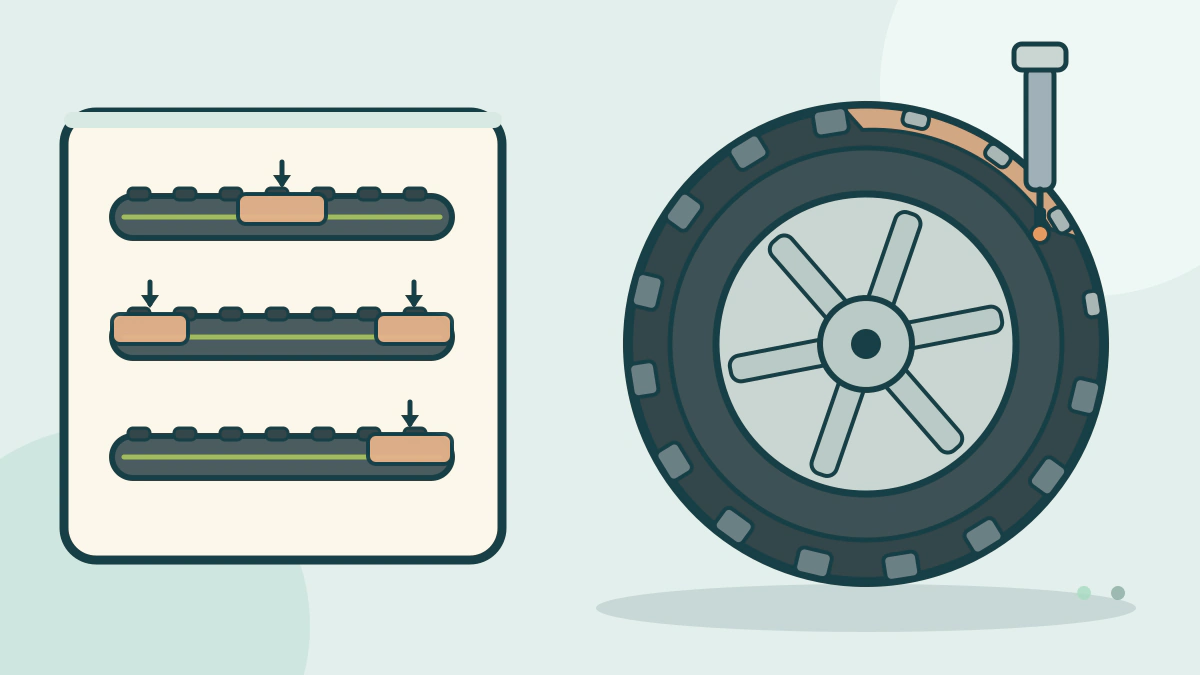
Four tires never do the same work. See how drive torque, braking, cornering, pressure, alignment and rotation shape tread wear, and which check comes first.
Why do tires wear unevenly?
Tires wear unevenly because each wheel carries a different load, drives or steers differently, and meets the road at its own angle. Drive torque, braking weight transfer, cornering force, inflation, alignment and missed rotations all leave a signature in the tread. The pattern tells a technician where to look first. It rarely proves the cause by itself.
The four corners do different work
Toyota’s tire rotation guide explains that tires on the drive wheels often wear faster because they handle the engine’s twisting force. On a front-wheel-drive car the front tires usually wear sooner. On a rear-wheel-drive car the rear pair often does. All-wheel and four-wheel-drive vehicles can wear unevenly even when all four wheels are powered.
Weight transfer adds to the difference. Toyota says braking shifts weight forward, so the front tires carry extra load. It also notes that most vehicles have the engine in front and the front row occupied, so the front tires may bear more weight than the rear. Cornering shifts weight sideways, which can scrub the outer shoulder of the front tires.
None of this is a defect. It is the reason rotation exists.
Pressure changes the shape of the contact patch
NHTSA’s tire page calls proper pressure the most important part of tire maintenance. It says underinflation can lead to a flat, a blowout or tread separation, and that properly inflated tires can extend average tire life by about 4,700 miles. NHTSA recommends checking all tires, including the spare, at least once a month when they are cold.
Use the pressure on the Tire and Loading Information label, not the maximum on the sidewall. The pressure placard guide explains the difference.
Kia’s 2027 US owner’s manual adds a detail that surprises drivers. A radial tire can look properly inflated while it is low, so a gauge is the only reliable check. Kia says to measure after the car has sat for at least three hours or has been driven no more than one mile.
Alignment and balance are different jobs
Kia’s tire rotation section says abnormal wear is usually caused by incorrect tire pressure, improper wheel alignment, out-of-balance wheels, severe braking or severe turning. That list is useful because it separates jobs that owners often treat as one.
Alignment is the service Kia says may be needed when a tire wears unusually, or when the car pulls or drifts. Balance addresses vibration felt on a smooth road. Kia also says newly installed tires must be balanced, and that a tire should be rebalanced whenever it is removed from the wheel. The Car Care Council lists uneven tire wear, shaking and pulling to one side as signs of an alignment problem, and suggests annual alignment checks.
| What the tread shows | A likely contributor | First check |
|---|---|---|
| Front tires lower on a front-wheel-drive car | Drive torque plus forward weight transfer | Compare axles and rotate as the manual allows |
| One edge much lower than the other | Alignment or a worn suspension part | Alignment measurement and suspension inspection |
| Both shoulders lower than the center | Pressure may be below the placard | Cold pressure on all four tires |
| Center lower than both shoulders | Pressure may be above the placard | Reset to the door-jamb value |
| Tread feels scalloped or saw-toothed | Balance or suspension movement | Wheel balance and suspension check |
| One tire wears much faster than the rest | A problem at that corner | Brake drag, bearing and suspension check |
No row proves a cause. A shop still has to measure.
Rotation spreads the load
Rotation moves each tire to a position with a different workload. NHTSA says rotation can reduce irregular wear. It says that when a manufacturer recommends rotation, the interval is usually every 5,000 to 8,000 miles, or sooner if uneven wear appears. Some vehicles cannot rotate at all, for example when front and rear sizes differ.
Kia’s manual for the model read here gives 8,000 miles. Toyota warns that skipping rotation may void a tire’s mileage warranty and can cause vibration and noise. The rotation patterns guide covers the move orders.
What to record before buying tires
Measure tread at several points across each tire, not one. Note the pressure in each tire, the date of the last rotation, and whether the car pulls or vibrates. NHTSA says tires should be replaced when tread reaches 2/32 inch, and the wear bars show that point. The tread depth guide explains the penny test and a gauge.
If a tire has exposed cords, a bulge or a deep cut, stop driving on it and have it inspected. A wear pattern is a maintenance clue. Damage like that is a safety decision.
For a step-by-step diagnosis, see uneven tire wear patterns explained. More guides sit in Tires, Wheels and Brakes.
Frequently asked questions
Can I fix uneven wear by rotating the tires?
Rotation can even out the remaining tread and slow further irregular wear, but it does not correct alignment, pressure or a worn suspension part. Find the cause first, then rotate on the schedule in your manual.
Does a wheel alignment stop all uneven wear?
No. Alignment is one contributor. Kia’s manual also lists incorrect pressure, out-of-balance wheels, severe braking and severe turning. A shop should measure before adjusting anything.
Why do the front tires wear faster than the rear?
On a front-wheel-drive car, the front tires handle drive torque, steering and most braking weight transfer. Toyota says that combination often makes them wear sooner. Rotating spreads that load.
How often should I check tire pressure?
NHTSA recommends at least once a month, when the tires are cold. Check the spare too, and use the door-jamb label rather than the sidewall maximum.