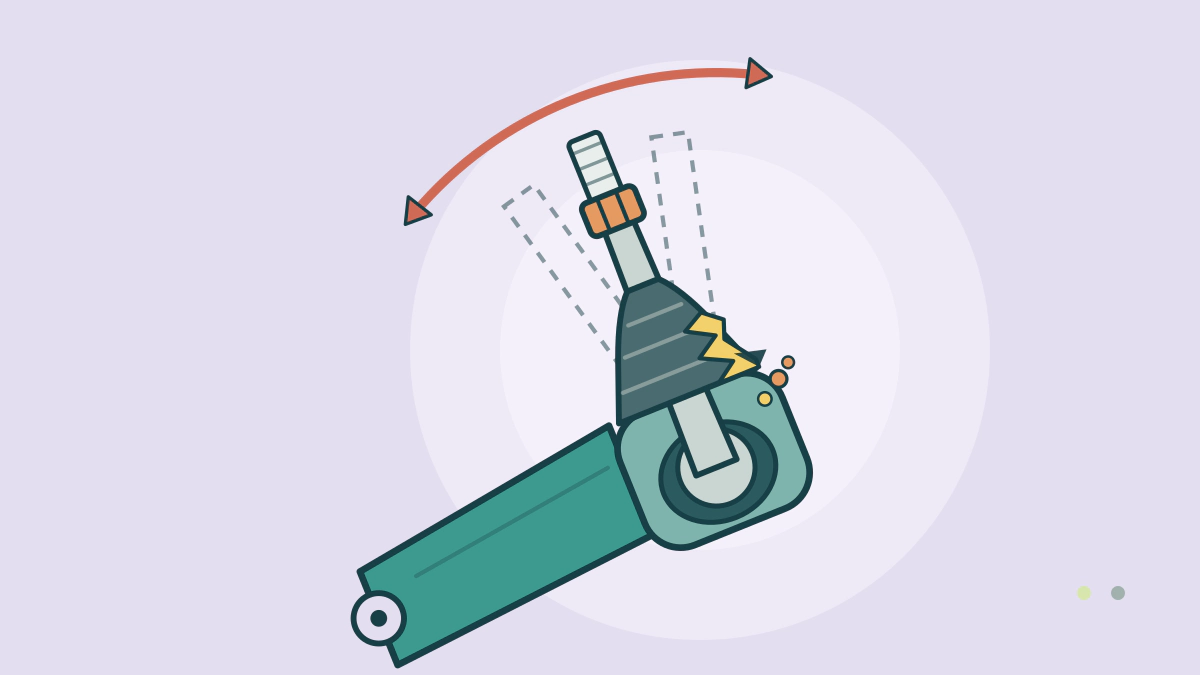
Learn the warning signs of a worn ball joint, from wandering steering to cracked boots, using FTC, Kia, Ford, Pennsylvania and NHTSA sources.
What are the warning signs of a worn ball joint?
The public sources point to steering that wanders, a car that pulls, looseness in the steering wheel and a cracked or damaged dust boot. None of them proves the joint is worn. Each can also come from tires, alignment or other suspension parts.
Only a technician with the vehicle raised can measure how worn a joint is. For the wider subject, see Tires, Wheels and Brakes.
What a ball joint does in the steering and suspension
The sources read do not explain how a ball joint is built, so this guide does not either. They do show where it sits. Kia’s 2024 manual lists the lower arm ball joint together with the steering gear box and linkage. Ford’s 2014 Escape schedule groups ball joints with the steering linkage and suspension.
The Car Care Council describes their jobs. The suspension keeps the wheels in the right relationship to the frame, while the steering system carries your input to the wheels.
Signs you may notice while driving
| Sign | What the sources say | Other things that cause it |
|---|---|---|
| Wandering or trouble steering straight | The FTC names worn steering parts such as a ball joint | Misaligned front wheels, per the FTC; tire inflation, per Ford |
| Pulling to one side | Kia asks owners to watch for a car that constantly pulls on smooth, level road | Under-inflated tires or a misaligned front end, per the FTC |
| Looseness in the steering wheel | Kia asks owners to notice looseness or a changed straight-ahead position | Other steering and suspension parts |
| Uneven tire wear | The Car Care Council lists it as a steering and suspension symptom | Pressure, alignment and missed rotations |
| Random clunk | The FTC ties a clunk to a loose suspension component | A loose shock or exhaust part |
Ford’s 2014 Escape manual gives a matching checklist for a car that wanders or pulls. It lists an improperly inflated tire, uneven tire wear, loose or worn suspension components, loose or worn steering components and improper alignment.
Why the symptoms overlap with other faults
The FTC treats wandering as a result of either misalignment or worn steering parts. It says a pull can be as routine as under-inflated tires or as serious as a damaged front end.
Check the simple items first, such as tire pressure and the last rotation. Our guides on why a car pulls to one side and uneven tire wear patterns cover those steps.
A clunk needs the same caution. The FTC does not name a ball joint for it. It names a loose shock absorber or other suspension component. Do not buy a joint on the strength of a noise alone.
What an inspection actually checks
A technician looks at the joint and at its dust boot. Kia’s manual says to check the dust boots and ball joints for deterioration, cracks or damage, and to replace any damaged parts. The same page says to check the steering wheel for excessive free play.
Pennsylvania’s inspection rule sets a measured test. An inspector rejects a vehicle when ball joint movement exceeds the manufacturer’s specification.
This guide gives no movement figure, because the limit belongs to the manufacturer. Ask the shop to show the measured movement and the limit for your model.
When a ball joint becomes a safety question
The sources read do not say how long a worn joint lasts or when it fails. They do call the systems important. The Car Care Council describes steering and suspension as key safety-related systems and lists loss of control among the symptoms.
A federal recall gives one concrete case. Tenneco reported that a MOOG ball joint for aftermarket installation on 2015-2018 Ford F-150 trucks could be installed incorrectly. NHTSA records that this may cause the ball joint stud to break, which can compromise front wheel control and increase crash risk.
That recall involves an installation problem on one part. It does not show that every worn joint will break.
How often to have the joints checked
The Car Care Council says to have steering and suspension checked at least once a year, usually with a wheel alignment. Kia’s schedule lists suspension ball joints as an inspection item. Its severe-use table asks for that inspection more frequently on rough, salted or mountain roads, with towing, or in taxi and patrol use.
Your owner’s manual gives your model’s schedule. If a shop recommends replacing a joint, the FTC advises asking for a written estimate that names the condition, the parts and the labor charge. For costly or complicated work, it recommends getting a second opinion.
Frequently asked questions
Can I check a ball joint myself?
The sources describe checks against the manufacturer’s limit, done by an inspector. The safest step for an owner is to report the symptom and let a shop measure the joint.
Does a clunk over bumps mean a bad ball joint?
Not necessarily. The FTC attributes a random clunk to a loose shock absorber or other suspension part, or to a loose exhaust pipe. A technician must find which part is loose.
Can a ball joint wear out without any noise?
The sources do not say. Kia’s manual lists boot and joint checks as scheduled inspection items, which suggests damage can be found by looking. Rely on the schedule, not only on sounds.
Is a worn ball joint covered by a recall?
Only if a recall names it. Recall 21E027 concerned one aftermarket ball joint, so it does not apply to most cars. Check your own vehicle’s recalls by VIN with NHTSA.